Key Takeaways
AI enables intelligent automation and decision-making across industries.
RAG enhances AI with real-time, factual knowledge reducing hallucinations.
AI is great for creativity and predictions, while RAG ensures accuracy and compliance.
RAG is ideal for industries where trust and regulated data matter most.
Together, AI + RAG deliver reliable, secure, and business-ready intelligence.
What Is the Difference Between RAG and AI?
Retrieval-Augmented Generation (RAG) is a specialized AI technique that enhances accuracy by retrieving real-time, verified knowledge before generating responses. On the other hand, Artificial Intelligence (AI) refers to the broader domain of intelligent technologies, including machine learning, natural language processing, and generative AI.
➡️ Key Difference: AI is the entire ecosystem of intelligent systems, whereas RAG is one advanced technique inside generative AI that makes outputs more trustworthy and business-ready. Modern enterprises increasingly adopt enhanced accuracy techniques like RAG as part of their broader AI development services strategy, often partnering with best AI development companies in the USA to ensure secure and compliant implementation.
➡️ In short:
- AI = The entire world of intelligent technologies
- RAG = A specific method inside AI that makes generative AI more reliable
1️⃣ What Is Artificial Intelligence (AI)?
Artificial Intelligence represents a wide set of smart technologies enabling machines to think, analyze data, and make decisions like humans. AI is the backbone of modern software development services, helping businesses automate tasks and unlock innovative capabilities.
Core branches of AI development:
- Machine Learning (ML)
- Natural Language Processing (NLP)
- Deep Learning
- Computer Vision
- Generative AI
- Predictive Analytics
Why businesses invest in AI:
- ✔ Reduce operational cost
- ✔ Increase productivity
- ✔ Data-driven insights & automation
- ✔ Better customer experience
- ✔ Competitive advantage
AI is transforming industries including healthcare, retail, real estate, manufacturing, and finance - enabling smarter and faster decision-making.
What Is RAG in AI?
RAG stands for Retrieval-Augmented Generation – a technique in advanced AI and machine learning development services that:
- ➡ Retrieves accurate information from enterprise systems
- ➡ Then generates responses using a Large Language Model (LLM)
What makes RAG unique?
- Regular AI models depend only on training data
- RAG models combine training knowledge + external data
Example:
If you ask a standard AI about new tax rules, it might guess.
A RAG-powered AI fetches the latest tax documents first → then answers confidently.
Result:
- ✔ More trustworthy outputs
- ✔ Lower hallucination
- ✔ Higher compliance and accuracy
Key Differences: RAG vs AI Systems
Understanding the difference between traditional AI and Retrieval-Augmented Generation helps businesses choose the right approach for their transformation goals. While both are powerful, they operate differently in terms of knowledge, accuracy, security, and scalability.
| Feature | AI (General / Traditional AI) | RAG (Retrieval-Augmented Generation) |
|---|---|---|
| Scope | AI is the entire ecosystem of intelligent technologies – from machine learning and NLP to generative AI models. | RAG is a specific enhancement technique used in generative AI to boost reliability and factual accuracy. |
| Knowledge Source | Depends entirely on what it was trained on – once deployed, its knowledge is fixed. | Retrieves fresh and relevant information from internal knowledge bases + external sources, ensuring updated responses. |
| Accuracy | Sometimes hallucinates or produces incorrect responses due to static and limited training data. | Designed to provide highly accurate & context-aware answers by grounding outputs in real-world data. |
| Use Cases | Great for predictions, pattern recognition, creative writing, summarization, and automation tasks. | Best for enterprise knowledge automation, compliance-heavy industries, and factual data processing like finance, legal, healthcare, etc. |
| Data Updates | Needs retraining or fine-tuning to learn new information – costly and time-consuming. | New content can be indexed instantly, enabling models to adapt to real-time changes without retraining. |
| Security Level | If not properly configured, may leak or mix sensitive information with general knowledge. | Keeps business data private and isolated, offering enterprise-grade security and controlled access to information. |
What does this mean in simple terms?
- AI is the mind, trained to think and predict based on past knowledge
- RAG gives that mind access to live knowledge, so it always has the correct answer
➡ AI alone can think , but may guess.
➡ RAG helps AI verify before responding.
Why this matters for businesses
Traditional AI models are powerful, but they:
- Can produce inaccuracies
- Struggle with constantly changing information
- Can’t naturally use private enterprise knowledge
RAG solves these limitations by:
- ✔ Connecting AI to company documents, CRM, ERP, product catalogs
- ✔ Delivering trustworthy insights
- ✔ Reducing compliance risks
- ✔ Eliminating retraining costs
This makes RAG the preferred approach for real-world enterprise AI integration.
Why RAG Is Essential for Businesses Today
Organizations across every industry are actively investing in artificial intelligence to improve efficiency, enhance decision-making, and unlock real-time insights. However, despite AI’s rapid adoption, trust remains the biggest concern.
Traditional AI models can:
- Provide outdated or incomplete information
- Produce hallucinated responses due to static training data
- Fail to access internal business knowledge
- Struggle with compliance-heavy environments
- Lack transparency into how answers are formed
As a result, enterprises hesitate to fully rely on AI for critical operations.
RAG Solves the Trust Problem in AI
RAG enhances AI systems by connecting them to dynamic and reliable data sources, such as:
- ✔ Internal enterprise repositories - CRM systems, ERP databases, product catalogs, SOPs, wikis
- ✔ Confidential and compliance-specific documents
- ✔ Real-time web data and external publications (when permitted)
- ✔ Domain-specific knowledge bases and research insights
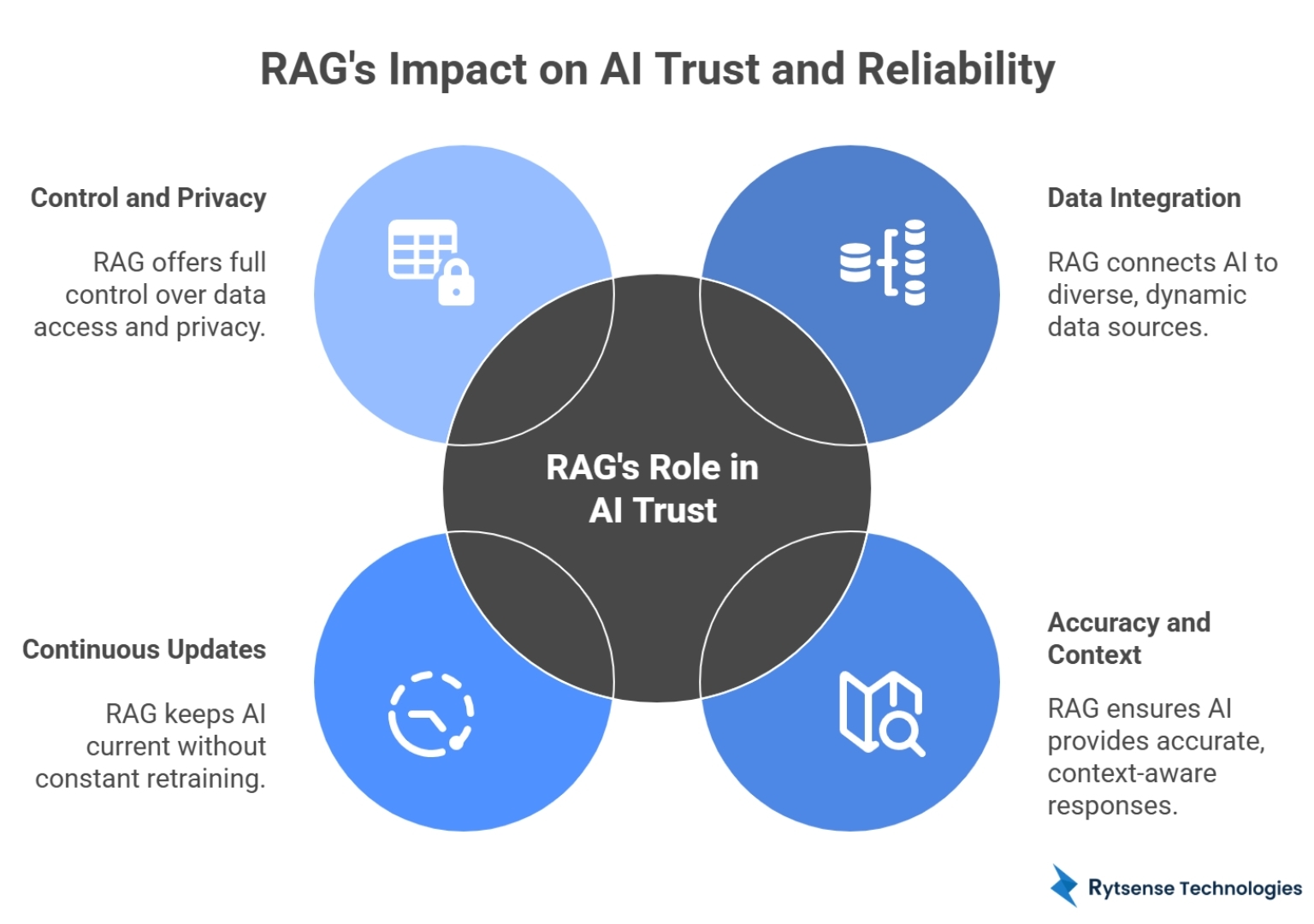
By combining learning models + verified data, RAG ensures:
- Accurate answers grounded in facts
- Context-aware intelligence tailored to business workflows
- Continuous updates without retraining the AI model
- Full control over data access and privacy
RAG makes AI operationally trustworthy.
Enterprise-Grade Intelligence Across Industries
RAG unlocks responsible and reliable AI adoption in sectors where correctness and compliance are non-negotiable:
- Finance → Auditor-ready advisory systems following the latest regulations
- Healthcare → Treatment support copilots referencing clinical guidelines
- Legal → Contracts and case law processed using updated statutes
- Government & Public Services → Secure automation with policy alignment
- Cybersecurity → Threat analysis using live intelligence feeds
These are areas where a wrong answer isn’t just inconvenient - it’s costly and dangerous. RAG dramatically reduces that risk.
From AI Chatbots → Intelligent Business Copilots
With RAG, AI evolves from:
- Simple FAQ-style chatbots to
- ➡ Strategic copilots that understand and execute tasks using enterprise knowledge
Such copilots can:
- Help employees make faster decisions
- Improve customer-facing interactions
- Reduce support workload and operational costs
- Assist with onboarding and training workflows
Real Use Cases of RAG-Powered AI Solutions
RAG is rapidly becoming a strategic priority for enterprises that want trustworthy and intelligent automation across their operations. By combining generative AI with real-time access to business knowledge, RAG unlocks high-value use cases across multiple industries.
| Industry | How RAG Enhances AI Applications |
|---|---|
| Healthcare | Powers clinical decision support systems by referencing up-to-date treatment guidelines, medical literature, patient records, and diagnostic insights - ensuring safer outcomes and reducing clinical errors. |
| Finance | Enables compliant financial advisory, real-time fraud detection, regulatory policy lookup, and up-to-date market analysis - essential in a constantly changing global economy. |
| Retail & eCommerce | Drives AI-powered search and personalized recommendations by connecting directly to product catalogs, price updates, inventory databases, and customer purchase histories. |
| Manufacturing | Assists frontline engineers with predictive maintenance, troubleshooting, equipment manual lookup, and optimization of production workflows using logged machine data. |
| Education | Delivers curriculum-linked, personalized learning assistants that reference course materials, lecture notes, and institution-approved study resources - not generic internet content. |
| Customer Service & Contact Centers | Elevates support bots into intelligent copilots capable of answering context-specific queries by pulling data from CRM, FAQs, manuals, policies, and help desk tickets - boosting customer satisfaction and reducing agent load. |
More Business Scenarios Where RAG Drives Real Value
Beyond major industries, RAG supports a wide range of enterprise functions:
- Enterprise knowledge search — Employees find the right information instantly
- Contract and document analysis — Accurate legal extraction and comparison
- Sales enablement copilots — Assist teams with pricing, product data, and proposals
- Supply chain intelligence — Updated vendor, shipment, and inventory details
- Secure internal AI assistants — Aligned with compliance and privacy policies
If a business relies on large volumes of knowledge and rapidly changing information, RAG ensures every response AI provides is grounded in truth.
Benefits & Challenges of RAG Architecture
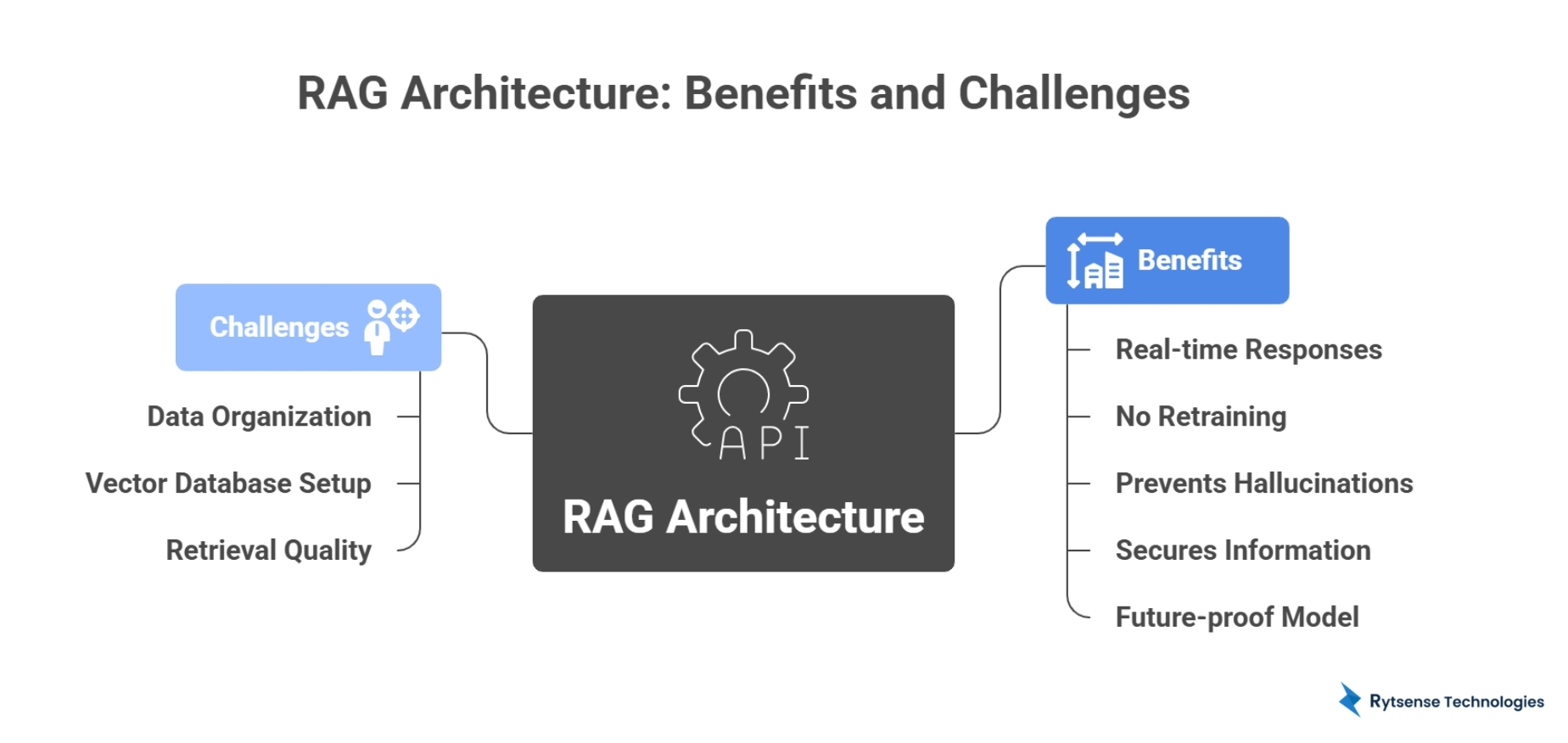
RAG has become a preferred AI approach for businesses looking to deploy trusted and knowledge-driven automation. However, like any advanced technology, it comes with both strengths and considerations.
Top Benefits for Enterprises
1️⃣ Real-time, contextual, and accurate responses
RAG pulls fresh information from enterprise databases, research materials, or official regulations right when a query is asked, ensuring the AI model responds with the most accurate and verified insight available – not outdated assumptions.
2️⃣ No retraining required when data changes
Traditional AI models require expensive fine-tuning whenever new information appears. With RAG, all updates happen through data indexing – meaning your AI remains current without touching the model weights.
→ Lower cost, faster adoption, easier scalability.
3️⃣ Prevents wrong answers (AI hallucination)
By grounding responses in factual content, RAG significantly reduces hallucinations, building organizational trust in AI – essential in regulated environments like finance, medical, or legal sectors.
4️⃣ Secures private business information
All sensitive knowledge remains within your controlled environment, making RAG ideal for internal copilots, corporate knowledge search, and compliance-focused applications. Security requirements are fully aligned with enterprise policies.
5️⃣ A future-proof AI development model
RAG allows businesses to expand AI capabilities:
- Across multimodal data: text, images, PDFs, web
- With new sources without architecture disruption
- Under a zero-data-leak framework
RAG grows and evolves with your business – not against it.
Possible Challenges
1️⃣ Requires clean & well-structured data
If knowledge is scattered, inconsistent, or poorly organized, retrieval quality drops. This often results in:
- Irrelevant search results
- Incomplete context returned to the AI
A data organization strategy may be needed before RAG deployment.
2️⃣ Needs vector database and embedding setup
Advanced components like:
- Vector databases (Pinecone, Weaviate, FAISS)
- Embedding models
- Document chunking pipelines
…must be carefully designed for high-performance retrieval.
3️⃣ Retrieval quality impacts AI output
If the search pipeline returns weak matches, the AI may still generate incorrect answers. This is why evaluation, ranking, and feedback loops are essential – to continuously improve the quality of retrieved information.
How RAG Works (Step-by-Step)
RAG combines two major intelligence processes – retrieval and generation – to ensure that every AI response is grounded in real, reliable, and business-specific knowledge. Below is a deeper breakdown of the workflow:
1️⃣ User Query
A user asks a question or provides an instruction to the AI system – for example:
“What were our product sales in Q3 based on the latest reports?”
The AI must interpret the intent and understand what information is needed.
2️⃣ Embedding Engine Converts Query into Vectors
The query is transformed into numeric vector representations (embeddings) that capture meaning - not just keywords.
This helps the system find semantically related content even if wording is different.
Example: “revenue” ↔ “sales” — embeddings recognize the similarity.
3️⃣ Vector Search in Enterprise Knowledge Sources
The embeddings are matched against indexed company data stored in a vector database, such as:
- Pinecone
- Weaviate
- FAISS
- Chroma DB
These databases retrieve the most contextually relevant chunks of information from:
- CRM records
- ERP data
- PDFs & manuals
- SOPs & wikis
- Product inventory systems
- Regulatory documents
This step ensures live knowledge access, not static memories.
4️⃣ Retrieval of Relevant Content
The best-matching results are extracted and passed as supporting factual context to the LLM. This prevents the model from inventing an answer.
Example returned context:
“Q3 product revenue = $12.5M (updated Excel sheet)”
5️⃣ Large Language Model Generates Final Response
Now the generative AI model uses retrieved context + learned intelligence to form a:
- Clear
- Accurate
- Fully referenced
- Actionable
answer, aligned with enterprise requirements.
AI understands not only the query, but also the context.
This ensures smart + accurate decision-making in enterprise workflows.
When Should Startups & Enterprises Use RAG?
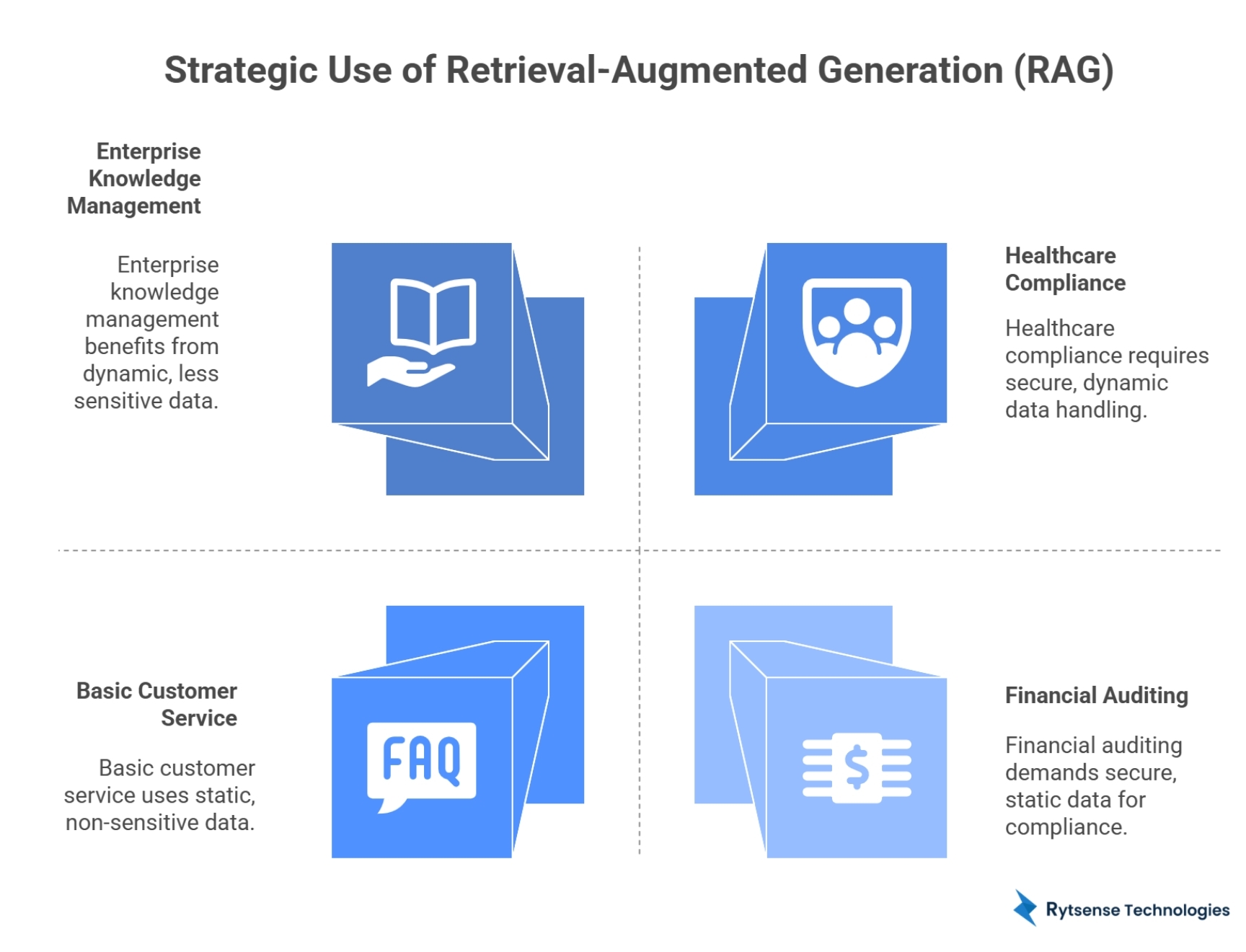
RAG is a strategic choice for organizations that want AI systems to act with precision, context, and compliance. It becomes essential when AI needs access to real-world, dynamic, and proprietary knowledge rather than generic information from training data.
Use RAG if your AI must:
-
✔ Access and use proprietary knowledge securely
If your business depends on internal reports, product data, customer records, legal documents, or confidential policies, RAG ensures AI responses are rooted in your org’s own truth, not random internet data.
-
✔ Support secure environments and compliance standards
Industries such as healthcare, finance, and government must follow strict regulations. RAG allows AI to stay privacy-first, ensuring zero data leakage and full governance.
-
✔ Deliver error-free responses with traceable sources
Incorrect answers can lead to legal risks, financial losses, or bad decisions. RAG enhances accuracy by grounding responses in validated business information.
-
✔ Handle massive and constantly changing information
Traditional AI models become outdated quickly. RAG updates instantly when new knowledge is indexed — no costly retraining needed.
-
✔ Improve productivity and reduce repetitive workloads
Employees often search through siloed tools and documents to find answers. RAG turns enterprise knowledge into a smart assistant, saving time and boosting efficiency.
The Future of RAG + AI Development Services
Industry analysts predict:
- 85%+ enterprise AI apps will use RAG soon
- AI copilots will become a standard workplace tool
- AI development will shift from generic → domain-specific
- Voice + structured database + multimodal RAG will rise
- RAG + fine-tuning + AI Agents will define innovation
Companies that adopt RAG-powered AI today will lead their industries tomorrow.
Conclusion
Artificial Intelligence has become a driving force behind digital transformation, helping organizations automate processes, unlock insights from data, and improve customer experiences. However, as AI adoption grows, trust and accuracy have emerged as major challenges – especially in industries where compliance and factual correctness are essential.
This is exactly where RAG (Retrieval-Augmented Generation) becomes the game-changing solution.
| AI (General) | RAG (Enhanced AI) |
|---|---|
| Broad field that includes machine learning, NLP, computer vision, predictive analytics, and generative AI. | A specialized technique inside generative AI that retrieves business-approved, real-time knowledge. |
| Learns from past data but knowledge becomes outdated after training. | Always stays updated through live access to documents, CRM, ERP, policies, and trusted sources. |
| Excellent for creativity, automation, interaction, and prediction tasks. | Ideal for compliance-driven, factual, and privacy-sensitive use cases. |
| Risk of hallucination or misinformation in critical scenarios. | Reduces hallucination and increases reliability with grounded, contextual responses. |
Meet the Author

Karthikeyan
Connect on LinkedInCo-Founder, Rytsense Technologies
Karthik is the Co-Founder of Rytsense Technologies, where he leads cutting-edge projects at the intersection of Data Science and Generative AI. With nearly a decade of hands-on experience in data-driven innovation, he has helped businesses unlock value from complex data through advanced analytics, machine learning, and AI-powered solutions. Currently, his focus is on building next-generation Generative AI applications that are reshaping the way enterprises operate and scale. When not architecting AI systems, Karthik explores the evolving future of technology, where creativity meets intelligence.