Key Takeaways
Generative AI focuses on creating new content such as text, images, audio, and code - making it essential for automation, creativity, and personalization in business workflows.
Multimodal AI understands and processes multiple data types together (text + image + audio + video), enabling human-like perception and intelligent decision-making
Generative AI is ideal for industries that require content generation, marketing automation, coding assistance, and scalable digital interactions.
Multimodal AI is best suited for real-time analytics, robotics, autonomous systems, smart surveillance, and advanced healthcare diagnostics.
The two technologies solve different problems: Generative AI creates; Multimodal AI interprets.
Leading organizations invest in both technologies to build context-aware, intelligent, and high-value AI solutions across operations.
Future AI development services will combine multimodal and generative intelligence with reasoning and autonomy — driving the rise of Agentic AI.
To achieve maximum ROI, businesses should partner with an expert AI development company for secure, scalable, and custom implementation.
What Is the Difference Between Generative AI and Multimodal AI?
Introduction
In today’s rapidly evolving artificial intelligence landscape, businesses are increasingly exploring powerful technologies like generative AI and multimodal AI to enhance innovation, improve productivity, and unlock smarter digital experiences. These two transformative AI technologies are often assumed to be the same — but each plays a unique role in modern AI development services.
Whether you are a startup founder, business leader, technology professional, or someone exploring AI software development, understanding the differences helps you choose the right path in your AI adoption roadmap.
This blog provides a detailed yet simple breakdown of Generative AI vs Multimodal AI, including how they work, real-world use cases, business benefits, future trends, and how companies can leverage them through custom AI solutions.
What Is Generative AI?
Generative AI is a category of machine learning models trained to generate new content such as text, images, videos, audio, code, business insights, and more. Instead of analyzing data like traditional AI models, generative AI creates original outputs by learning patterns, meaning, and context from large datasets.
This technology forms the foundation of modern AI-powered applications, including:
- Generative chatbots (e.g., AI virtual assistants)
- Automation tools for content and design
- Code generation tools for developers
It supports organizations across industries by accelerating innovation and enabling AI integration in core processes.
Why Generative AI Matters for Businesses
Companies implement generative AI development services to:
- Automate repetitive work
- Boost creativity and productivity
- Personalize customer experiences
- Enhance decision-making through data-driven insights
Generative AI gives businesses the capability to scale faster with less operational burden — a major advantage in competitive digital markets.
How Generative AI Works
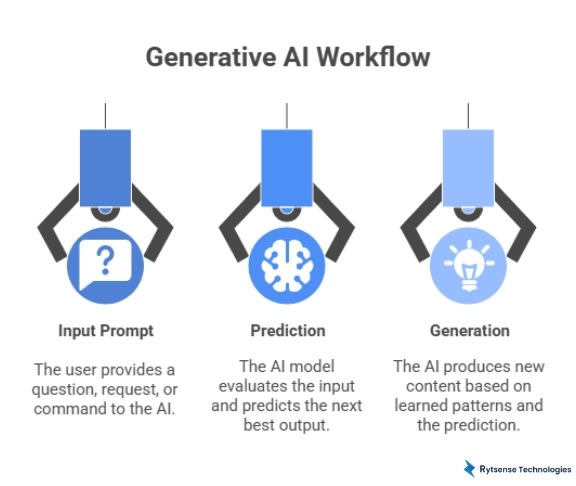
Generative models such as LLMs, diffusion models, and GANs learn from billions of data points. The model uses this knowledge to predict the best possible next output based on a prompt.
Basic workflow:
- Input Prompt → A question, request, or command
- Prediction → Model evaluates what should come next
- Generation → AI produces new content based on learned patterns
This makes generative AI extremely valuable for AI app development, marketing automation, and product design.
Examples of Generative AI Tools
| Category | Examples |
|---|---|
| Text generation | ChatGPT, Jasper, Writesonic |
| Image generation | Midjourney, DALL·E |
| Code generation | GitHub Copilot, Tabnine |
| Video generation | Runway ML, Synthesia |
These tools are increasingly embedded into enterprise AI systems through custom AI integration services.
3. Top Generative AI Use Cases
Generative AI supports diverse sectors:
| Industry | Business Innovations Powered by Generative AI |
|---|---|
| Healthcare | AI-generated radiology summaries, medical reporting |
| E-commerce | Automated product descriptions, dynamic personalization |
| Finance | Synthetic training data, compliance reporting |
| SaaS & IT | Code generation, QA automation |
| Media | Creative asset production, marketing personalization |
| Manufacturing | AI documentation, workflow optimization |
This encourages organizations to collaborate with an advanced AI development company to unlock high-value, scalable solutions.
4. What Is Multimodal AI?
While generative AI focuses on content creation, multimodal AI processes and understands multiple types of data together - such as text, images, audio, video, and sensor inputs.
This enables richer interpretation, similar to how humans use their senses to understand context.
Example:
A multimodal AI system can:
- Analyze product images
- Read customer complaints
- Understand voice instructions
- Combine insights into a single response
This is a core capability for intelligent automation, robotics, and advanced AI decision-making systems.
Examples of Multimodal AI in Real Life
- GPT-4o, Google Gemini → Multi-format reasoning & responses
- Self-driving cars → Cameras + Lidar + Radar + NLP
- Smart surveillance → Face + speech + behavioral analysis
- Healthcare diagnostics → Scans + reports + patient history
These examples highlight how multimodal AI makes digital systems more human-like and context-aware.
5. How Multimodal AI Works
Multimodal AI uses data fusion, a process of combining signals from different sources to generate a deeper and high-accuracy understanding.
Key components:
- Computer Vision
- Natural Language Processing (NLP)
- Speech Recognition
- Sensor Data Processing
- Deep Learning
This makes it a preferred technology in industries requiring real-time decision intelligence, like automotive, aerospace, retail, and security.
6. Use Cases of Multimodal AI
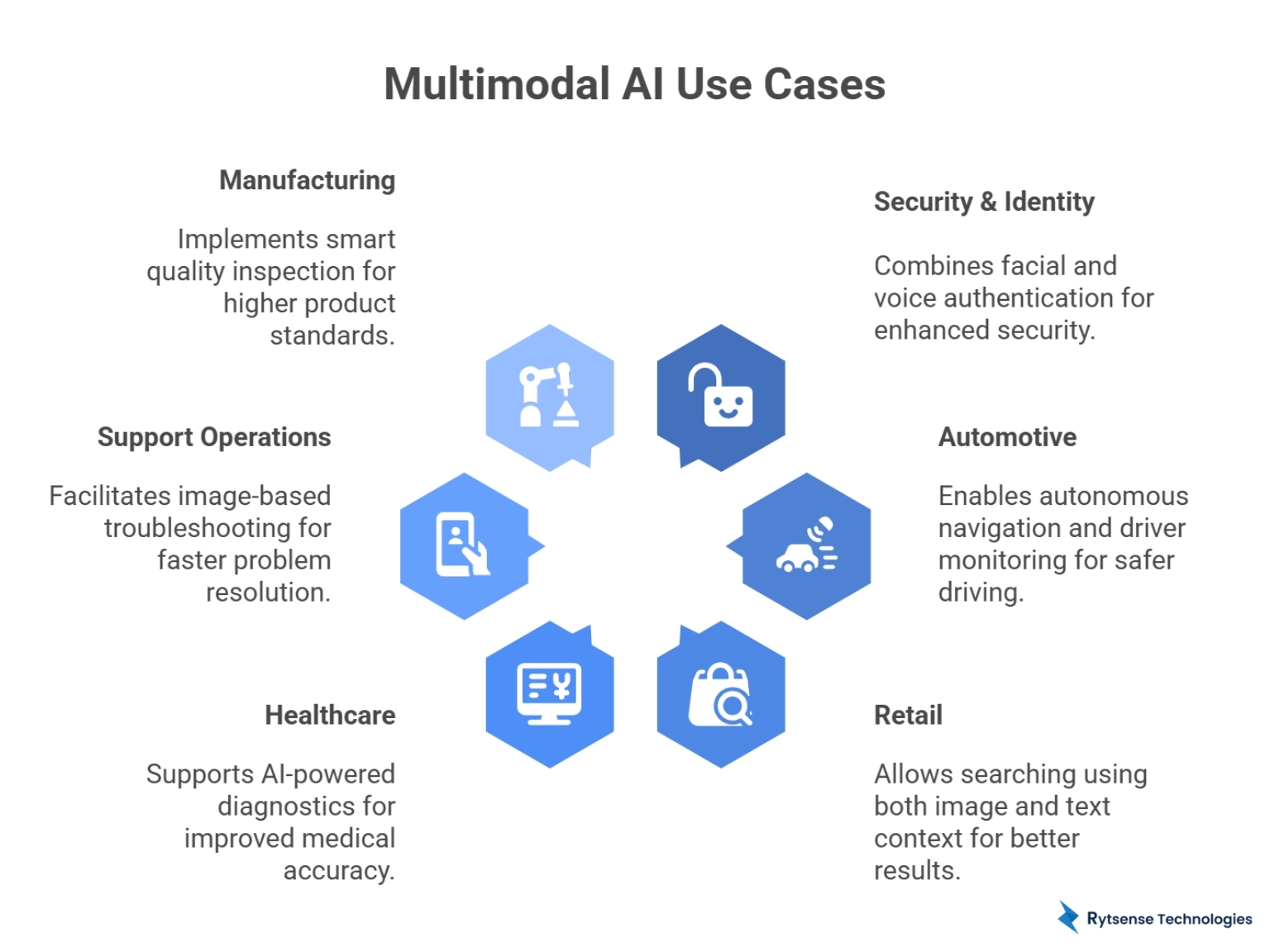
Multimodal AI enables systems to combine vision, language, speech, and other inputs to produce more accurate, context-aware intelligence. This makes it essential for real-world operations where multiple data types exist together.
Here are the most impactful business use cases of multimodal AI development services:
| Industry | Multimodal Innovation |
|---|---|
| Security & Identity | Facial + voice authentication |
| Automotive | Autonomous navigation, driver monitoring |
| Retail | Search by image + text context |
| Healthcare | AI-supported diagnostics |
| Support Operations | Image-based troubleshooting |
| Manufacturing | Smart quality inspection |
With the right AI systems development partner, businesses can create highly adaptive multimodal solutions.
7. Generative AI vs Multimodal AI: What’s the Difference?
- Generative AI is designed to create new content such as text, images, audio, video, and code using patterns learned from data.
- Multimodal AI is designed to understand and combine multiple types of input (like text + images + speech + video) to produce more context-aware responses and decisions.
| Feature | Generative AI | Multimodal AI |
|---|---|---|
| Purpose | Generate new content | Understand multiple inputs together |
| Data Types | Single modality (usually text or image alone) | Multi-sensory data (text + vision + audio etc.) |
| Output Style | Creative, synthetic | Analytical, context-aware |
| Best For | Marketing, design, automation | Robotics, healthcare, surveillance, real-time analysis |
| Example | Write a blog post | Analyze image + written prompt for repair guidance |
Simple One-Line Difference
Generative AI creates content.
Multimodal AI comprehends complex input.
8. Which AI Approach Do Businesses Need?
It depends on goals and industry needs:
| Business Requirement | Best Fit |
|---|---|
| Faster content workflows | Generative AI |
| Customer support automation | Both |
| Interactive product experiences | Multimodal AI |
| Real-world system intelligence | Multimodal AI |
| Developer productivity & automation | Generative AI |
Enterprises can unlock maximum value by using both together inside their AI transformation strategy.
9. Challenges & Considerations
| Challenge | Generative AI | Multimodal AI |
|---|---|---|
| Infrastructure cost | Medium | High |
| Risk of hallucination | High | Lower |
| Data handling complexity | Medium | Very High |
| Security & compliance | Requires strict governance | Stronger multi-data governance needed |
Partnering with expert AI developers helps ensure compliance, security, and scalability.
10. Future of AI: Convergence Into Agentic Intelligence
The future of innovation lies in combining:
- Multimodal Perception
- Generative Creation
- Reasoning + Autonomous action (Agentic AI)
Next-gen AI development services will deliver:
- Adaptive robotics
- Cognitive enterprise automation
- Unified AI platforms for end-to-end operations
This shift enables AI to not just respond - but think, decide, and act.
11. Final Thoughts
Generative AI and Multimodal AI are reshaping the capabilities of modern software and digital transformation. While they differ in purpose and implementation, both are critical components of innovative AI software development.
- Choose generative AI for creativity, automation & personalization
- Choose multimodal AI for contextual understanding & real-time decision intelligence
Forward-thinking companies are investing now to stay competitive in a world driven by AI models, machine learning networks, and intelligent automation systems.
Meet the Author

Karthikeyan
Connect on LinkedInCo-Founder, Rytsense Technologies
Karthik is the Co-Founder of Rytsense Technologies, where he leads cutting-edge projects at the intersection of Data Science and Generative AI. With nearly a decade of hands-on experience in data-driven innovation, he has helped businesses unlock value from complex data through advanced analytics, machine learning, and AI-powered solutions. Currently, his focus is on building next-generation Generative AI applications that are reshaping the way enterprises operate and scale. When not architecting AI systems, Karthik explores the evolving future of technology, where creativity meets intelligence.