What Is the 30% Rule in AI? A Complete Guide With Real Enterprise Case Studies
Why the 30% Rule in AI Matters Today
As artificial intelligence rapidly transforms industries, many business leaders , especially those working with an AI development company or evaluating top AI development companies, are trying to understand how much of their operations should be automated. Should AI replace entire workflows? Should humans still manage everything manually? Or should companies aim for a balanced hybrid approach?
This is where the 30% Rule in AI comes in.
The rule states:
AI should automate roughly 30% of a given task - especially the repetitive, mundane, and rules-based work - while humans should handle the remaining 70%, which typically requires creativity, judgment, empathy, and strategic decision-making.
This approach prevents over-automation, reduces risk, increases productivity, and ensures AI becomes a supporting partner instead of a disruptive replacement.
In this blog, we’ll break down:
- What the 30% Rule in AI actually means
- Why it’s becoming a global standard in AI adoption
- How industries are implementing it
- Real enterprise case studies from Rytsense Technologies - a custom AI development company
- Why this rule is more strategic than limiting
- How companies can apply it to maximize ROI
- Common misconceptions about AI automation
Let’s dive deep into this powerful concept.
What Is the 30% Rule in AI?
The 30% Rule in AI is a practical guideline used by enterprises adopting artificial intelligence. Instead of fully automating a process, companies allow AI to take over around 30% of the workflow, primarily repetitive, operational tasks.
This includes:
- Data extraction
- Document processing
- Scheduling
- Claims submission
- Data validation
- Trigger-based notifications
- Rule-based decisions
The remaining 70% is handled by humans, involving:
- Strategy
- Creativity
- Decision-making
- Exceptions management
- Quality assurance
- Edge-case handling
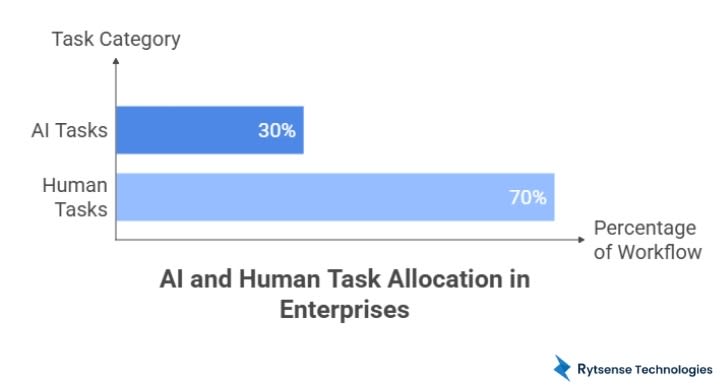
Why 30%?The Strategic Balance Between Automation & Human Control
It’s not a hard limit — it’s a balanced starting point.
Enough automation to save time and reduce errors…
Enough human involvement to maintain control and accuracy.
This ratio creates:
- Higher productivity
- Reduced burnout
- Improved decision quality
- Faster turnaround times
- Immediate ROI
It’s designed to augment humans, not replace them.
Why the 30% Rule Improves Workforce Productivity(H2)
When AI handles the repetitive or administrative parts of a workflow, humans get time to focus on:
- Critical thinking
- Innovation
- Strategic planning
- Creative problem solving
- Customer relationships
- Complex decision trees
This redesigns the workplace into something more meaningful and impactful.
Instead of humans acting like robots doing the same manual work every day… AI acts like a digital workforce assistant that makes humans exponentially more capable.
Case Study #1: How Rytsense Automated 70% of Insurance Claim Workflows in Healthcare
One of the strongest examples of the 30% rule in action comes from Rytsense Technologies, where we implemented AI agents for a major healthcare network handling insurance processes.
The Challenge
Insurance claims processing is a massive workflow involving:
- Claim submission
- Document validation
- Status updates
- Rejection management
- Re-submissions
- Communication with insurers
- Patient updates
This process previously required 50+ team members, involved manual errors, and caused significant delays.
The AI Solution
Rytsense built autonomous AI agents capable of:
- Handling claims submission
- Processing rejects
- Managing re-submissions
- Extracting data from documents
- Communicating with insurance companies
- Updating patients in real-time
- Reducing human workload drastically
The Outcome
- 70% increase in successful claim processing
- Rejection rate significantly reduced
- Human dependency dropped from 50+ people to just 5 AI agents
- Faster turnaround times
- Better patient experience
- Predictable processing accuracy
This is a perfect example of how a top AI development company can automate repetitive tasks while humans supervise and make high-level decisions.
Is 30% a Fixed Rule?
No - and this is where most people get it wrong.
The 30% rule is not a rigid threshold. It’s a starting point to find your balance.
In many enterprise workflows, Rytsense has achieved 90% automation without compromising accuracy.
Even with high automation:
- Humans still provide training
- Humans validate complex outputs
- Humans handle exceptions
- Humans set strategy and quality benchmarks
So the rule is:
Start with 30% automation, then expand as long as humans remain in the feedback loop.
There is no limit to automation when AI outputs become predictable, safe, and beneficial.
Case Study #2: Document Processing Automation for an Enterprise Client
Another enterprise client partnered with Rytsense to automate document-heavy workflows that previously required a large human team.
The Process
We built an AI agent that:
Preprocesses documents
- Converts unstructured formats into structured output
- Standardizes messy PDFs, images, and forms
Uses a reranker system
- It identifies what information is most relevant
- It cleans, verifies, and reorganizes the data
Runs with 90%+ accuracy
- This is extremely high for document workflows
But - humans are still in the loop. Even with 90% accuracy:
Even with 90% accuracy:
- Humans provide feedback
- Humans verify edge cases
- Humans help the model reduce hallucinations
- Humans refine the agent with real-world corrections
This hybrid model ensures safe, scalable automation trusted by enterprises choosing the best AI development companies.
Industries That Benefit the Most From 30% AI Automation
Based on enterprise projects we’ve executed, the industries that benefit the most are:
- Healthcare
- BFSI (Banking & Financial Services)
- Logistics & Transportation
- Retail
- Real Estate
Why?
Because they involve:
- High-volume processes
- Document-heavy tasks
- Repetitive administrative workflows
- Rule-based decision-making
- Compliance-driven systems
- High cost of human errors
Even 30–50% automation in these industries leads to enormous ROI.
Case Study 3: How Rytsense Automated Trip Scheduling in Logistics
A logistics company managing pooled city trips had the entire workflow run by multiple human operators:
- Assigning drivers
- Scheduling trips
- Optimizing routes
- Balancing loads
- Reducing fuel consumption
- Handling multi-pickup patterns
This process was error-prone and expensive.
What We Built
Rytsense deployed an AI agent that:
- Compares thousands of possible routes
- Assigns optimal driver-trip combinations
- Reduces fuel usage
- Minimizes travel time
- Enables multi-loading strategies
- Eliminates human scheduling errors
The Impact
- Higher trip efficiency
- Shorter travel time
- Reduction in operations cost
- Dramatic improvement in fleet utilization
- Nearly full automation of scheduling workflows
Again, the 30% rule became 90%+ automation, but with humans supervising the system.
Common Misconceptions About the 30% Rule
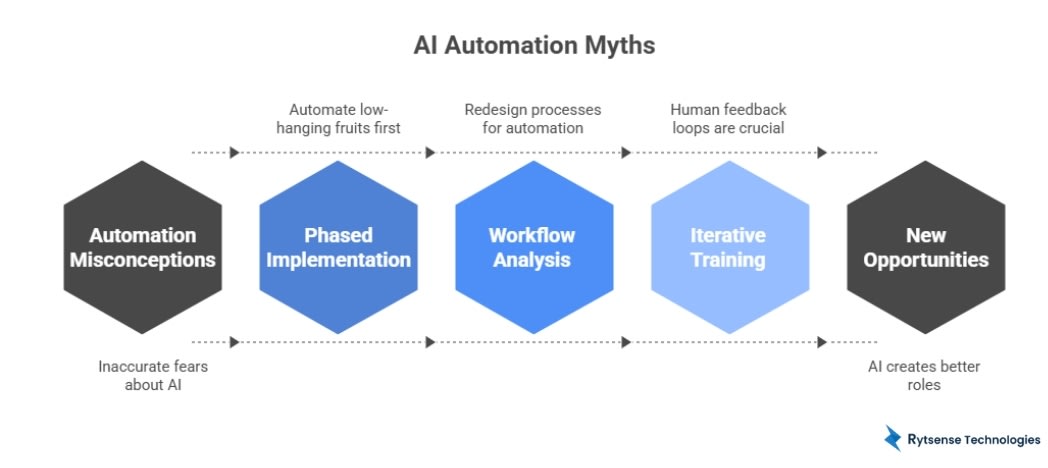
Myth #1: AI will replace jobs
This is the biggest fear — and the most inaccurate.
History shows:
- Cars didn’t eliminate transportation jobs
- Computers didn’t eliminate office jobs
- The internet didn’t eliminate communication jobs
Every automation wave creates more and better roles.
AI eliminates only the mundane work, allowing humans to grow into:
- New roles
- New specialties
- New technical functions
- New leadership opportunities
Myth #2: Automation happens overnight
True enterprise automation requires:
- Workflow analysis
- Process redesign
- Edge-case identification
- Safety mechanisms
- Iterative training
- Human feedback loops
It’s a step-by-step transformation, not a sudden replacement.
Myth #3: Everything must be automated or nothing
Most enterprises make this mistake.
Rytsense’s consulting approach shows:
You automate the low-hanging fruits first — the tasks AI does better, faster, and more consistently than humans.
Then slowly scale from 30% → 50% → 80% → 90%.
This phased approach reduces:
- Risk
- Cost
- Operational disruption
- Employee resistance
How Rytsense Technologies Helps Enterprises Implement the 30% Rule
At Rytsense, our methodology is centered around practical, safe, and ROI-driven automation.
Step 1: Analyze the Existing System
We study:
- How humans currently perform tasks
- Which tasks are repetitive
- Which tasks cost the most time
- What can be structured into AI workflows
Step 2: Identify “Low-Hanging Fruits”
These are tasks that:
- Humans spend too much time on
- Cause bottlenecks
- Are predictable
- Can be automated quickly
These tasks give the highest ROI within weeks.
Step 3: Build AI Agents for Workflow Automation
Our agents handle:
- Document processing
- Claims
- Approvals
- Scheduling
- Notifications
- Exception flagging
- Data extraction
- Reconciliation
- Customer updates
Step 4: Implement Human Feedback Loop
Humans:
- Approve AI outputs
- Catch edge cases
- Improve safety
- Provide training signals
- Prevent hallucinations
This ensures long-term accuracy and reliability.
Step 5: Scale Automation Across Departments
Once the system stabilizes, we expand AI into:
- Finance
- HR
- Operations
- Customer support
- Logistics
- Administration
This phased approach creates enterprise-wide transformation.
Conclusion: The 30% Rule Is the Future of AI - Human Collaboration
The 30% Rule in AI is not about limiting automation, it’s about creating balance, safety, and long-term productivity.
From healthcare to BFSI to logistics, the hybrid AI-human model:
- Reduces repetitive work
- Boosts accuracy
- Speeds up operations
- Cuts costs
- Enhances creativity
- Improves strategic focus
- Prevents burnout
AI does the hard work.
Humans do the smart work.
This is the future of work.
Meet the Author

Karthikeyan
Connect on LinkedInCo-Founder, Rytsense Technologies
Karthik is the Co-Founder of Rytsense Technologies, where he leads cutting-edge projects at the intersection of Data Science and Generative AI. With nearly a decade of hands-on experience in data-driven innovation, he has helped businesses unlock value from complex data through advanced analytics, machine learning, and AI-powered solutions. Currently, his focus is on building next-generation Generative AI applications that are reshaping the way enterprises operate and scale. When not architecting AI systems, Karthik explores the evolving future of technology, where creativity meets intelligence.