What Companies Are Building AI Infrastructure? Insights from Rytsense
Artificial Intelligence isn’t just about models or algorithms—it’s about deploying those models reliably at scale. Behind every AI system that can make real-time decisions, optimize operations, or automate workflows, there’s a complex, high-performance AI infrastructure powering it.
At Rytsense, a leading AI development company in USA, we’ve been building enterprise-grade AI solutions and AI development services for clients in healthcare, logistics, finance, and other sectors. Our experience gives us a unique view of which companies are truly shaping artificial intelligence infrastructure - the backbone that turns research into actionable, production-ready AI applications.
In this article, we explore:
- What AI infrastructure really means
- Leading companies in this space
- Real-world case studies of infrastructure impacting results
- Emerging players and future trends
Defining AI Infrastructure
From Rytsense’s perspective, AI infrastructure is more than hardware - it’s the entire ecosystem that makes enterprise AI development scalable, practical, and reliable. It enables machine learning, deep learning, and AI model deployment at production scale.
Components include:
- High-performance compute: GPUs, TPUs, and specialized AI accelerators enabling faster AI model training and inference.
- Cloud platforms: Flexible environments like AWS, Google Cloud, and Microsoft Azure to run AI workloads globally.
- Data pipelines: Secure, structured systems enabling reliable data analysis and model feeding.
- Model-serving systems: Low-latency platforms supporting real-time AI agents and enterprise operations.
- Distributed computing frameworks: Efficient execution of heavy machine learning workloads across multiple machines.
In short, AI infrastructure is everything that allows a custom AI solution to move from research to real-world deployment in enterprises.
Who Are the Leading Builders of AI Infrastructure Today?
Today’s AI infrastructure landscape is a mix of big tech giants and emerging specialized providers:
- AWS, Google Cloud, Microsoft Azure: Dominant cloud providers for AI offering scalable, reliable, and compliant platforms for AI workloads. Enterprises rely on these platforms for compute, storage, and managed AI services.
- NVIDIA: Leader in GPUs and AI hardware, enabling high-speed model training and real-time inference.
- Specialized providers: Smaller companies delivering optimized AI clusters, high-performance model-serving platforms, and innovative distributed computing solutions tailored to specific workloads.
Big tech firms provide a stable backbone, while specialized infrastructure innovators allow enterprises to push the boundaries of efficiency and performance.
Impact of AI Infrastructure on Client Projects
From our work at Rytsense on AI Software Development, certain infrastructure providers consistently accelerate project delivery, model training, and deployment:
- AWS: GPU-enabled cloud instances allowed us to scale training workloads in parallel, reducing training time by nearly 40%.
- NVIDIA: High-performance GPUs and optimized libraries enabled faster inference, complex model experimentation, and low-latency AI agents for logistics and healthcare projects.
The combination of reliable cloud infrastructure and high-performance hardware allowed Rytsense to deploy models faster, iterate more frequently, and maintain stable enterprise-grade performance.

Industry-Specific Performance
AI infrastructure isn’t one-size-fits-all. Certain providers excel in specific domains:
- Healthcare AI: AWS and Azure excel with HIPAA compliance and secure environments.
- Logistics AI: NVIDIA GPUs on cloud platforms improve route optimization, scheduling, fleet automation.
- Financial AI: Distributed compute clusters support large-scale predictive analytics and transaction modeling.
Choosing the right infrastructure impacts model accuracy, uptime, and operational success.
Why Scalability and Reliability Matter
In enterprise AI, even minor disruptions in infrastructure can have cascading effects:
- RCM automation: Any downtime in model-serving systems forces manual intervention, increasing errors.
- Logistics AI: Limited GPU availability can delay route optimization and delivery schedules, impacting operational efficiency.
From Rytsense’s experience, scalability and reliability are often the difference between a project’s success or failure. Enterprises demand seamless, high-performance infrastructure to maintain confidence in AI systems.
Case Study: Non-Emergency Healthcare Logistics
A real-world example demonstrates the importance of infrastructure:
Challenge: Schedule hundreds of patient transport trips daily while accounting for driver availability, route optimization, and last-minute disruptions.
Solution: Using AWS cloud AI infrastructure with NVIDIA GPU acceleration, we processed massive datasets and executed real-time optimization models for healthcare AI workflows.
Impact:
- Trips were dynamically rescheduled
- Drivers were reallocated efficiently
- ETAs provided in real time
Without this infrastructure, training and deploying such models would have taken weeks instead of hours, and real-time reliability would have been impossible.
Cloud vs On-Premise Infrastructure
From Rytsense’s experience:
- Cloud-based infrastructure: Greater flexibility and scalability; ideal for training large models, real-time inference, and global deployment.
- On-premise or hybrid AI System: More control over data privacy, compliance, and predictable costs; essential for sensitive workloads in healthcare or finance.
Often, a hybrid approach combines the best of both worlds: cloud for scalability, on-premise for sensitive data handling.
The Role of Infrastructure Partnerships
Rytsense integrates multiple infrastructure providers depending on client needs:
- AWS/Google Cloud for scalable training and deployment
- NVIDIA GPUs for high-performance inference
- Specialized data pipeline platforms for secure, structured data management
Result: Accelerated delivery, consistent performance, and enterprise-ready AI solutions that aren’t limited by a single provider.
Quiet Leaders in AI Infrastructure
Not all leaders make headlines. Some smaller providers excel in niche areas:
- Lambda Labs: Optimized GPU workstations and clusters for efficient model training at lower costs.
- Paperspace: Flexible, low-latency GPU cloud instances for rapid prototyping and real-time inference.
- Prefect/Dagster: Reliable orchestration of complex AI workflows, critical for healthcare and logistics automation.
These “quiet leaders” allow Rytsense to optimize training, handle sensitive data securely, and deploy complex AI systems reliably.
Looking Ahead: AI Infrastructure Trends
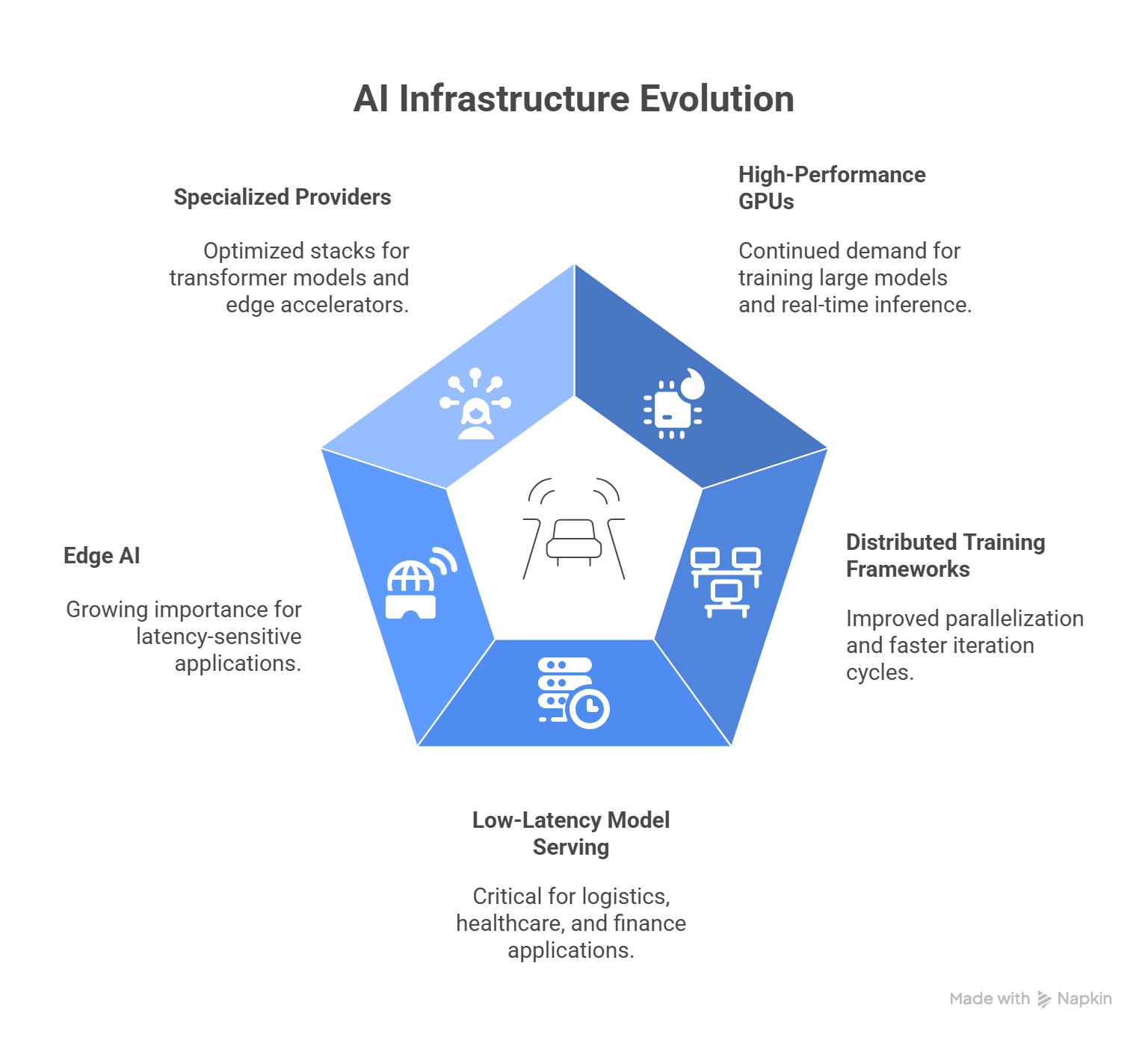
Over the next 12–24 months, Rytsense expects AI infrastructure to evolve in several key areas:
- High-performance GPUs and TPUs: Continued demand for training large models and real-time inference.
- Advanced distributed training frameworks: Improved parallelization and faster iteration cycles.
- Low-latency model-serving platforms: Critical for logistics, healthcare, and finance applications.
- Edge AI: Growing importance for latency-sensitive applications like remote patient monitoring or fleet management.
- Specialized providers: Optimized stacks for transformer models, multi-GPU clusters, and lightweight edge accelerators.
Staying aligned with these trends enables Rytsense to integrate cutting-edge infrastructure into client solutions, ensuring faster training, reliable deployment, and scalable enterprise AI systems.
Conclusion
AI infrastructure is the backbone of successful AI software development, that turns models into real-world solutions. At Rytsense, we’ve seen first-hand how the right combination of cloud platforms, high-performance hardware, and specialized tools can dramatically improve AI project outcomes.
- Big tech providers like AWS, Google Cloud, Microsoft Azure, and NVIDIA offer stability, scalability, and enterprise-ready services.
- Emerging and specialized providers offer highly optimized, domain-specific solutions that enhance performance and efficiency.
- Hybrid and integrated approaches allow enterprises to balance scalability, compliance, and cost.
Enterprises that understand AI infrastructure adopt AI solutions more effectively - and grow faster.
Empower your enterprise with the infrastructure AI depends on.
Meet the Author

Co-Founder, Rytsense Technologies
Karthik is the Co-Founder of Rytsense Technologies, where he leads cutting-edge projects at the intersection of Data Science and Generative AI. With nearly a decade of hands-on experience in data-driven innovation, he has helped businesses unlock value from complex data through advanced analytics, machine learning, and AI-powered solutions. Currently, his focus is on building next-generation Generative AI applications that are reshaping the way enterprises operate and scale. When not architecting AI systems, Karthik explores the evolving future of technology, where creativity meets intelligence.