Key Takeaways
Machine learning development follows 7 essential stages: problem definition, data collection, data preparation, model selection, model training, model evaluation, and deployment.Each stage plays a critical role in building accurate, scalable, and business-ready AI solutions.Startups focus on rapid iteration and lightweight models, while enterprises prioritize governance, accuracy, and large-scale AI integration.Techniques like AutoML, MLOps, fine-tuning, and deep learning accelerate modern AI development.Successful AI implementation requires continuous monitoring, retraining, and performance optimization.Companies partnering with a reliable AI development company gain faster deployment, better accuracy, and long-term scalability.
What Are the 7 Stages of Machine Learning? (Explained Simply for 2025)
Machine learning development generally follows seven essential stages: problem definition, data collection, data preparation, model selection, model training, model evaluation, and deployment & monitoring.
These steps form the foundation of modern artificial intelligence development, helping businesses build scalable, accurate, and production-ready AI systems.
This guide explains each stage clearly, whether you're a startup building your first AI app, an enterprise modernizing operations, or someone exploring how machine learning models are actually developed.
1. What Are the 7 Stages of Machine Learning?
While different AI frameworks describe machine learning workflows differently, the widely accepted seven stages are:
Define the problem
Collect data
Prepare & clean the data
Select the right ML model
Train the model
Evaluate the model
Deploy, monitor, and improve the model
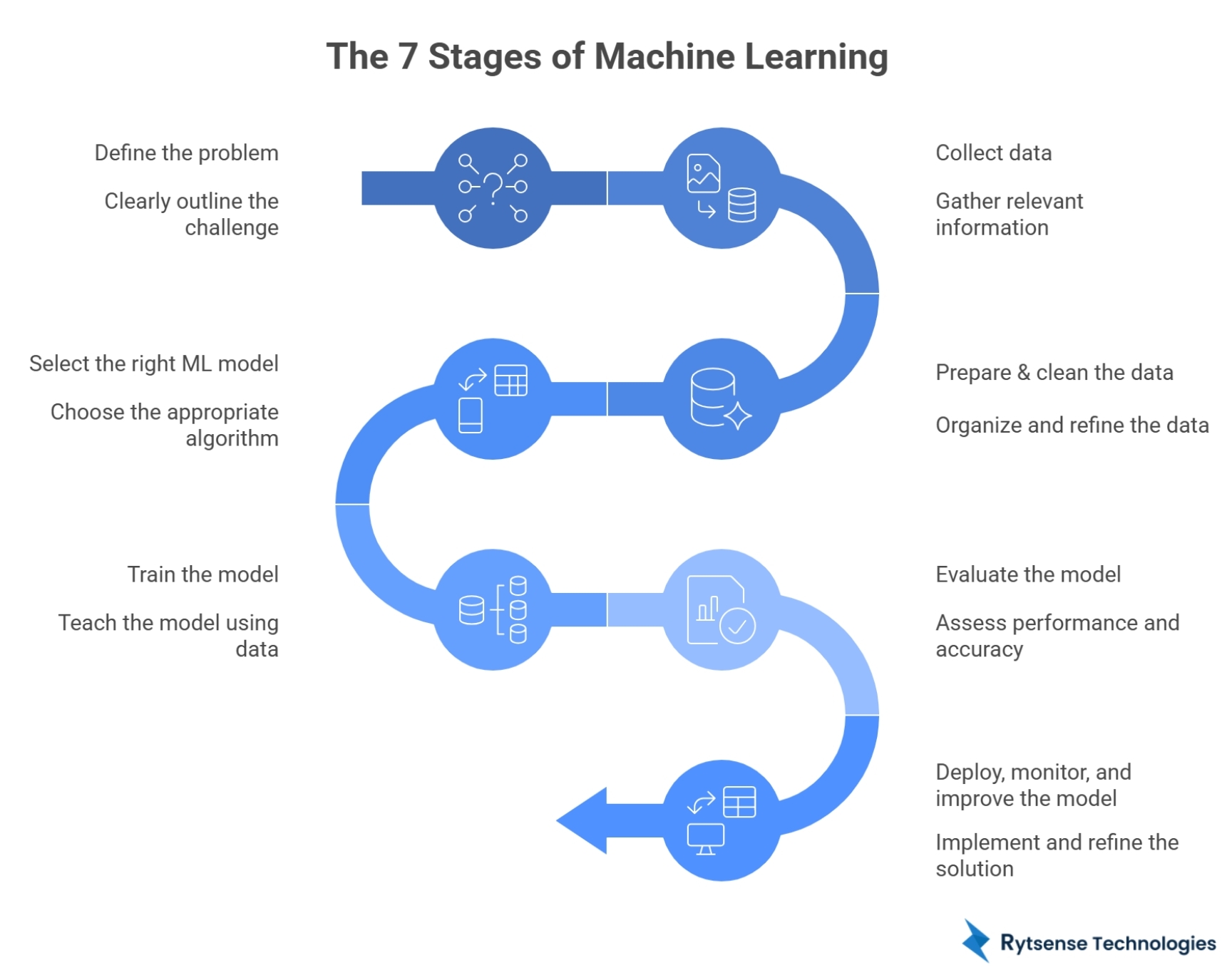
Every AI solution—from predictive analytics to generative AI—goes through these steps. Understanding these stages helps businesses make better decisions about AI integration, AI models, data strategy, and development processes.
Want to Build ML Models Faster and More Accurately?Work with a Top AI Development Company that builds production-ready AI systems for startups and enterprises. 👉 Get a Free Consultation →
2. Why Machine Learning Stages Matter in 2025
Machine learning isn't just a technical process anymore, it’s a business capability. Companies across healthcare, manufacturing, retail, real estate, logistics, and finance now depend on ML-driven automation, predictive analytics, computer vision, NLP, and deep learning applications.
By following a structured 7-stage development process, organizations get:
- Reliable, explainable AI models
- Faster AI deployment
- Better model accuracy and performance
- Scalable AI systems that work with existing software
- A clearer roadmap for AI investment
In 2025, where AI development services are becoming mainstream, understanding these stages is essential for strategic planning.
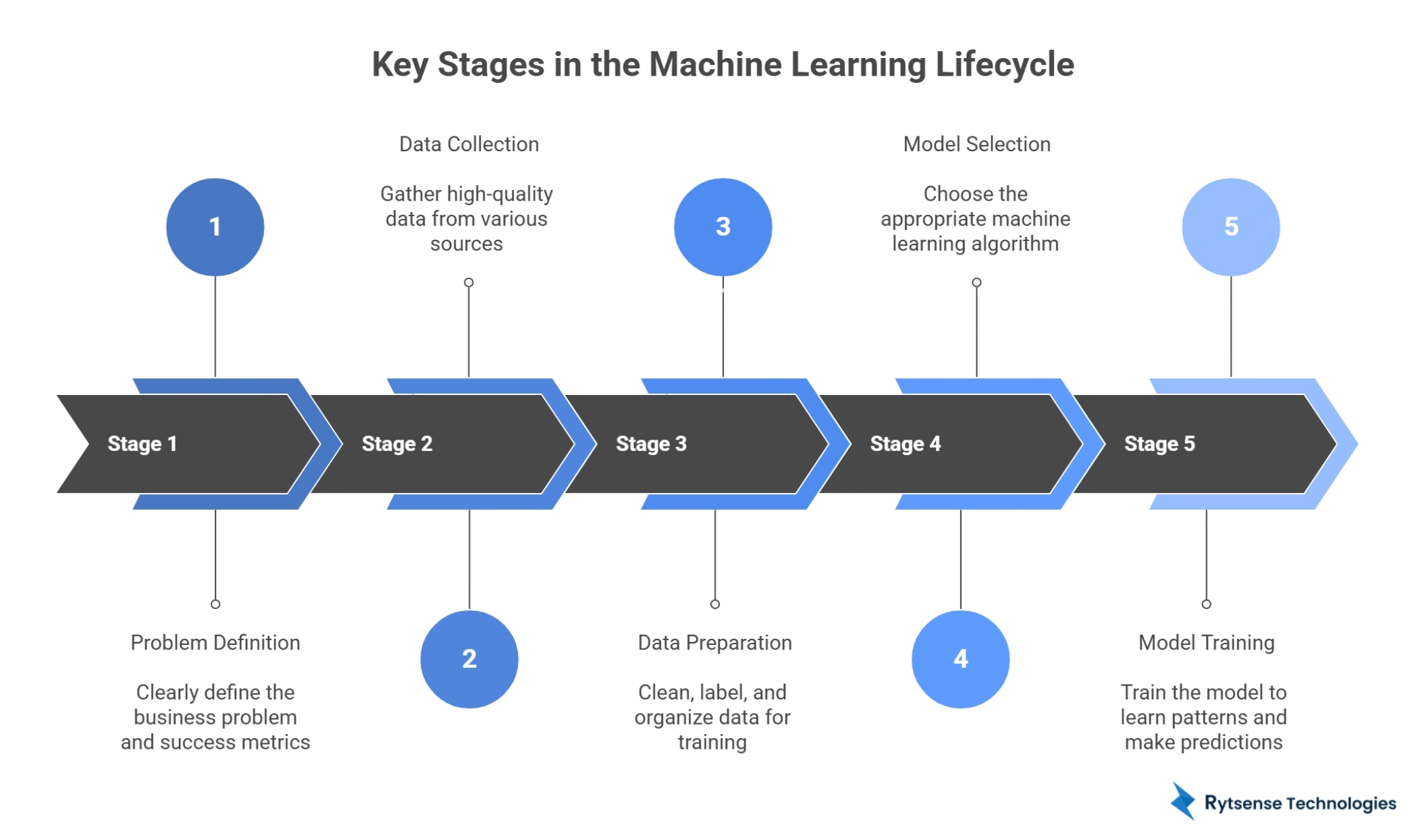
3. Stage 1 - Problem Definition: Knowing What to Solve
Machine learning begins with a simple question: “What decision or task should the model improve?”
Poor problem framing leads to wasted effort — even with perfect data and advanced algorithms.
Key questions AI teams ask:
- What business problem are we solving?
- What KPIs define success?
- Is ML necessary, or will rules-based automation work?
- What type of machine learning fits best (supervised, unsupervised, reinforcement, or semi-supervised)?
Business examples
- Retail: Predicting customer churn
- Real Estate: Forecasting property values
- Manufacturing: Detecting faulty products using computer vision
- Finance: Fraud detection using pattern analysis
Clear scoping ensures alignment between business goals and technical execution.
4. Stage 2 - Data Collection: Building the Foundation
Every AI model depends on high-quality data. The data collection stage defines how reliable and accurate your ML model will be.
Where data comes from:
- Internal databases
- CRM and ERP systems
- IoT sensors
- Web scraping
- Public datasets
- Third-party APIs
- Real-time event streams
For startups with limited data, synthetic data or pre-trained AI models can accelerate development.
Types of data collected:
- Text (NLP)
- Images (computer vision)
- Audio
- Structured tables
- Sensor data
- User behavior logs
In modern AI software development, data strategy is now as important as algorithm selection.
5. Stage 3 - Data Preparation: Cleaning, Labeling & Organizing
Also called data preprocessing, this stage can take up to 60–80% of the entire ML lifecycle.
Data prep includes:
- Removing duplicates
- Handling missing values
- Normalizing values
- Encoding categorical features
- Splitting data into training, testing, and validation sets
- Labeling data for supervised learning
Why this stage matters
Without clean data, even the most sophisticated neural networks will produce inaccurate or biased results. Businesses often use specialized AI development services for large-scale annotation tasks, especially in computer vision and NLP.
6. Stage 4 - Model Selection: Choosing the Right Algorithm
Choosing the right machine learning model is one of the most strategic decisions in the entire AI development lifecycle. Even with high-quality data, the wrong model can lead to poor accuracy, slow prediction time, or high infrastructure cost. That’s why AI teams carefully evaluate the problem type, data structure, and business objectives before selecting a model.
Common models used:
- Linear Regression (predictions)
- Random Forest (classification)
- Support Vector Machines
- Decision Trees
- Neural Networks
- CNNs (for images)
- RNNs and Transformers (for text and sequences)
Startups often prioritize simpler models for faster iteration. Enterprises may adopt advanced deep learning models for highly accurate AI solutions.
Factors influencing model choice:
- Accuracy requirements
- Training time
- Explainability
- Deployment environment
- Real-time processing needs
No single model works for everything; smart selection drives results.
7. Stage 5 - Model Training: Teaching the Model to Learn
Model training is the heart of the machine learning lifecycle. This is where the algorithm transforms from a simple mathematical function into an intelligent system capable of recognizing patterns, making predictions, and supporting real-time decision-making. Whether you're building a recommendation engine, fraud detection model, or a generative AI system, training is the stage that determines how accurately your AI will perform in real-world environments.
What happens during training?
- The model analyzes input data
- It adjusts weights & parameters
- It learns to minimize error (loss function)
- It iterates thousands or millions of times
Training requires computing resources such as GPUs, TPUs, or cloud-based AI infrastructure.
Key Techniques Used During Model Training
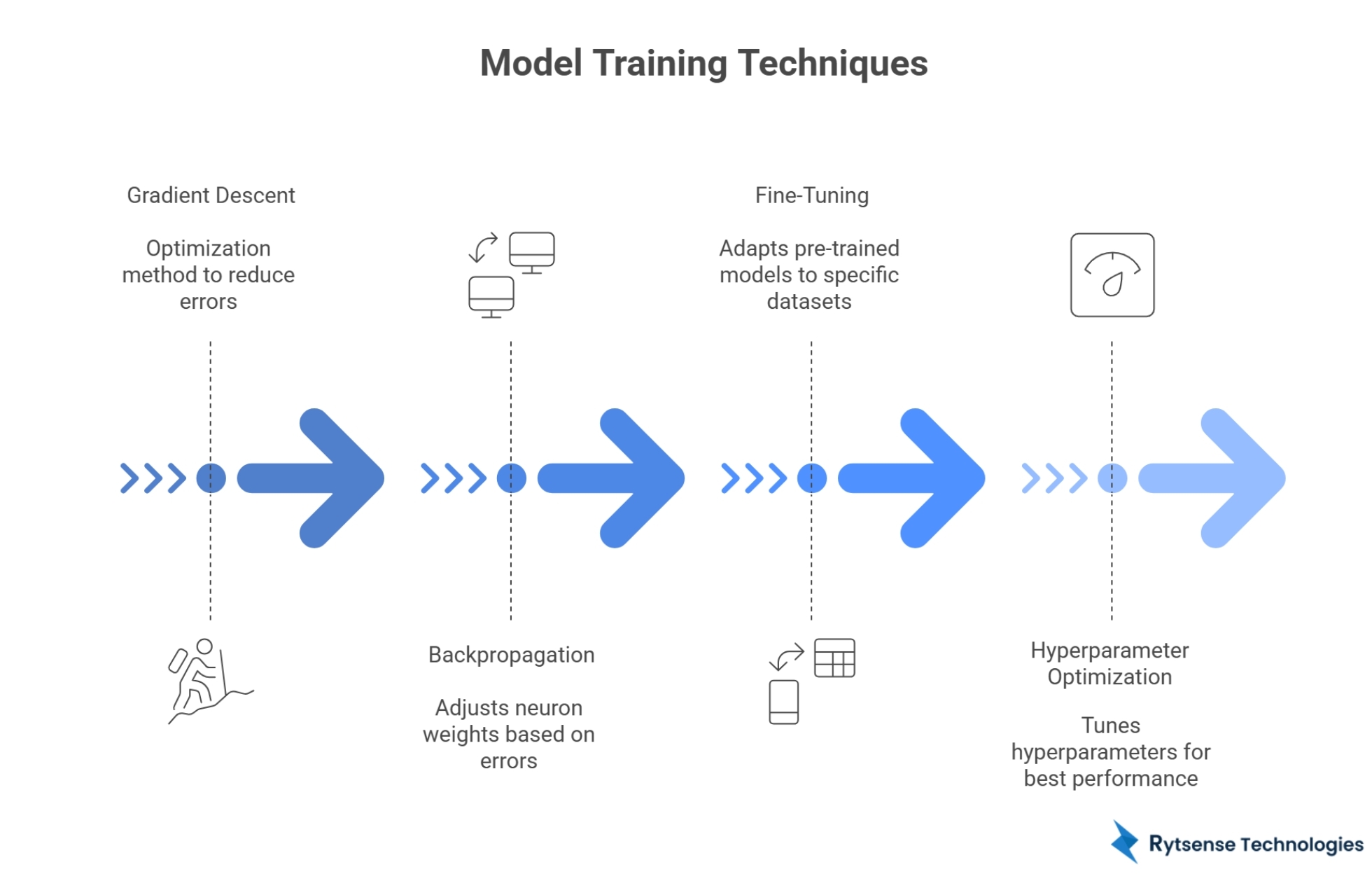
1. Gradient Descent — How Models Learn Step-by-StepGradient descent is an optimization method that helps the model reduce errors. It calculates how each parameter should change to move closer to the minimum loss. Think of it like walking downhill toward the lowest point in a valley — step by step.2. Backpropagation - The Engine Behind Neural NetworksBackpropagation computes how wrong each neuron was and adjusts its weights accordingly. It works by: Moving forward through the network → generating predictionsMoving backward → updating weights based on errors This is how deep learning systems — from image models to large language models — actually learn. 3. Fine-Tuning Pre-Trained ModelsInstead of training from scratch, developers now use pre-trained models and adapt them to business-specific datasets. Fine-tuning BERT for customer sentiment analysisCustomizing a CNN for product defect detectionAdapting a Transformer for industry-specific text generation This technique reduces training time dramatically and improves accuracy, making AI more accessible for startups and enterprises. 4. Hyperparameter Optimization - Tuning for the Best PerformanceHyperparameters control how the model learns (learning rate, batch size, number of layers, dropout rate, etc.). Finding the optimal configuration can massively boost performance. Grid searchRandom searchBayesian optimizationAutomated tuning tools (AutoML) This stage ensures the ML model is not just trained — but trained efficiently and intelligently.
Modern AI development companies in USA use automated ML pipelines (AutoML, MLOps) to speed up this process.
8. Stage 6 - Model Evaluation: Measuring Performance
After training, the model is tested against unseen data.
Key evaluation metrics:
- Accuracy
- Precision & Recall
- F1 Score
- ROC-AUC
- Mean Absolute Error
- Confusion Matrix
Why evaluation matters
A model that performs well during training but poorly in production may suffer from issues like overfitting, bias, or insufficient testing. Businesses must ensure the model is robust across edge cases, seasons, customer groups, and real-world variations.
9. Stage 7 - Deployment, Monitoring & Scaling
Once the model passes evaluation, it's deployed into real applications.
Deployment options:
- Cloud (AWS, Azure, GCP)
- On-premise
- Edge devices
- Mobile apps
- Existing enterprise systems
What happens after deployment?
- The model is continuously monitored
- Data drifts are detected
- Performance is retrained or improved
- Feedback loops refine accuracy
MLOps tools automate deployment pipelines, helping companies scale AI systems more efficiently.
Need Production-Ready AI & Machine Learning Systems?Partner with AI experts who build, deploy, and maintain scalable ML models tailored to your business. Book Your Free Strategy Call →
10. How Startups vs Enterprises Approach the 7 Stages
Startups Focus On:✓ Rapid prototyping✓ Lean data collection✓ Pre-trained AI models✓ Cost-effective deployment✓ Cloud-native developmentThey need speed, flexibility, and minimal overhead.Enterprises Focus On:✓ Data governance✓ Privacy and compliance✓ Model explainability✓ Integration with legacy systems✓ Large-scale automationThey require reliability, audit trails, and long-term scalability.
Both benefit from structured AI development processes, but priorities differ dramatically.
11. Common Challenges in the Machine Learning Lifecycle
- 1. Insufficient or low-quality data: Models can’t learn without representative data.
- 2. Data silos inside organizations: Enterprises often struggle to unify fragmented data sources.
- 3. High computational cost: Deep learning requires expensive infrastructure.
- 4. Model bias and fairness issues: Models can inherit human or systemic bias.
- 5. Deployment delays: Many organizations build great models — but never move them to production.
- 6. Model decay: AI systems lose accuracy over time without monitoring.
These challenges illustrate why partnering with experienced AI developers is critical for sustainable AI success.
12. How AI Development Services Help Across All 7 Stages
A professional AI development company streamlines the ML lifecycle by offering:
Strategic SupportProblem framingAI roadmap creationData strategy developmentTechnical ExpertiseAI model developmentData engineering & annotationModel training & optimizationBuilding custom AI solutionsMLOps & DeploymentProduction-ready pipelinesContinuous monitoringReal-time analytics
Startups accelerate product development. Enterprises modernize operations. Both achieve long-term AI ROI.
13. Conclusion
The seven stages of machine learning form the foundation of every successful AI project. From defining the problem to deploying and monitoring the model, each step ensures your AI solution delivers measurable business outcomes.
In 2025, as AI development services continue to evolve, companies that follow a structured ML lifecycle will build more accurate, scalable, and intelligent systems that outperform their competitors.
Accelerate Your AI Journey with Industry ExpertsWhether you're a startup or enterprise, we build custom AI solutions that deliver measurable results. 👉 Start Your AI Project Today
Meet the Author

Co-Founder, Rytsense Technologies
Karthik is the Co-Founder of Rytsense Technologies, where he leads cutting-edge projects at the intersection of Data Science and Generative AI. With nearly a decade of hands-on experience in data-driven innovation, he has helped businesses unlock value from complex data through advanced analytics, machine learning, and AI-powered solutions. Currently, his focus is on building next-generation Generative AI applications that are reshaping the way enterprises operate and scale. When not architecting AI systems, Karthik explores the evolving future of technology, where creativity meets intelligence.