How Smart Digital Assistants Are Changing Business Operations
Companies are processing a greater amount of data, customer relationships, and internal activities than ever. Manual processes tend to slow down as the team expands and operations get more complicated.
This complexity is being simplified by smart digital assistants, which are automating routine work and assisting in making decisions faster. In the early stages of adoption, many companies explored generative AI development services to improve how machines understand language and context. Rytsense Technologies focuses on building intelligent systems that support efficiency rather than replace people.
Smart digital assistants are computer-based applications that can be run on artificial intelligence and assist users to do or answer questions, as well as to record workflows. These technologies may be chatbots who answer customer questions, voice assistants that would make appointments, or automation that manages the tedious processes of a back office. They are to minimize the manual work, enhance speed and accuracy in the day-to-day activities.
What Smart Digital Assistants Are?
Smart digital assistants are not mere chat applications. They are smart systems that can perceive requests, process information, and act according to some prescribed rules or learned behavior. They rely on technologies like natural language processing, machine learning, and data integration to engage with users more naturally.
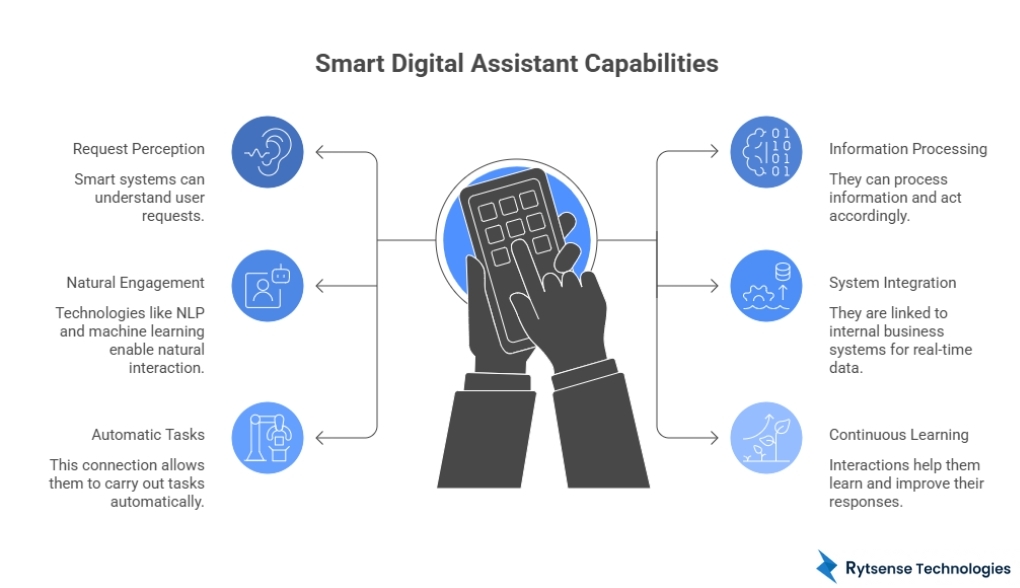
These assistants are usually linked to the internal systems in the business world such as databases of customers, human resource, and inventory. This connection enables them to give real-time information and carry out tasks automatically. With time, interactions help them to learn, and responses become more accurate and relevant.
The Uses of Smart Digital Assistants by Businesses
Smart digital assistants assist companies in industries in their daily activities. Chatbots are used by customer support workers to respond to simple queries, order tracking, and to fix minor problems. Assistants help the sales teams to qualify leads, schedule follow-ups, and deliver product information in real-time.
Assistants can help the human resources departments with the onboarding questions and leave requests of their employees as well as explaining the policies. Automation tools are used by the internal teams to create reports, approvals, and system alert monitoring. In many organizations, AI Agent Development Services help customize these assistants so they fit specific business needs rather than offering generic responses.
Smart digital assistants also enable employees to work on tasks of higher value, which need creativity and judgment, by performing repetitive tasks.
Effect on Customer Service and Sales
One of the most visible impacts of smart digital assistants is customer support. Customers are not required to spend their time in a long queue but are automatically answered through chat or voice applications. This enhances satisfaction and also lessens the support staff workload.
Assistants are used in sales operations to take leads, give response to questions regarding products, and direct potential customers on the first steps in the purchase process. They make sure that they do not miss any inquiry even when they are not in business. Such a steady supply keeps businesses attentive and does not raise the cost of staffing.
Supporting HR and Internal Workflows
Digital assistants that are smart are increasingly involved in internal operations. They are used to give the employees instant solutions to certain questions concerning benefits, payroll, and company policy. This reduces repetitive inquiries and allows HR teams to focus on people-focused initiatives.
In internal workflows, assistants automate approvals, reminders, and data entry tasks. For example, they can notify managers about pending actions or flag unusual activity in systems. This level of automation improves accuracy while keeping operations running smoothly.
Key Benefits for Business Operations
The benefits of smart digital assistants go beyond convenience. They help businesses save time by handling tasks instantly and consistently. Costs are reduced because fewer manual hours are required for repetitive work. This enhances productivity because employees are less involved in administration and are more engaged in strategic objectives.
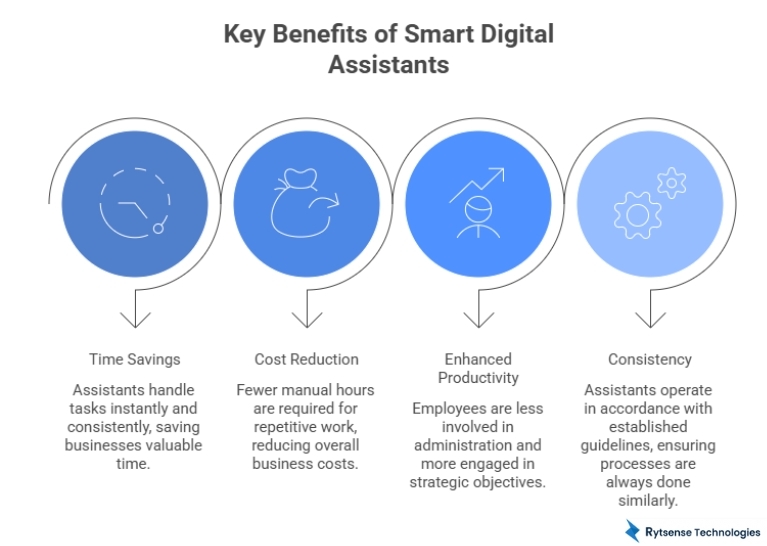
Another significant advantage is consistency. Assistants operate in accordance with established guidelines making sure that processes are always done in a similar manner. This will minimize the mistakes and enhance interdepartmental compliance.
Challenges and Considerations
Smart digital assistants are beneficial, but they are also associated with difficulties. Inadequately structured systems may be frustrating when they cannot make out requests or give wrong responses. Another issue is data security and in particular, when assistants have access to sensitive business or customer data.
Companies also should not have automation eliminating the human touch where it is still required. The digital assistants are most effective when they assist individuals, not when they dominate important human interaction.
The Future of Smart Digital Assistants
The future of intelligent digital assistants is in more integration and intelligence. Assistants will be more active in the conversation, will predict the needs of the users and will make proactive offers. Voice-based systems will also increase especially in hands-free settings.
With the development of AI technology, assistants will be more flexible and context-sensitive. To keep the business effective and trusted, businesses will have to emphasize on ethical usage, transparency, and constant progress.
The Importance of Smart Digital Assistants
Smart digital assistants are not a far-off experiment. They are currently emerging as key components of modern business. They also help organizations keep pace with a fast changing environment by automating common tasks, improving communication and making decisions much faster.
Companies working with experienced technology partners like Rytsense Technologies often focus on building assistants that align with real operational needs rather than trends. It guarantees long-term value and improved outcomes.
Conclusion
Smart digital assistants are transforming the way businesses are run by enhancing efficiency, minimizing cost, and assisting employees working in various fields. Whether it is customer care and sales or HR and internal procedures, these tools can be used to enable organizations to handle increasing needs without any increase in complexity.
With the ongoing improvement of technology, companies embracing smart digital assistants will be in a better place to grow sustainably. Rytsense Technologies continues to explore how intelligent systems can support practical, scalable business operations without unnecessary disruption.
Meet the Author

Co-Founder, Rytsense Technologies
Karthik is the Co-Founder of Rytsense Technologies, where he leads cutting-edge projects at the intersection of Data Science and Generative AI. With nearly a decade of hands-on experience in data-driven innovation, he has helped businesses unlock value from complex data through advanced analytics, machine learning, and AI-powered solutions. Currently, his focus is on building next-generation Generative AI applications that are reshaping the way enterprises operate and scale. When not architecting AI systems, Karthik explores the evolving future of technology, where creativity meets intelligence.