Key Takeaways
LangGraph enables advanced AI workflows with branching, looping, and stateful memory — far beyond simple prompt-response systems.
It allows multiple AI agents to collaborate, share context, and execute tasks, making it ideal for scalable automation solutions.
Businesses can integrate AI with existing tools and data using LangGraph for real-world processes like approvals, reporting, and analytics.
The framework is designed for production-grade AI, with strong monitoring, error handling, and long-running task support.
LangGraph plays a crucial role for startups and enterprises adopting custom AI solutions, automation, and AI-driven products.
With growing demand for AI integration, LangGraph will be central to the future of enterprise AI and intelligent workflow automation.
How is LangGraph used in AI?
If you’re exploring how to build serious AI-powered systems – from AI apps and AI solutions to enterprise-grade automation – then LangGraph is one of the most powerful tools you can adopt today. It lets you design complex, stateful AI workflows, not just simple prompt-and-response, enabling advanced logic, multi-agent orchestration, memory, conditional flows, and much more. For anyone evaluating AI development services, or thinking of building custom AI products or integrating AI into existing systems, understanding LangGraph is critical.
1. What is LangGraph – the core idea
At its heart, LangGraph is an open-source framework (from the same ecosystem as LangChain) that enables graph-based orchestration of AI workflows and agents. Rather than thinking of an AI application as a simple linear pipeline (prompt → LLM → response), LangGraph treats the workflow as a graph: tasks (or agents) are nodes, and the paths between them (edges) define how data, control flow, and logic moves.
This means you can build stateful, branching, looping, multi-step AI systems – with memory, decision-making, tool integrations, and even multi-agent coordination.
In simple terms: LangGraph lets you treat AI as software, not just occasional LLM calls, giving you the flexibility of custom AI development, AI integration, and even enterprise-scale AI systems.
2. How LangGraph fits into the AI/ML and generative-AI ecosystem
The growth of artificial intelligence — especially generative AI, deep learning, and large language models (LLMs) — has opened vast possibilities: from chatbots to document summarization, content generation, predictive analytics, automation, and more. Many businesses now look toward custom AI solutions or AI software development services to leverage these possibilities.
However, off-the-shelf “LLM + prompt” approaches have limitations:
- They tend to be stateless — each prompt is independent.
- Hard to embed real business logic, conditional flows, memory, or integration with existing systems (APIs, databases, workflows).
- Hard to scale for complex, multi-step tasks, multi-agent interactions, automation pipelines, or enterprise-grade AI systems.
That’s where LangGraph becomes relevant. It allows AI development companies, in-house developers, or AI teams to build custom AI solutions that combine the power of LLMs with traditional software engineering best practices – integrating data analysis, business logic, AI model calls, and workflow orchestration. For companies evaluating “AI development services” or “AI integration services,” LangGraph is often the backbone.
Moreover, because LangGraph supports modular and maintainable architecture, it aligns with how software development services build custom software, but with AI and machine learning logic deeply embedded.
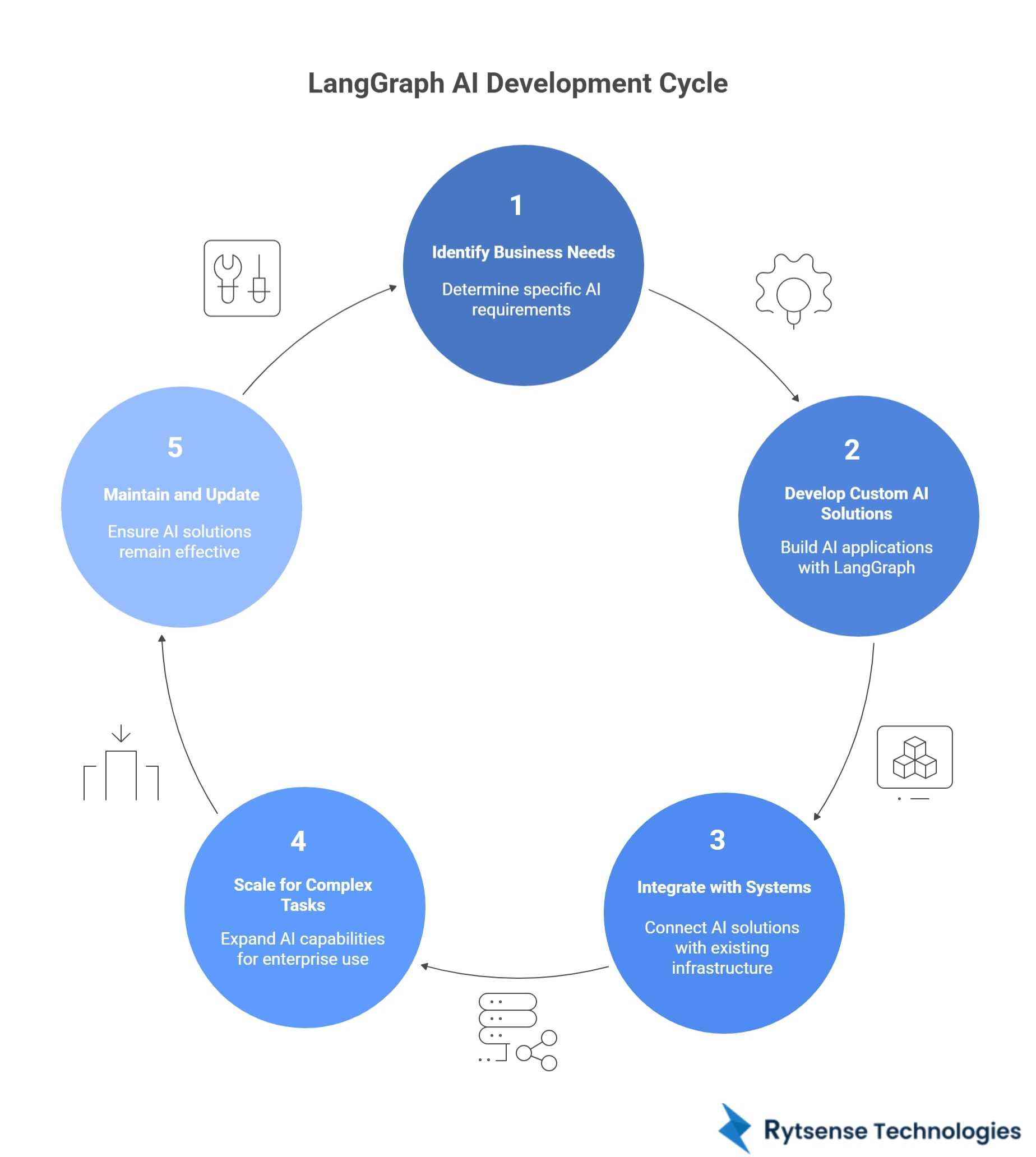
3. Key advantages: Why LangGraph matters for AI development services & custom AI solutions
Key Advantages of Using LangGraph in AI Development:
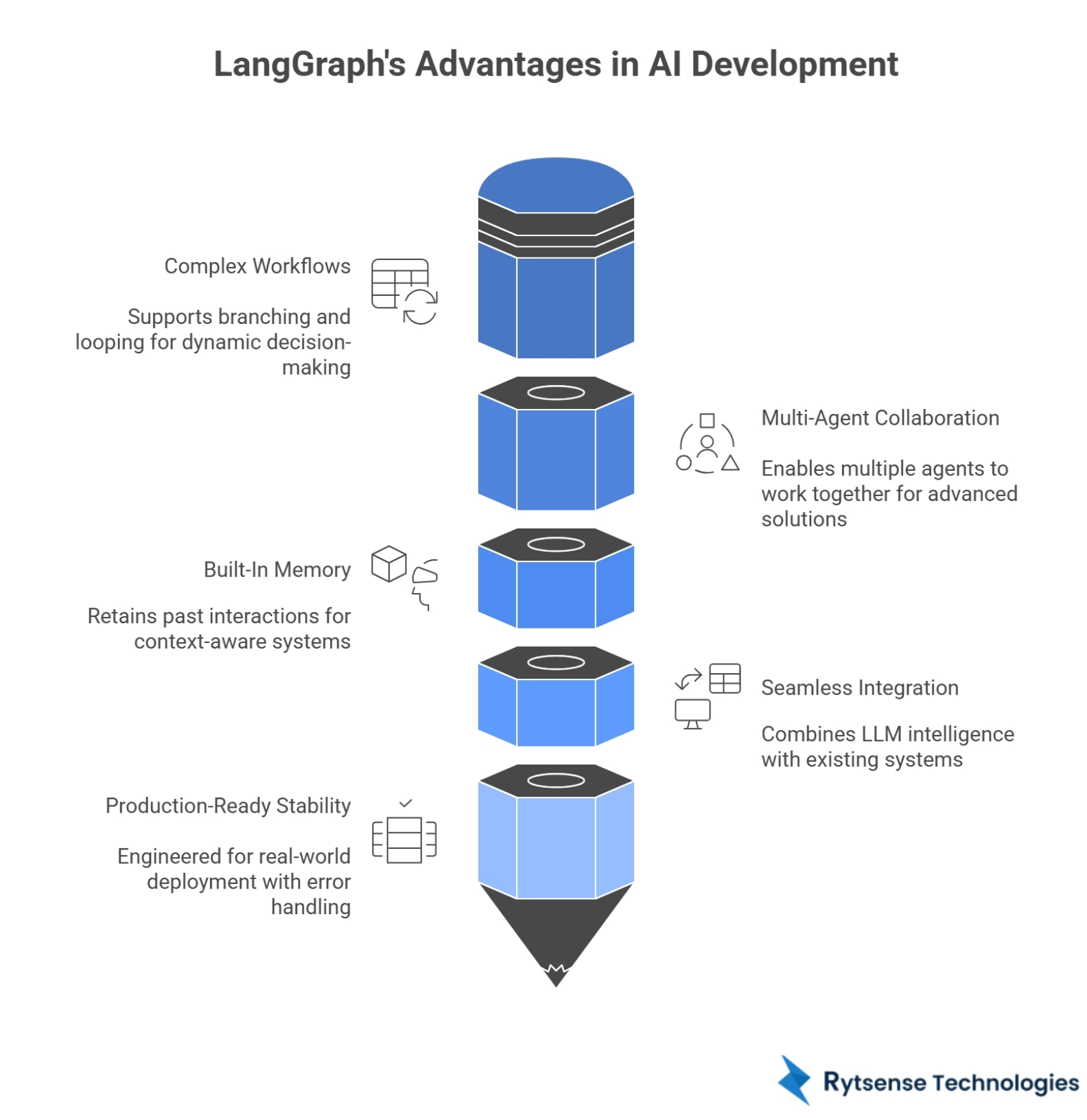
🔹 Supports Complex & Flexible Workflows
LangGraph allows workflows to branch, loop, and adapt based on real-time conditions. It maintains state across steps, enabling dynamic decision-making and far more sophisticated behavior than a basic one-direction prompt chain.
For businesses investing in AI development services or custom AI product development, this flexibility is vital – whether you’re building multi-step approval engines, smart assistants, or automation pipelines.
🔹 Designed for Multi-Agent Collaboration
Multiple specialized agents can work together inside a single system – one might retrieve data, another may analyze it, and a third could generate responses or trigger actions. This enables you to create advanced AI solutions such as AI copilots, automated researchers, or intelligent business process automation tools that go well beyond simple chatbots.
🔹 Built-In Memory for Context-Aware Systems
By passing a shared state through each stage, LangGraph retains past interactions, user context, and intermediate outputs. This makes it perfect for use cases like long customer conversations, ongoing task tracking, or any scenario where the AI must remember what happened previously.
🔹 Seamless Integration with Tools, Data & Existing Systems
You can easily combine LLM intelligence with traditional software elements like databases, APIs, analytics engines, and business logic. This makes LangGraph ideal for enterprise AI integration, where organizations need AI to work together with current infrastructure and software development environments.
🔹 Production-Ready Stability & Scalability
Unlike simple prototypes or linear LLM pipelines, LangGraph is engineered for real-world deployment. It supports error handling, retries, long-running tasks, observability, and human oversight – all necessary for enterprise-grade AI systems that deliver consistent business value.
For any organization offering AI development services or planning to build intelligent digital products, LangGraph provides a solid backbone to create reliable, scalable, and impactful AI applications – moving from experimental ideas to production-ready solutions.
4. Core architecture: Nodes, edges, state, loops & multi-agent workflows
Understanding the internal design of LangGraph helps appreciate why it’s powerful for AI systems.
- Nodes: Represent tasks or operations. A node might be an LLM call, a tool invocation, a database query, custom code, or any function.
- Edges: Define transitions: which node runs after which, under what conditions; allows branching, conditional flows, loops, parallel execution.
- State object: A central data object that flows through nodes. Nodes can read and update state. This allows persistent memory, context tracking, passing of intermediate results.
- Loops / Conditional Logic / Branching: Unlike linear frameworks, LangGraph supports cyclical logic: e.g. re-checking output, asking follow-up questions, error handling, retry logic, flexible decision paths.
- Multi-agent orchestration: Multiple agents (sub-workflows) with different roles/purposes can coexist and coordinate via shared state or routing logic, useful for complex systems (e.g. research assistants, customer-support workflows, data-processing pipelines).
In effect, LangGraph lets AI developers – or AI software development companies – treat generative AI not as a toy but as a first-class part of software architecture. You can build full-fledged AI systems: custom AI apps, AI integration layers, AI-based automation pipelines, AI copilots, and more.
5. Common real-world use cases & business applications
LangGraph stands out as a powerful framework for companies looking to build smarter and more automated AI systems. Below are some practical scenarios where it delivers exceptional results:
🔹 Advanced AI Assistants & Context-Aware Chatbots
LangGraph allows you to move far beyond basic FAQ bots. With its ability to store and update state:
- Conversations can continue with full awareness of context
- The agent can access internal data systems for real-time answers
- Decisions such as escalation or ticket routing can be automated
- External business tools and APIs can be triggered on demand
This leads to more intelligent digital assistants that support real business operations and elevate customer experience.
🔹 AI-Orchestrated Business Automation
Many organizations rely on long workflows that include multiple approvals, validations, and decision checkpoints. With LangGraph, you can streamline these processes by:
- Combining LLM reasoning with established business rules
- Validating data along the way
- Adding human review when required
- Automatically generating reports, summaries, or outcomes
This approach benefits industries like finance, logistics, real estate, healthcare, compliance, and more — wherever repetitive processing meets decision-making.
🔹 Data Intelligence & Predictive Decision Support
For teams involved in AI development services or data analytics, LangGraph helps integrate:
- Data retrieval and transformation
- Machine learning and predictive analysis
- Natural language explanation and reporting
- Alerting and actionable recommendations
As a result, businesses get insights that are easier to understand and quicker to apply for operational decisions.
🔹 Multi-Agent Collaboration for Scalable Solutions
LangGraph supports multiple specialized agents working together such as:
- Research agents collecting information
- Execution agents triggering system updates
- QA agents validating output accuracy
- Summarization agents preparing final responses
This design is ideal for large-scale automation like continuous localization, automated documentation, workflow optimization, or development assistance.
🔹 Robust AI Solution Development for Enterprises
Startups and enterprises can use LangGraph to build:
- AI-enabled mobile and web applications
- Smart backend services with automated logic
- AI-integrated upgrades for existing software systems
Its ability to manage state, integrate data sources, and execute complex logic makes it well-suited for production environments that require reliability and compliance.
6. When to choose LangGraph vs simpler frameworks (and limitations)
LangGraph brings power but with power comes complexity. Knowing when (and when not) to choose LangGraph is important.
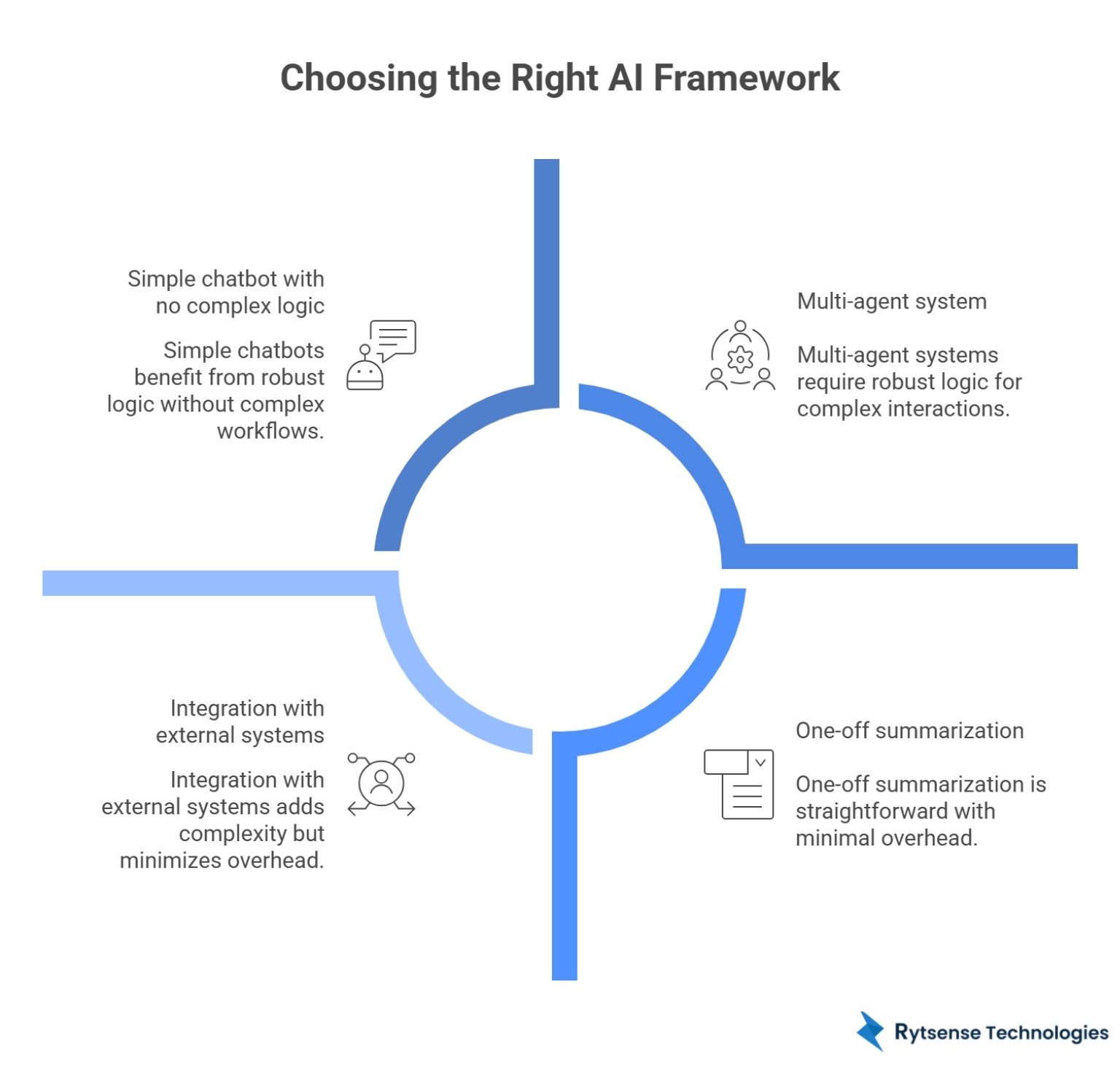
✔ When LangGraph is appropriate:
- Your AI project involves multi-step workflows, branching logic, loops, or memory/state.
- You need integration with external systems or databases, business logic, or tool-calls.
- You expect long-running tasks, human-in-the-loop decisions, retries, error-handling.
- You plan a multi-agent system with different components (e.g. data retriever, summarizer, decision agent, tool-invoker).
- You want scalable, maintainable AI software moving beyond prototype to production-grade AI system or custom AI solution.
✘ When to avoid LangGraph (simpler alternatives better):
- Your use case is simple: e.g. one-off summarization, single question → answer, or simple chatbot with no complex logic.
- You need rapid prototyping or minimal overhead – simpler frameworks (e.g. just using LLM directly or simple chain-of-LLM calls) may suffice.
- You don’t require persistent state, complex decision paths, or external integrations.
In short: if your AI project is simple – go with simplicity. If it’s complex, enterprise-grade or requires robust logic – LangGraph is likely worth the investment.
7. Best practices for building robust AI systems with LangGraph
To successfully implement LangGraph in enterprise environments – whether for AI integration, AI development services, or custom AI application development – it’s important to follow a structured approach:
-
Design the workflow first:
Before jumping into coding, visualize your process as a graph. Identify every step of the workflow – the key actions (nodes), the pathways between them (edges), branching conditions, loops, and the information each stage should carry.
-
Keep agents and components modular:
Separate responsibilities such as database access, LLM reasoning, business logic, and tool usage. This modular structure makes your system easier to manage, scale, and troubleshoot.
-
Handle memory and state with discipline:
Define exactly what needs to be stored in memory and for how long. Efficient state handling prevents performance issues and keeps context relevant.
-
Enable strong monitoring and transparency:
Track how agents behave, what decisions they make, and how data changes throughout the workflow. Clear observability ensures reliability and simplifies debugging in production environments.
-
Use AI + traditional software together:
Generative AI shouldn’t replace your existing systems – it should enhance them. Combine classical logic and APIs with AI-driven reasoning to deliver more accurate and compliant outcomes.
-
Test workflows thoroughly and iteratively:
Because branching logic and multi-agent coordination can introduce complexity, incorporate fallbacks, error-handling, and human-in-the-loop steps where needed. Continuous testing ensures the system remains robust as it evolves.
When these best practices are applied, the result is scalable, secure, and future-ready AI software that performs in the real world – not just in prototypes.
8. What the future holds: Trends in AI systems, enterprise AI, multi-agent workflows
As artificial intelligence continues to move from experimentation to full-scale deployment, demand is rising for reliable AI software development, intelligent automation, and custom AI solutions. LangGraph is well positioned to support this shift due to its ability to merge LLM intelligence with structured software engineering.
Here are the major trends shaping the future:
- Hybrid systems become standard: AI models will work alongside business logic, structured data, and external tools – powering smarter workflows in sectors like finance, healthcare, real estate, retail, and customer service.
- Multi-agent AI capabilities expand: More applications will rely on AI copilots, digital workforce automation, and knowledge assistants that can collaborate, recall context, and act intelligently.
- AI-driven automation at scale: Long-running workflows will be automated – such as regulatory checks, analytics pipelines, reporting engines, and content lifecycle management.
- Growing investment in custom AI platforms: Organizations will increasingly seek dedicated solutions through AI development services, aiming to modernize products and streamline operations.
- Greater focus on safety, governance & visibility: With AI becoming mission-critical infrastructure, observability, compliance, testing, and human oversight will become essential – areas where LangGraph already provides strong capability.
9. Conclusion
LangGraph is becoming a foundational technology for advanced AI systems – especially for companies looking to go beyond simple prompt-based tools. Its graph-based architecture supports:
- Multi-agent coordination
- Stateful memory across tasks
- Integration with real databases & APIs
- Complex branching logic for enterprise workflows
- Scalable AI software development
Whether a startup building a new AI product or a large enterprise modernizing legacy systems, LangGraph enables production-ready AI app development by blending artificial intelligence with proven software engineering practices.
Businesses often partner with experienced AI developers who understand frameworks like LangGraph and can architect custom AI solutions, integrate AI models into existing systems, streamline workflows, and deploy reliable, scalable AI applications. That’s why choosing the right AI development company matters when launching new AI projects in the USA or globally.
Today, many organizations search for the Best AI Development company in USA to help them adopt modern AI technologies, apply LangGraph in automation, and deliver future-ready AI systems that drive real revenue growth — not just prototypes.
Meet the Author

Co-Founder, Rytsense Technologies
Karthik is the Co-Founder of Rytsense Technologies, where he leads cutting-edge projects at the intersection of Data Science and Generative AI. With nearly a decade of hands-on experience in data-driven innovation, he has helped businesses unlock value from complex data through advanced analytics, machine learning, and AI-powered solutions. Currently, his focus is on building next-generation Generative AI applications that are reshaping the way enterprises operate and scale. When not architecting AI systems, Karthik explores the evolving future of technology, where creativity meets intelligence.