Key Takeaways
- AI enhances CI/CD with predictive analytics, intelligent automation, and real-time decision-making.
- It helps businesses deliver software faster and with fewer errors, improving release confidence.
- AI-driven DevOps strengthens security, automates monitoring, and ensures high application uptime.
- Integration of AI and machine learning reduces manual workload, boosting developer productivity.
- Self-optimizing pipelines improve cloud efficiency, reduce costs, and support enterprise-scale innovation.
- Companies adopting AI development services gain a competitive advantage in digital transformation.
- The future of CI/CD is autonomous DevOps, where systems heal, adapt, and optimize themselves.
How AI Can Be Used in CI/CD?
Artificial Intelligence can be used in CI/CD to automate pipeline operations, accelerate testing, improve reliability, optimize deployments, monitor performance, detect security issues, and help teams deliver high-quality software faster. With AI development services and machine learning integrated into DevOps workflows, businesses can transform traditional automation into intelligent CI/CD pipelines that learn, adapt, and evolve with every release.
This isn’t a future vision — it’s already happening. Whether you run a startup building your first AI app or a growing enterprise scaling multiple digital products, AI-powered CI/CD helps you release faster, innovate confidently, and ensure seamless customer experiences.
Let’s explore how.
1. What Is CI/CD and Why It Matters Today
Continuous Integration (CI) automates the integration of code changes into a shared repository. Continuous Delivery / Deployment (CD) ensures fast and seamless movement from tested code → production.
Key objectives:
- Reduce development delays
- Improve product quality
- Remove manual bottlenecks
- Enable rapid cloud software delivery
But traditional CI/CD has limitations:
- ⚠ Pipeline failures are detected late
- ⚠ Testing takes longer with increasing features
- ⚠ Manual oversight still needed in approvals
- ⚠ Developers spend time troubleshooting rather than innovating
This is why organizations are turning to AI and machine learning in software development to power DevOps.
2. Why AI Is a Game-Changer for CI/CD & Digital Transformation
In today’s digital-first world, businesses strive to deliver software faster, with stronger quality and zero downtime. However, traditional CI/CD pipelines are still largely rule-based and need human decisions at every critical stage. This becomes a roadblock as systems scale.
Artificial Intelligence changes this paradigm completely.
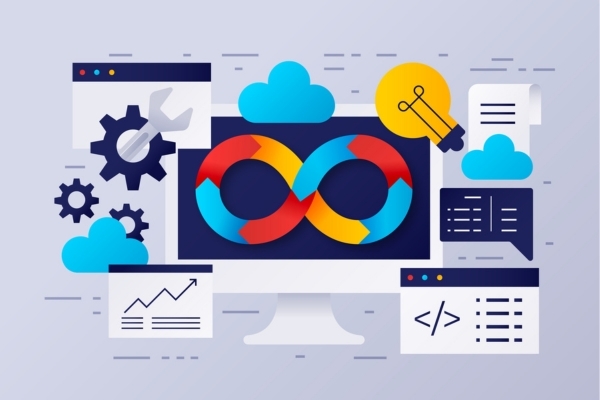
AI introduces predictive and autonomous intelligence into DevOps workflows
Instead of simply automating tasks, AI learns from pipeline behavior, identifies patterns, and intelligently predicts outcomes before they even occur. This transforms CI/CD from just an automation mechanism into a smart, self-evolving system.
Growing Business Demands & How AI Solves Them
| Modern DevOps Needs | How AI Helps (Detailed) |
|---|---|
| Automation beyond scripts | Modern cloud applications evolve rapidly. AI enables pipelines to adapt automatically to code changes, test requirements, infrastructure conditions, and user behavior. Instead of fixed automation rules, AI-powered CI/CD analyzes contextual data to make decisions — such as which tests to skip, prioritize, or auto-resolve. |
| Secure deployments | Security threats are increasing. AI-driven vulnerability scanning continuously analyzes code, dependencies, APIs, and runtime logs to detect risks early. Machine learning models detect unusual behavior or misconfigurations that humans may overlook. This ensures compliance and reduces breach possibilities. |
| Scalable cloud DevOps | As organizations expand, cloud environments become cost and performance challenges. AI automatically optimizes compute resources, autoscaling containers or clusters only when required, reducing cloud spend while maintaining performance. |
| Risk-free software updates | Deployment failures impact revenue and customer trust. AI uses predictive analytics to estimate stability of new builds, evaluate code quality trends, and warn teams before production. This enables smarter rollout strategies such as canary releases, blue-green deployments, or instant rollback recommendations. |
Direct Business Outcomes with AI-Powered Software Delivery
AI in software development services doesn’t just improve DevOps — it drives strategic business results:
- ✔ Accelerated Time-to-Market: Teams deploy new features faster, giving products a competitive edge.
- ✔ Consistent Quality Across Devices and Platforms: AI-based testing ensures compatibility with multiple OS, device types, and environments.
- ✔ Proactive Risk & Error Detection: Problems are fixed before customers see them—reducing downtime and failures.
- ✔ Enhanced Customer Experience: Stable releases, fewer bugs, and real-time optimization ensure seamless usage.
AI Doesn’t Replace Teams — It Augments Their Capabilities
There is often hesitation that AI will automate away roles — but in CI/CD:
- ❌ AI does NOT take over developers
- ✔ AI frees them from manual, repetitive troubleshooting
AI empowers:
- AI developers: Focus on model improvements & innovation
- DevOps engineers: Spend more time on strategy, less on firefighting
- QA teams: Prioritize exploratory and business-critical testing instead of routine checks
Human expertise drives decisions — AI accelerates execution.
AI Integration in Every Stage of CI/CD Pipeline
AI doesn’t just automate tasks — it understands the pipeline, predicts failures, and helps teams deploy with confidence. When integrated into CI/CD workflows, AI transforms the entire lifecycle from code commit → integration → testing → deployment → monitoring → continuous improvement.
"AI DevOps = Smart pipelines that think before they execute."
Let’s look at how AI upgrades each stage of DevOps with intelligence and data-driven decisions:
1️⃣ Code Integration
AI Capabilities:
- AI-powered code review tools (detect security vulnerabilities, performance issues, logic flaws)
- Smart merge conflict resolution using pattern learning
- Auto-suggested code improvements through generative AI
Impact:
- ✔ Cleaner code reaches the pipeline → fewer integration failures later
- ✔ Developers get instant feedback → productivity improves
- ✔ Reduced technical debt and stronger software development quality
Result: Teams commit confidently, knowing that AI secures the integrity of their codebase.
2️⃣ Build Automation
AI Capabilities:
- Predicts build success or failure based on past CI history
- Identifies steps likely to break the build and recommends fixes
- Optimizes build queue priority to minimize delays
Impact:
- ✔ Fewer unnecessary re-runs → reduced compute cost
- ✔ Stronger CI reliability → better team velocity
- ✔ Continuous integration that self-corrects
Result: Builds complete faster with fewer interruptions, enabling smoother delivery cycles.
🔹 3️⃣ Testing
AI Capabilities:
- Automated generation of test cases using machine learning
- Risk-based test prioritization: Critical tests run first, unaffected areas are skipped automatically
- Identifies flaky tests and resolves root issues
- Simulates real-user behavior to improve test coverage
Impact:
- ✔ Up to 60–90% reduction in manual testing effort
- ✔ Massive improvement in release speed and confidence
- ✔ More reliable pipelines with lower defect leakage
Result: AI testing accelerates innovation without compromising on product quality.
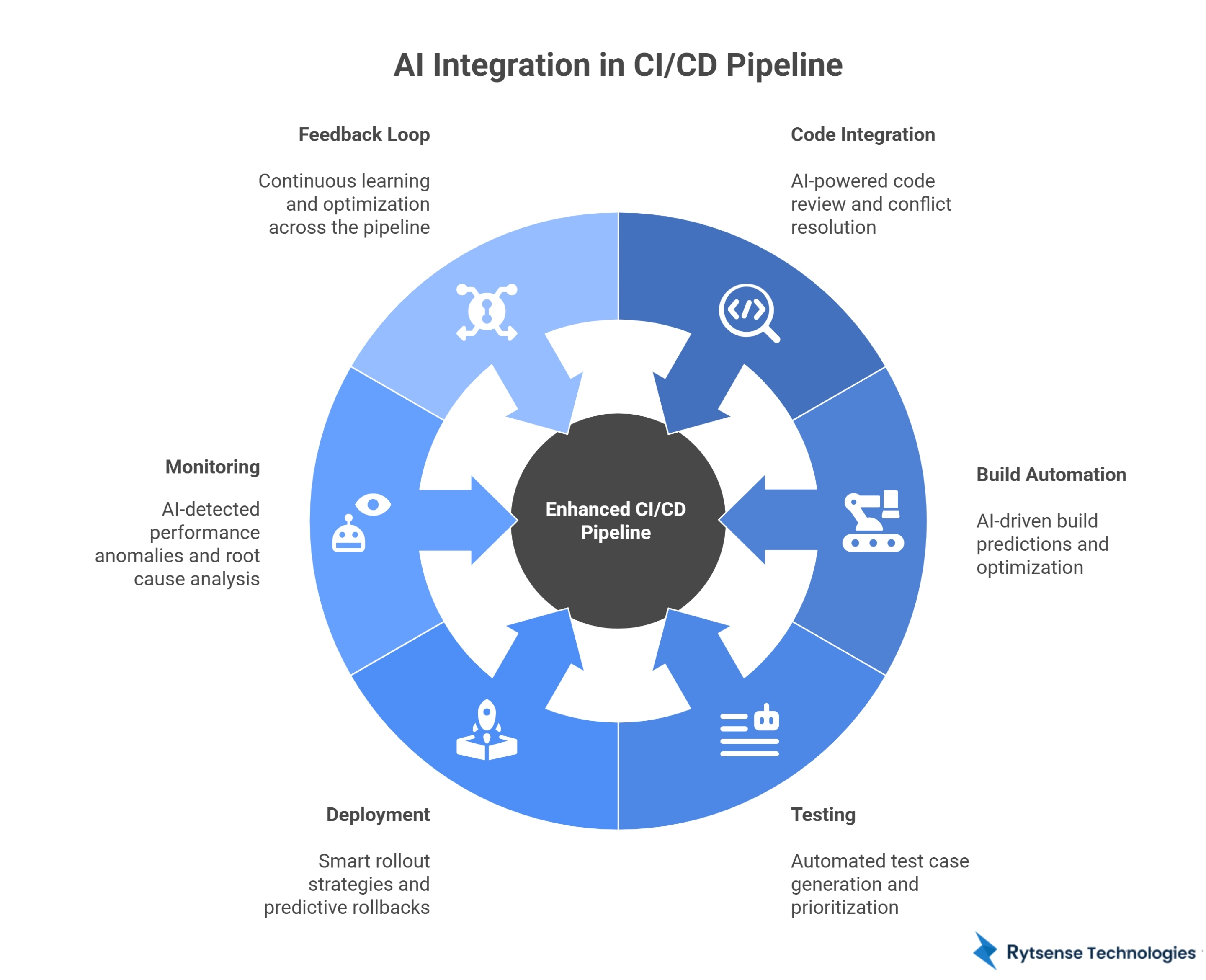
4️⃣ Deployment
AI Capabilities:
- Smart rollout strategies like canary, A/B testing, and blue-green deployments
- Predictive rollback decisions when anomalies appear
- Learns from previous deployments to improve future success
Impact:
- ✔ Zero-downtime releases → uninterrupted user experience
- ✔ Faster deployments even during peak traffic
- ✔ Reduced human decision-making pressure
Result: Deployments become safer, intelligent, and future-aware.
5️⃣ Monitoring & Production Reliability
AI Capabilities:
- Detects performance anomalies in logs, metrics & user behavior
- Performs Root Cause Analysis automatically
- Alerts teams before issues impact end-users
Impact:
- ✔ Operational incidents reduced drastically
- ✔ Faster MTTR (Mean Time To Resolution)
- ✔ High uptime ensures business continuity and customer trust
Result: The system practically watches over itself, improving reliability 24/7.
6️⃣ Continuous Feedback Loop
AI Capabilities:
- Learns from every build, test, and deployment result
- Suggests optimization opportunities across the pipeline
- Predicts demand surges and scales infrastructure automatically
Impact:
- ✔ Ongoing improvements without manual intervention
- ✔ DevOps evolves into intelligence-driven continuous delivery
- ✔ Maximizes ROI from cloud infrastructure and automation efforts
Result: The CI/CD pipeline continuously evolves — becoming smarter with usage.
AI enhances DevOps from commit → release → monitoring.
| CI/CD Stage | AI Capabilities | Impact |
|---|---|---|
| Code Integration | Intelligent code review, AI Git conflict resolution | Cleaner & secure code |
| Build Automation | Smart build predictions, fewer re-runs | Faster pipeline |
| Testing | Automatic test generation & prioritization | 60–90% faster execution |
| Deployment | Self-learning release strategies | Zero-downtime rollouts |
| Monitoring | AI-driven anomaly detection | Quick resolution of issues |
| Feedback Loop | Insights from runtime | Continuous optimization |
4. Benefits of AI in CI/CD for Startups & Enterprises
Here’s why companies leverage AI-driven software development services:
🔹 Performance Efficiency
- Automated test case selection improves execution times
- Cloud cost optimization using telemetry analysis
🔹 Predictive DevOps
- Machine learning models analyze historical logs to predict build failures
- Faster remediation with contextual recommendations
🔹 Reduced Risk of Production Failures
- AI validates deployment safety using code health scoring
- Automated rollback decisions minimize disruptions
🔹 Smarter QA & Security Coverage
- AI vulnerability detection prevents exploitation
- Fewer escape bugs → delighted users
🔹 Developer Productivity Boost
- Less repetitive pipeline debugging
- Developers focus on creativity and feature delivery
Business Outcome → More releases, fewer incidents, higher ROI
Practical AI Use Cases Across CI/CD + MLOps
AI is no longer a theoretical add-on; companies are already implementing real AI use cases to strengthen CI/CD pipelines and MLOps workflows. These intelligent enhancements make software development faster, scalable, secure, and more reliable.
Here is how AI delivers measurable value across DevOps:
| Category | Use Case | Business Value |
|---|---|---|
| Testing | Flaky test prediction | Increased confidence in production releases |
| Monitoring | AI-based anomaly alerts | Faster root cause analysis |
| Security | Threat detection inside pipelines | Compliance & ransomware protection |
| Deployment | Canary release optimization | Minimizes customer-facing errors |
| Efficiency | Log intelligence & cluster autoscaling | Lower infrastructure spending |
| Collaboration | ChatOps with NLP | Voice/text approvals & build triggers |
Generative AI is also now helping:
- Write CI/CD YAML configurations
- Auto-generate documentation
- Suggest pipeline performance upgrades
This accelerates software development, product releases, and operational governance.
AI & ML Technologies Behind Smart Pipelines
| Technology | Role in CI/CD | Example Functions |
|---|---|---|
| Machine Learning | Predict pipeline outcomes | Failure forecasting |
| Deep Learning | Anomaly detection in logs | Fraud & breach detection |
| Natural Language Processing (NLP) | AI-powered code reviews | Security pattern detection |
| Generative AI | Automated testing & deployment scripts | Faster DevOps iteration |
| Reinforcement Learning | Continuous pipeline tuning | Release dependency management |
These AI models evolve as the system scales — reflecting true adaptive software development.
AI Tools for Modern CI/CD in 2025
| Category | Tools |
|---|---|
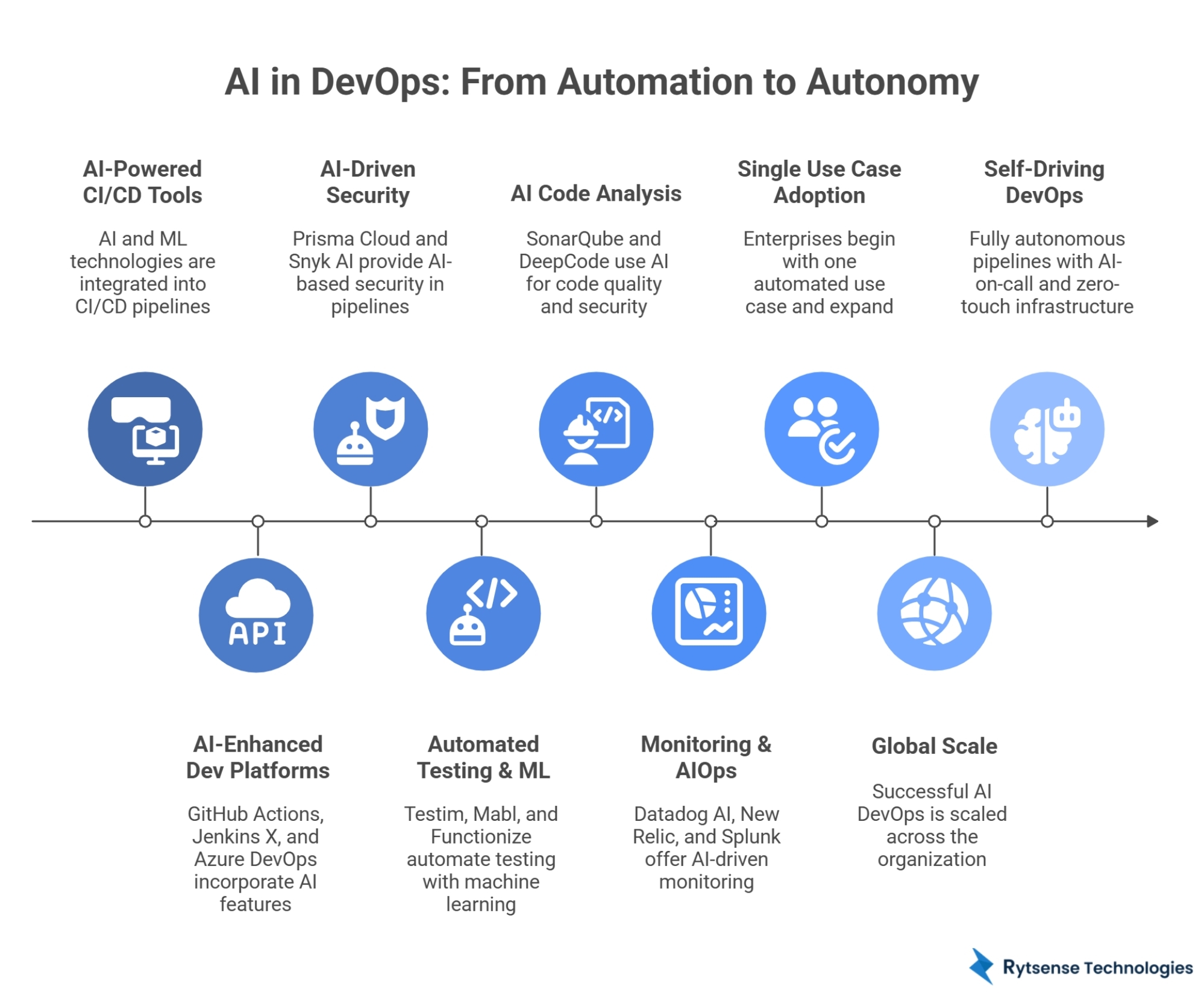
| Auto Testing & ML | Testim, Mabl, Functionize |
| AI Code Analysis | SonarQube, DeepCode |
| Monitoring & AIOps | Datadog AI, New Relic, Splunk |
| AI-enhanced Dev Platforms | GitHub Actions + Copilot, Jenkins X, Azure DevOps AI |
| Security | Prisma Cloud, Snyk AI |
Choosing the right stack requires expert AI developers who understand both engineering + automation strategy.
Business Challenges & Best Adoption Strategies
| Common Challenge | Best Practice |
|---|---|
| Hard to collect DevOps datasets | Start with pipeline logs for predictive models |
| AI system maintenance cost | Automate model retraining cycles |
| Integration effort | Use modular AI capabilities instead of full replacement |
| Skill gap inside IT teams | Partner with a reliable AI development company |
Begin with a single automated use case → expand gradually → scale globally. That’s how enterprises succeed at AI DevOps.
Future of DevOps: Fully Autonomous Pipelines
The next stage is self-driving DevOps:
- Auto-approval pipelines
- Pipelines healing themselves
- Code auto-corrected by AI
- AI-on-call instead of human on-call
- Zero-touch infrastructure provisioning
- Deployment controlled by real-time user behavior
This is AI-driven digital transformation — the ultimate competitive edge.
Why Your Business Must Adopt AI CI/CD Now
Modern enterprises are under constant pressure to innovate faster and deliver high-quality digital products with zero downtime. AI-powered CI/CD is no longer optional — it’s becoming a strategic lever that separates tech leaders from late adopters.
Here’s why forward-thinking businesses are embracing AI in DevOps today:
- ➡ Faster innovation cycles
- ➡ Predictable and reliable software releases
- ➡ Enhanced security posture
- ➡ Reduced DevOps staffing dependencies
- ➡ Improved enterprise agility
Businesses investing today will lead software markets tomorrow.
Conclusion: The Future of CI/CD Is Intelligent, Autonomous, and AI-Driven
As software delivery scales in speed and complexity, traditional CI/CD pipelines can no longer keep pace with modern business demands. AI-powered CI/CD transforms DevOps from simple automation into a predictive, intelligent, and self-optimizing system that continuously learns and evolves.
With AI and machine learning integrated into software development pipelines:
- Releases become faster, safer, and smarter
- Security risks are addressed long before deployment
- Teams eliminate manual bottlenecks and operational guesswork
- Businesses innovate with confidence and agility
Whether you are a startup aiming for quick product-market fit or an enterprise driving large-scale digital transformation, AI in CI/CD helps you deliver better software - every single time.
Companies that adopt AI-driven DevOps today will become the technology leaders of tomorrow.
Meet the Author

Co-Founder, Rytsense Technologies
Karthik is the Co-Founder of Rytsense Technologies, where he leads cutting-edge projects at the intersection of Data Science and Generative AI. With nearly a decade of hands-on experience in data-driven innovation, he has helped businesses unlock value from complex data through advanced analytics, machine learning, and AI-powered solutions. Currently, his focus is on building next-generation Generative AI applications that are reshaping the way enterprises operate and scale. When not architecting AI systems, Karthik explores the evolving future of technology, where creativity meets intelligence.