Key Takeaways
- The product of high-impact AI is achieved through engineering, as well as innovation.
- Skilled AI engineers relate models with actual operational requirements.
- Key success factors are data handling and deployment.
- Scalability involves constant monitoring and optimization.
- Sustainable actions promote trust and reliability.
The Impact of Engineering Expertise on Successful AI Products
The creation of AI-adapted products is no longer an experiment with emerging technology. In the case of large and growing organizations, it is now time to focus on creating reliable, scalable, and easy systems that can always be counted on to deliver in real world circumstances. This is where trained AI engineers become very important.
Numerous AI projects cannot be successful because the conception is not strong, but the implementation is not technical and the work knowledge. The way out of this gap is an experienced engineer that will develop a system that will strike a balance between performance, reliability and long-term maintainability. Rytsense Technologies focuses on structured AI development that aligns with business workflows rather than isolated experimentation.
In other product lifecycle phases, staff begin with AI-driven chatbot creation services to support the urgent contact or automation grants, establishing the foundation of wider AI usage.
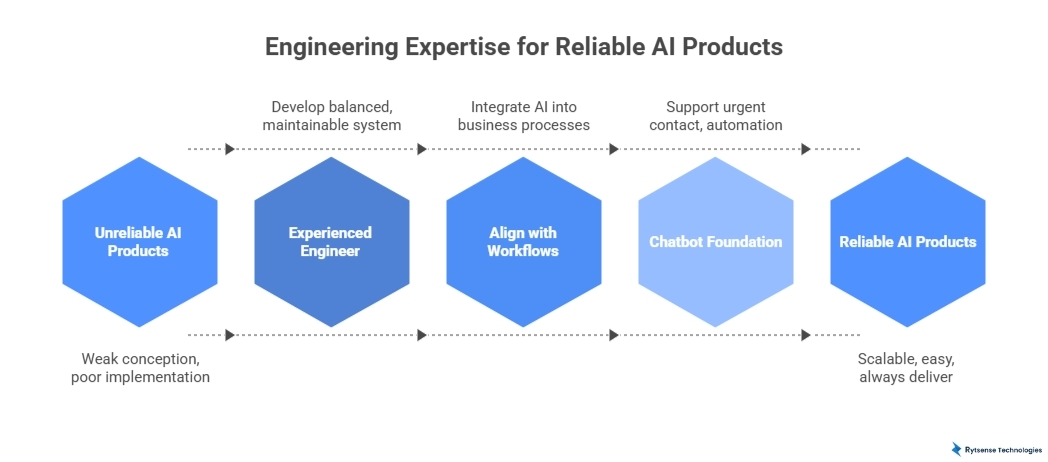
The Process of creating reliable AI Products by Skilled AI engineers
Skilled AI engineers aid in developing high-impact products by creating resilient models and operating data pipelines, as well as deploying AI systems that operate in a reliable manner at scale and support real business goals.
What High-Impact AI Engineering Really Involves
High-impact AI products are not defined by complexity. They are characterized by utility, reliability, and flexibility. The knowledgeable AI engineers know that the success of intelligent systems and processes is determined by the effectiveness of the intelligence integration into the existing systems.
AI engineering is not just about code writing. It involves the choice of the right model architectures, responsible preparation of data, validation of the output, and making sure that the systems can be used as the conditions evolve. Infrastructure constraints, integration requirements and user expectations are also considered by engineers.
Instead of substituting the team, such systems facilitate the process of making decisions, by structuring information, identifying patterns, and lowering the friction of operations. Good engineers make sure that intelligence will streamline the processes rather than cause confusion or technical debt.
The Reason Data Complexity Requires Experienced AI Engineering
Companies produce huge volumes of data in the context of customer relationship management, business processes, financial services, and technology infrastructure. This data is not easy to manage and even harder to make effective to work without the appropriate structure.
A good number of businesses continue to use isolated instruments and policies. Such restrictions make decision-making slow and prone to mistakes. When designed in a proper way, AI-powered products can allow organizations to deal with complexity, rather than contribute to it.
Skilled AI engineers are also instrumental in ensuring that this is made achievable by constructing a system that ties data sources together, ensures data consistency and produces insights that are trustworthy by the teams.
Key functions of Expert AI Engineers
The AI engineering professionals will present a combination of analytical thinking, software discipline and awareness of operation. Their duties are usually:
- Developing models with compromised accuracy and efficiency.
- Training data preparation and validation.
- Establishing pipelines of flow of data.
- Implementing models into practice.
- Checking performance and reliability in the long run.
Such activities demand cross-departmental coordination, particularly where AI systems affect more than one business process.
The Role of Intelligent Systems in End-to-End Product Delivery
Intense AI products are manifested in different product and service delivery phases.
- Product Design and Testing: Estimating the usage of features, Determining possible performance bottlenecks.
- Operations: Repetitive workflow automation, Real-time behavior of monitoring systems.
- Customer-Facing Applications: Arranging the data of interaction, Helping to handle responses faster.
- Infrastructure and IT: Proactive system Maintenance, Resource optimization.
Many of these initiatives evolve with the support of custom machine learning development services, particularly when products must adapt to new data sources or expand user bases.
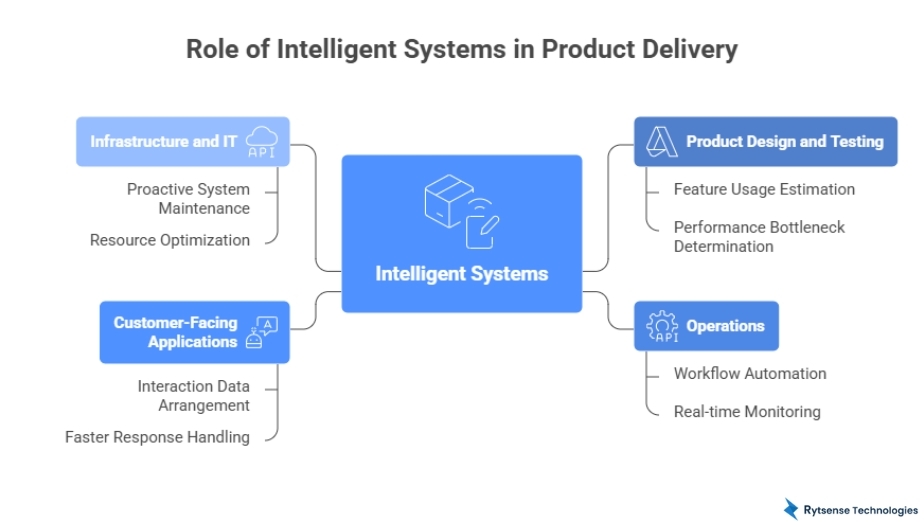
AI Engineering Design to Scale
| Development Area | Contribution of AI Engineers | Practical Impact |
|---|---|---|
| Data Preparation | Cleaning and validation | More reliable model outputs |
| Model Development | Architecture selection | Balanced accuracy and performance |
| Fielding System | System integration | Stable real-world usage |
| Deployment | Drift and error detection | Early detection of issues |
| Scaling | Optimization and retraining | Consistent growth support |
Skilled AI Engineering Value in Business
Organizations gain advantages when AI products are developed through the discipline of engineering:
- Less overheads in operation.
- Earlier actionable insights.
- Better inter-team consistency.
- Improved technology and strategy fit.
These are the results based on long-term thinking and not on short-term experimentation.
Difficulties in the Constructions of AI-Driven Products
Although it has some advantages, development of AI products encounters the following challenges:
- Partial or skewed data.
- Having trouble in explaining automated decisions.
- Performance issues at scale.
- Integration of legacy systems.
Skilled engineers foresee these difficulties in advance and create systems which are able to evolve without necessitating immediate re-engineering.
The Future of AI-Driven Products and Long-Term Scalability
With the increased adoption of AI in business processes, isolated use cases are losing favor and instead, long-term scalability is taking shape. High impact products need to change with the fluctuating data sources, user expectations as well as regulatory environments.
Experienced AI engineers plan for this evolution from the beginning. They design systems that support retraining, modular updates, and infrastructure flexibility. This allows products to adapt without requiring full redesigns every time conditions change.
In the future, AI-based products will emphasize more on explainability, real-time flexibility, and integration more deeply with decision-making processes. The performance of systems will be balanced more towards transparency and governance by engineers ensuring that their systems are understandable and trustworthy as they expand.
Companies investing in scalable engineering today are in a better position to manage all future complexity preserving control, reliability and clarity in their AI projects.
Responsibility, Governance, and Ethics
Sustainable impact requires responsible AI engineering. This includes:
- Effective data governance policies.
- Protective management of confidential data.
- Periodical accuracy and bias checking.
- Clearly defined decision makings.
Such practices enable organizations to remain trustful and scale AI capabilities in a responsible manner.
Conclusion
Building high-impact products with AI requires more than advanced algorithms. It demands experienced engineers who understand data, systems, and business realities. When intelligence is designed with care, it becomes a reliable asset rather than a fragile experiment.
Organizations that prioritize structured AI engineering, like Rytsense Technologies, demonstrate how thoughtful implementation can support sustainable growth without sacrificing clarity or control.
Meet the Author

Co-Founder, Rytsense Technologies
Karthik is the Co-Founder of Rytsense Technologies, where he leads cutting-edge projects at the intersection of Data Science and Generative AI. With nearly a decade of hands-on experience in data-driven innovation, he has helped businesses unlock value from complex data through advanced analytics, machine learning, and AI-powered solutions. Currently, his focus is on building next-generation Generative AI applications that are reshaping the way enterprises operate and scale. When not architecting AI systems, Karthik explores the evolving future of technology, where creativity meets intelligence.