Key Takeaways
Voice is moving from a “nice-to-have” feature to a daily business tool.
Better speech recognition and language understanding have improved reliability.
Voice helps speed up tasks, support hands-free work, and improve accessibility.
Businesses are using voice to cut delays, reduce costs, and improve service.
Voice works best when it connects smoothly with existing systems.
Why Voice Interfaces Are Becoming Core Business Infrastructure
Voice technology is no longer limited to smart speakers or basic phone menus. Many businesses now use voice tools to handle real work, like answering common questions, routing requests, and helping employees complete tasks faster. As the tech improves, voice is becoming something companies build around, not something they add at the end. Rytsense Technologies supports businesses that want to use modern AI solutions in real workflows, including voice-driven systems that fit into existing operations.
In industries such as AI in insurance, voice tools are being used to speed up customer support, handle routine questions, and guide users through basic steps without long wait times. This shift is happening because voice systems are getting more accurate, more consistent, and easier to integrate across business platforms.
What Changed So Voice Became Business-Ready?
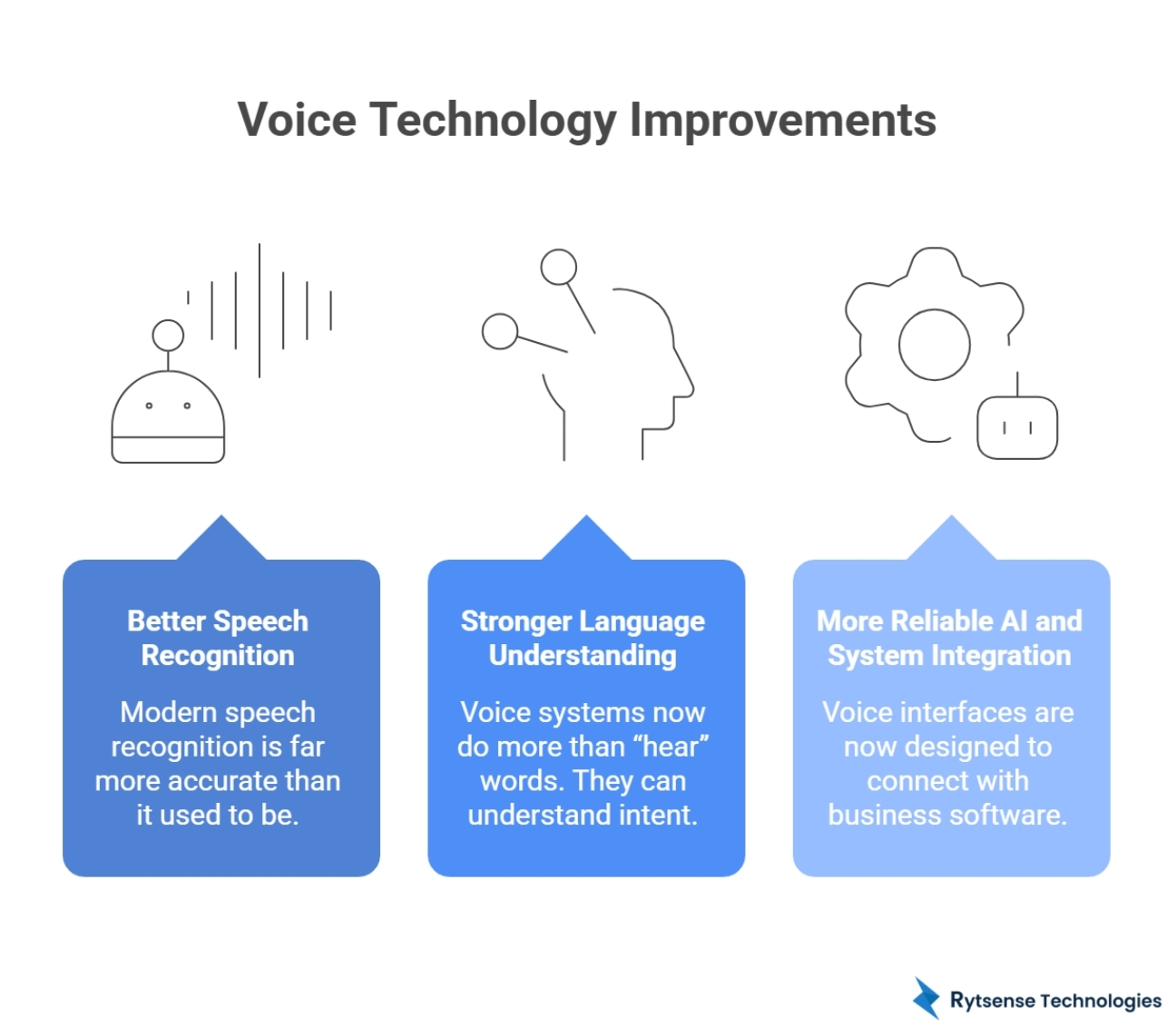
A few years ago, voice tools often struggled with accents, background noise, and complex requests. They could handle simple commands, but they broke down in real business scenarios. That has changed because the underlying technology has improved in three key ways.
1. Better speech recognition
Modern speech recognition is far more accurate than it used to be. It can pick up words in noisy environments, handle different speaking styles, and recognize common workplace terms.
2. Stronger language understanding
Voice systems now do more than “hear” words. They can understand intent. That means they can respond based on what a person is trying to do, not just the exact phrase they used.
3. More reliable AI and system integration
Enterprises need systems that work consistently, not tools that only work in perfect conditions. Voice interfaces are now designed to connect with business software, follow workflows, and handle handoffs when a request needs a human.
Why Are Businesses Pushing for Faster & Easier Interactions?
A big reason voice is becoming core infrastructure is speed. People want quick answers and quick actions. No one wants to wait on hold, search through menus, or fill out long forms for simple tasks.
Voice helps in areas like:
- Customer support, where faster routing reduces wait time
- Operations, where employees can log updates quickly
- Field work, where hands-free tasks reduce friction
- Internal help desks, where common requests can be handled instantly
When voice is used well, it reduces small delays that add up across the workday. It also helps reduce workload on teams that spend hours handling repeat requests.
How Do Voice Interfaces Support Hands-Free Work and Accessibility?
Voice technology is also growing because it supports people in real situations where typing is not ideal.
Hands-free workflows matter in:
- Warehouses and logistics
- Healthcare environments
- Field service and repair work
- Busy front desks and service counters
Voice also improves accessibility. For many users, voice is easier than typing, reading small screens, or navigating complex apps. This can help customers and employees who need a simpler way to interact with systems.
Businesses often see voice as a practical tool here because it makes systems easier to use for more people, without requiring major workflow changes.
Where Are Voice Interfaces Making the Biggest Business Impact?
Voice tools are being used in real business scenarios, not just for demos. Many companies now treat voice as a serious part of how work gets done.
Common use cases include:
- Call routing and customer service triage
- Appointment scheduling and reminders
- Policy or account information requests
- Internal task logging and ticket creation
- Guided troubleshooting and basic support
Some of the strongest results show up when voice tools reduce repeat work. If a business can handle routine questions through voice, teams have more time for complex cases that require human judgment.
This is also where companies often bring in a generative AI consulting company to help design voice systems that fit real workflows, not just surface-level automation.

Voice Interfaces vs Traditional Channels
Voice is not replacing every channel. It is becoming the fastest option for certain tasks, especially when speed and simplicity matter.
| Business Need | Traditional Channel | Voice Interface |
|---|---|---|
| Quick questions | Chat or email | Instant voice response |
| Hands-free tasks | Not practical | Works while moving |
| Accessibility support | Mixed results | Often easier for users |
| High-volume requests | Adds pressure on staff | Handles routine load |
| Workflow updates | Manual entry | Fast voice logging |
The main advantage is not that the voice is “better” than everything else. The advantage is that voice removes steps for tasks that should not take long.
What Does It Take to Integrate Voice into Enterprise Systems?
For voice to work as infrastructure, it must connect with the systems businesses already use. A voice interface that lives on its own does not solve much.
Successful voice systems usually have:
- Secure identity and access controls
- Clear escalation to humans when needed
- Integration with CRMs, ticketing, or databases
- Strong testing for real-world speech patterns
- Clear reporting so teams can measure results
This is where enterprises get real value. When voice is connected to workflows and data, it becomes part of daily operations, not a side feature.
What If Your Team Could Handle 3x More Requests — Without Adding Staff?
Voice AI makes it possible. We've helped businesses reduce support load by 80% using AI-driven voice systems built for real enterprise workflows.
Conclusion
Voice interfaces are becoming core business infrastructure because they make work faster, easier, and more accessible. Better speech recognition and stronger language understanding have made voice reliable enough for real enterprise use. Businesses are adopting voice to reduce delays, support hands-free tasks, improve service experiences, and connect people to systems with fewer steps.
When voice is integrated properly, it also improves productivity and lowers operational costs over time. Organizations working with Rytsense Technologies are increasingly treating voice as a foundational layer for digital-first operations that need to move quickly and scale smoothly.
Meet the Author

Co-Founder, Rytsense Technologies
Karthik is the Co-Founder of Rytsense Technologies, where he leads cutting-edge projects at the intersection of Data Science and Generative AI. With nearly a decade of hands-on experience in data-driven innovation, he has helped businesses unlock value from complex data through advanced analytics, machine learning, and AI-powered solutions. Currently, his focus is on building next-generation Generative AI applications that are reshaping the way enterprises operate and scale. When not architecting AI systems, Karthik explores the evolving future of technology, where creativity meets intelligence.