Key Takeaways
- Custom-built AI solutions are designed around specific business goals, not generic use cases.
- Custom AI systems offer better performance, flexibility, and scalability than off-the-shelf platforms.
- Custom AI also gives businesses more control of data, integrations, and long-term optimization.
- Custom AI can provide greater value in the long term, although its short-term costs can be increased.
- Basic needs can be handled by generic platforms, whereas complex, changing needs require custom AI.
- Purpose-built systems are easier to manage in terms of ethical use, transparency, and governance.
Understanding Custom-Built AI Solutions and Their Importance
Custom-built AI solutions are artificial intelligence systems designed specifically for an organization's workflows, data, and objectives. When compared to generic platforms, which incorporate methods to cover large audiences, custom AI is designed to address clear-cut issues with accuracy.
This is a crucial strategy since most businesses have their own processes, customer behaviors, and compliance requirements. These realities cannot be absorbed in a general AI tool and often restrict its usefulness.
How Do Custom AI Solutions Differ from Generic AI Platforms?
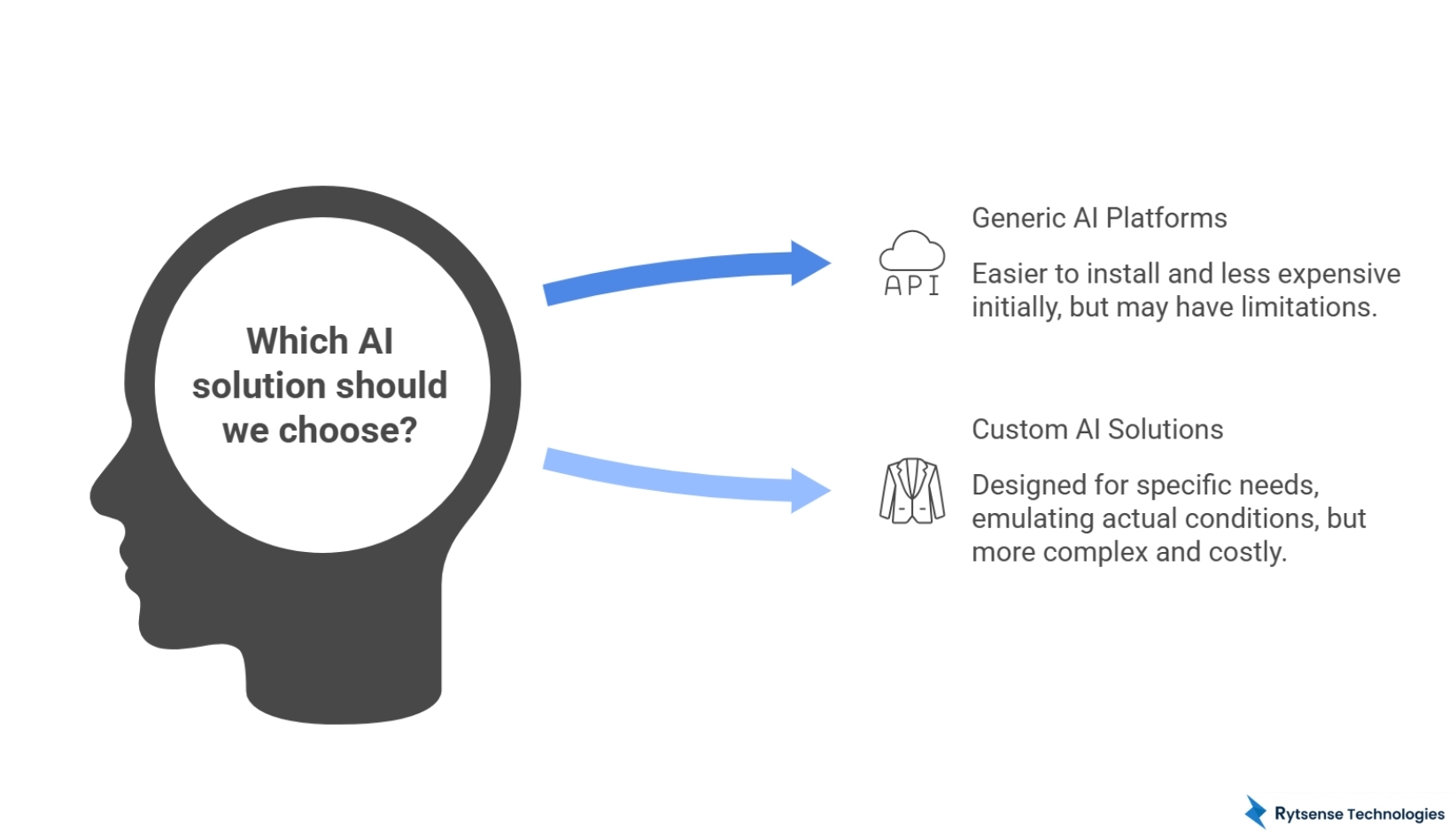
Generic AI platforms consist of ready-to-use models and standard features that are applicable to numerous industries. They are easier to install and tend to be less expensive initially, though at the expense of limitations.
Individually designed AI solutions are created based on individual data, systems, and performance objectives of a company. This enables the AI to emulate actual operating conditions rather than the assumed averages. Many technology teams at Rytsense Technologies focus on the alignment between AI design and business logic, which is the deciding factor in long-term success.
How Organizations Are Actually Adopting AI Today
Most organizations implement off-shelf AI platforms because they feel that they will save time and money. Although this may be true at an initial level, constraints usually emerge as the usage increases.
There are also common myths, such as:
- Generic AI is able to adjust to any workflow.
- Custom AI is never fast to develop.
- Off-the-shelf platforms scale just as effectively.
In reality, as data volumes increase and use cases become more complex, businesses often outgrow generic tools. This is why decision-makers now evaluate AI as a long-term capability rather than a quick add-on.
Difference Between Custom AI and Generic Platforms
The difference can be reduced to control and relevance. Generic platforms offer convenience, while custom-built AI offers precision.
A generic AI system is similar to a shared workspace on rent. It works, but it is not customized to the way you work. An industry-specific AI system is comparable to creating your own office. Each of the parts contributes to the way your team functions, develops, and functions.
This transparency enables both technical and non-technical stakeholders to comprehend why customized systems tend to be superior compared to standardized systems.
Important Features that make Custom AI More efficient
1. Data Alignment
The custom AI models are trained using business-specific data. This enhances accuracy, relevance, and quality of prediction.
2. System Integration
Bespoke solutions are intertwined with the existing solutions like CRM, ERP, and internal dashboards. This saves time on friction and manual labour.
3. Model Flexibility
Personalized AI can be modified with a change in business requirements. Platforms are not limited to adding new features, data sources, or rules.
4. Performance Optimization
The system is designed to be purpose-built, so performance tuning is based on real workloads rather than generalized benchmarks.
In industries that rely on visual data, organizations often explore custom computer vision software development services to ensure models match real-world environments rather than generic image datasets.
Business advantages of custom-built AI systems
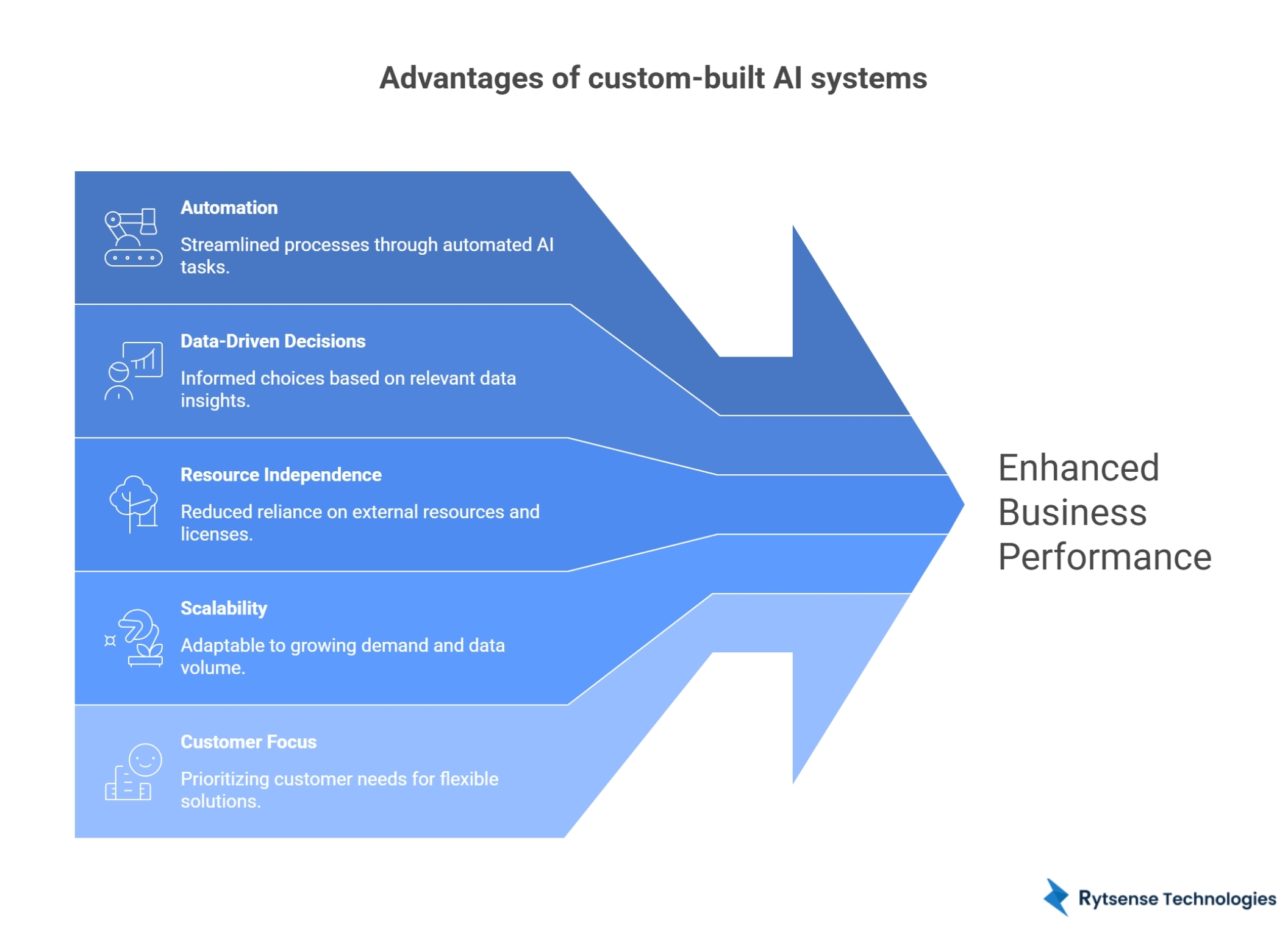
Custom AI influences business results directly in a variety of ways:
- Increased automation in line with real-life operational activities.
- Better decision making based on insights that are made using relevant data.
- Less dependence on external resources in the long-term and limited licensing restrictions.
- Scales better with increase in demand, users or volume of data.
Custom AI also enables companies to focus on what customers value the most, be it speed, accuracy, compliance, or user experience, and it is that, which makes custom AI flexible.
Reasons Why Custom AI is a Business Requirement
Competitive gaps can be developed by using generic tools as the trends in markets are becoming increasingly data-driven. Companies with customized AI can adapt to changes more promptly, personalize their services, and optimize their operations in real-time.
A failure to take this change into consideration can result into:
- Slower innovation cycles.
- Limited differentiation.
- Increased long-term workaround and inefficiency costs.
This urgency explains why many organizations now consider enterprise AI development services when building AI strategies that support long-term growth rather than short-term experimentation.
Finding a Balance between Human Expertise and AI Capabilities
AI can be used with large datasets, pattern recognition, and decision scaling. Humans are good when it comes to making judgments, creativity and ethical reasoning.
In-house developed AI assists in supporting this balance by:
- Improving human decision-making rather than avoiding it.
- Allowing teams to create rules, benchmarks and control systems.
- Prefer to have coordination between the business and the technical team.
The strategy will build trust and transform AI into a supporting system instead of a black box.
Why Custom AI Enables More Responsibility
Organizations can incorporate ethical guidelines in the design of systems with custom AI solutions. This includes:
- Clear data usage policies.
- Transparent decision logic.
- Bias monitoring and mitigation.
- Compliance with the industry and regional regulations.
As the system is internally owned and controlled, accountability is better than third party platforms, which are black boxes.
Industry-Specific Applications of Custom AI
| Industry | Custom AI Application | Outcome |
|---|---|---|
| Healthcare | Predictive diagnostics models | Improved accuracy and early detection |
| Manufacturing | Visual quality inspection | Reduced defects and waste |
| Finance | Risk assessment engines | Better fraud detection |
| Retail | Demand forecasting | Optimized inventory levels |
| Logistics | Route optimization | Lower fuel and delivery costs |
These examples demonstrate how customized systems are directly converted into quantifiable outcomes.
How Businesses at Different Stages Should Adopt Custom AI
1. Startups
Start with focused apps that deliver quick value. Build systems that are scalable.
2. Small and Medium Businesses
Focus on the integration with old tools and scaling. Find solutions to high-impact problems first.
3. Enterprises
Design long-term AI strategies. Invest in governance, data infrastructure and cross team collaboration.
It is a tactic that ensures that AI investments remain aligned with business maturity and business goals.
Challenges and Limitations to Consider
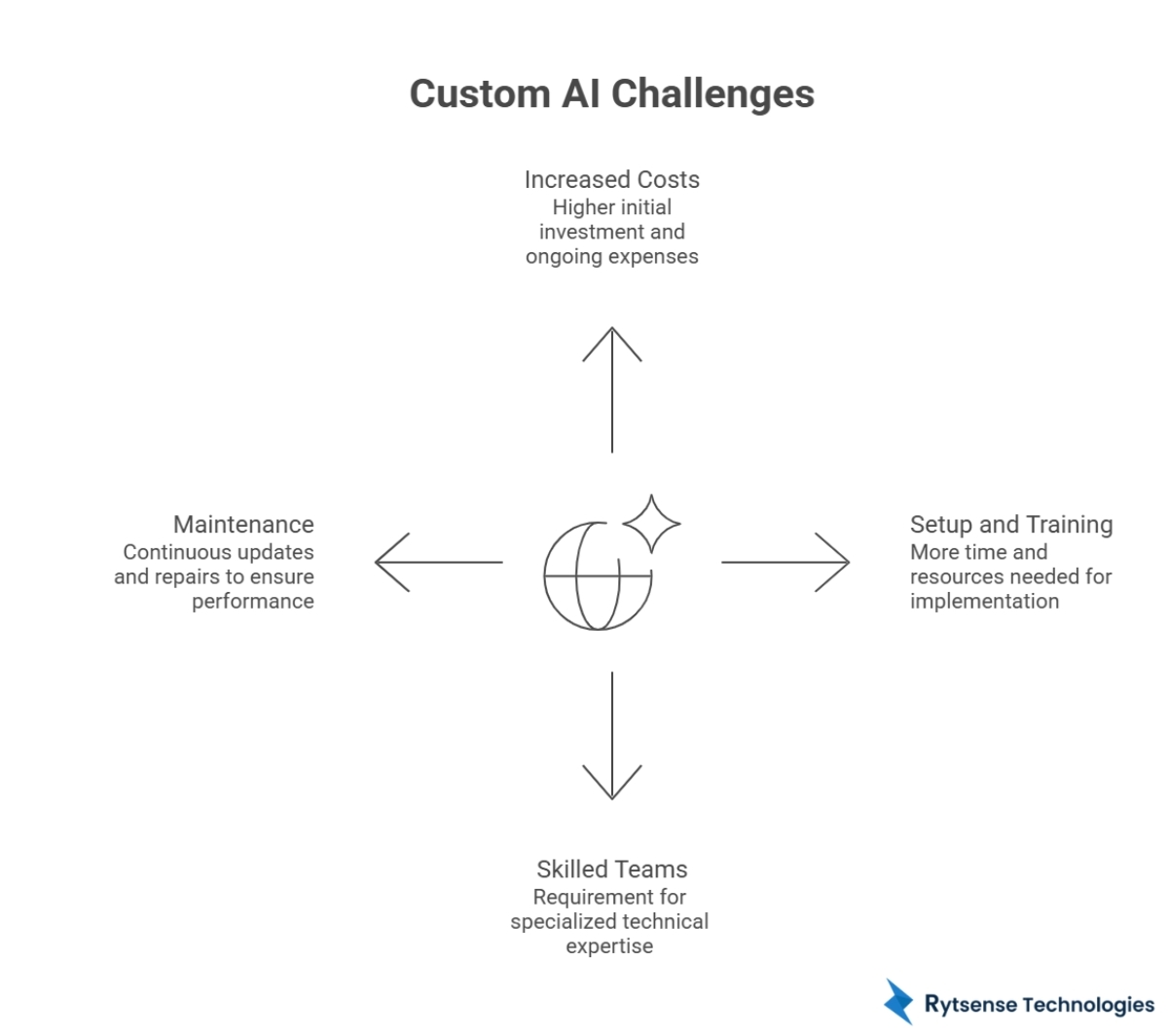
Custom AI does not come without difficulties:
- Increased start-up expenses.
- Greater set up and training.
- Skilled technical teams required.
- Constant repairs and updating of models.
However, by knowing such constraints upfront, organizations can be realistic in their planning and can avoid certain pitfalls.
The Future of Custom AI Solutions
The future is more personalised, adaptive and explainable AI systems. With the changing regulations and the rising complexity of data, businesses will heavily depend on solutions that can be fully managed.
Both organizations that regard AI as a long-lasting asset will probably build custom-built AI as a matter of standard.
Conclusion
Custom-built AI solutions outperform generic platforms because they align directly with how businesses operate, grow, and compete. Custom systems provide long-term value that is often not available with standardized tools by concentrating on flexibility, scalability and performance.
Organizations that take a simple, strategic approach to AI development are better positioned to adapt to change and maintain control over their data and outcomes.
Rytsense Technologies often highlights that successful AI adoption is less about technology only and more about how well it fits real business needs. When designed with clarity and responsibility, custom AI becomes a lasting advantage rather than a short-term experiment.
Meet the Author

Co-Founder, Rytsense Technologies
Karthik is the Co-Founder of Rytsense Technologies, where he leads cutting-edge projects at the intersection of Data Science and Generative AI. With nearly a decade of hands-on experience in data-driven innovation, he has helped businesses unlock value from complex data through advanced analytics, machine learning, and AI-powered solutions. Currently, his focus is on building next-generation Generative AI applications that are reshaping the way enterprises operate and scale. When not architecting AI systems, Karthik explores the evolving future of technology, where creativity meets intelligence.