Key Takeaways
Conversational AI enables businesses to analyze customer data and respond faster.
It helps identify patterns across conversations, behaviour, and intent.
Organizations use it to support marketing, operations, finance, and service teams.
Conversational AI improves consistency without removing human oversight.
Responsible design provides accuracy, trust and value in the long term.
Adoption involves precise objectives, quality data, and continuous improvement.
Understanding Conversational AI at Its Core
Building conversational AI means creating systems that understand human language, analyze data patterns, and provide accurate, context-aware responses that improve how businesses interact with customers across digital channels. Rytsense Technologies focus on practical AI systems that support real business workflows rather than surface-level automation.
What Makes Conversational AI Different From Traditional Automation
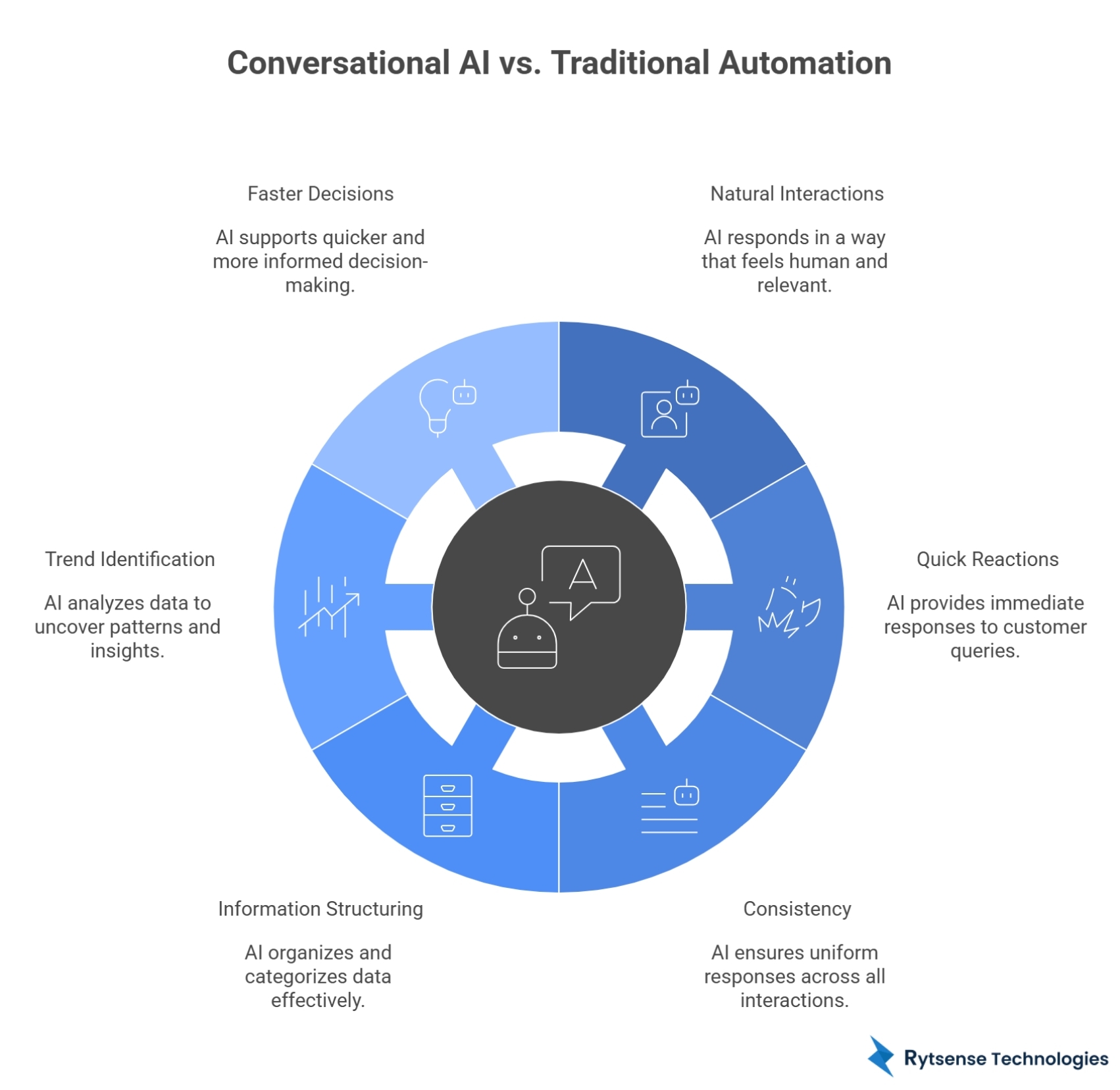
Conversational AI uses artificial intelligence to interpret text or voice inputs and respond in a way that feels natural and relevant. Why Conversational AI is Important to Businesses.
The customers are after quick reactions and consistency. At the same time, businesses are responding to growing numbers of queries on the web, apps, and chat software.
Several organizations continue to stick with manual processes that are slow in responding and generate discrepancies. Conversational AI can resolve these issues as it helps to structure the information, find tendencies, and make faster decisions without putting extra pressure on the work.
Introduction to Conversational AI
The conversational artificial intelligence requires several technologies to interact with one another:
- Natural language processing word and intent recognition.
- Variables in order to determine data trends.
- Analytics of performance and behaviour tracking.
- Automatic interactions to be made.
Such systems are designed to benefit individuals and not to replace them. Human control is needed on complex decision making and relationship building.
Fundamental Elements of Conversational AI
- Natural Language Understanding: This is what allows a system to interpret customer queries regardless of how they are phrased.
- Data Analysis and Pattern Recognition: Helps identify recurring problems, likes, and trends in discussions.
- Integration with Business Systems: Connects conversational AI with CRMs, analyticals, and internal systems.
- Continuous Learning: Improves accuracy over time as more data is processed, often supported by machine learning development services that focus on refining models and decision logic.
Integrating Conversational AI and Existing Workflow
The integration of conversational AI into the existing business processes ensures that the insights will be made use of without disrupting the operations. It is possible to connect AI systems to CRMs, analytics platforms, and client support solutions, and in this way, businesses are able to simplify their processes and make sure that they offer uniform experiences at every touchpoint. Integration often includes:
- Introducing AI checks in accordance with company policies
- Diverting complicated requests to human departments effectively.
- Linking data reporting and analytics.
Proper integration promotes efficiency, reduced redundancy of effort and decision making which is based on data.
Business Solutions of Conversational AI
The conversational AI provides value that can be measured within departments. Key benefits include:
- Reduce staff without raising the response time.
- Regular cross channel communication.
- More effective utilization of customer interaction information.
- Better decision-making involving actual patterns.
| Business Area | Practical Outcome |
|---|---|
| Marketing | Improved lead qualification and intelligence. |
| Operations | Lower focus on manual workload. |
| Finance | More rapid access to transaction data. |
| Customer Experience | Timely and regular response. |
Market Reality and Urgency
Conversational AI is no longer an experimental option, but a common feature. Those businesses that take too long to adopt face the risk of having slow response times, data fragmentation, and decreased customer satisfaction.
Customer expectations are the root cause of this change and not technology trends.
Striking the right balance between AI and Human Teams
Conversation AI is good at organization and repetition. Humans excel at judgment, empathy, and complex problem-solving.
The most effective systems combine both. AI handles the processes that are heavy in data and individuals concentrate on decision making processes that demand context and interpretation.
Conversational AI and Ethics and Responsibility
Conversational AI responsible design comprises:
- Openness regarding automated interaction.
- Safe customer data management.
- Clearly defined upwards relationships to human teams.
- Constant accuracy and bias control.
These are some practices that ensure trust and compliance.
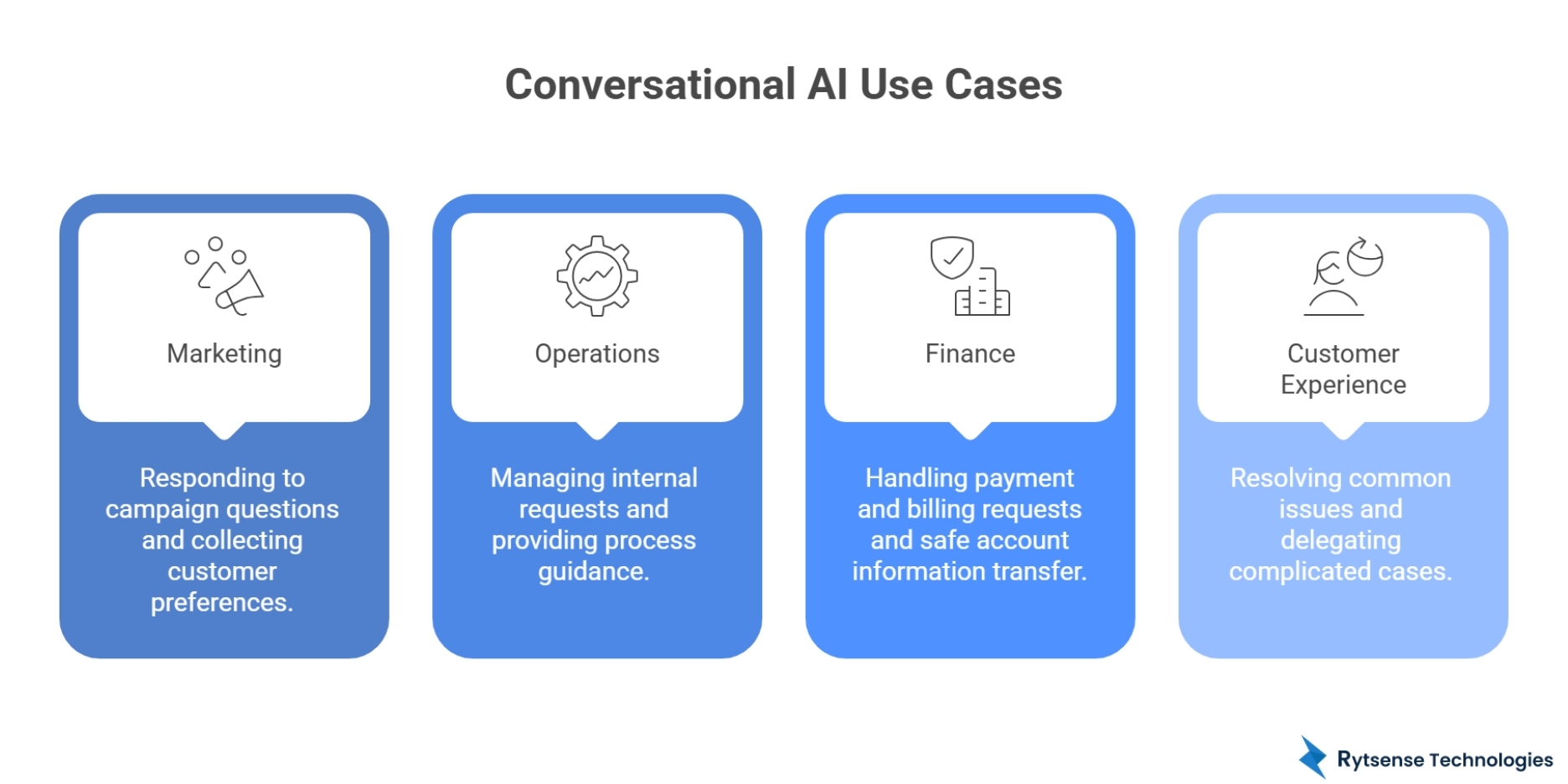
The use of Conversational AI in businesses in various industries
Marketing
- Responding to campaign-based questions.
- Collecting customer preferences.
Operations
- Managing internal requests
- Providing process guidance
Finance
- Paying and billing requests.
- Safe transfer of account information.
Customer Experience
- Resolving common issues
- Delegation of complicated cases.
Many of these use cases are implemented alongside AI Chatbot Development Services that focus on structured, business-aligned interactions.
Application Strategy by Business Type
- Startups: Focus on application and rapid response.
- Small and Mid-Sized Businesses: Introduce conversational AI to the existing tools in order to increase productivity.
- Business units: Departmental expansion in governance, analytics, and compliance systems.
Best Practices of Conversational AI Deployment
The effective development of conversational AI is an implemented process and continuous observation. Best practices include:
- Have specific objectives: Be goal-oriented and goal-focused on objectives and clear business problems.
- Focus on quality data: Train data should be clean, relevant and regularly updated.
- Implement human control: Implement human intervention where there are complex decisions and escalations.
- Repeat: Optimize models based on user feedback and trends.
- Pay attention to transparency: Be transparent to users and be ethical.
Challenges and Limitations
Common challenges include:
- Poor data quality
- Unclear objectives
- Integration complexity
- Over-reliance on automation
Handling these early enhances future success.
Future Outlook
The conversational AI is developing into more personalization and voice interaction and analytics. The systems that will be developed in the future will be more oriented to context and purpose in addition to reacting to keywords.
Conclusion
Building conversational AI that enhances customer experiences requires simple design, reliable data, and ongoing collaboration between technology and people. When done responsibly, it assists businesses to analyze data, spot patterns and make decisions that are more accurate and quicker to come up with across functions.
Companies like Rytsense Technologies focus on practical, business-oriented AI solutions that foster long-term growth without making unrealistic promises about automation.
Meet the Author

Co-Founder, Rytsense Technologies
Karthik is the Co-Founder of Rytsense Technologies, where he leads cutting-edge projects at the intersection of Data Science and Generative AI. With nearly a decade of hands-on experience in data-driven innovation, he has helped businesses unlock value from complex data through advanced analytics, machine learning, and AI-powered solutions. Currently, his focus is on building next-generation Generative AI applications that are reshaping the way enterprises operate and scale. When not architecting AI systems, Karthik explores the evolving future of technology, where creativity meets intelligence.