-
Key Takeaways
- AI/ ML Development needs expertise across entire lifecycle from problem identification and data preprocessing to model deployment and ongoing maintenance.
- Modern AI/ML solutions offer competitive advantages through automation, personalized experiences, and enhanced data insights.
- Project costs are determined by data quality requirements, ongoing maintenance needs, scope complexity and technology stack selection.
- The future of AI development completely focuses on emerging trends.
Choosing the Right AI ML Development Company for Your Business Needs
The digital environment of 2025 will create unique opportunities for businesses to utilize artificial intelligence (AI) and machine learning (ML) technologies. Finding the right ai ml development company is essential for companies looking to use AI technologies to create real business value, promote growth and enhance their ability to work efficiently. This guide will highlight the aspects that are pivotal in creating successful AI/ML partnerships and implementation options.
Why AI/ML Development Company Matters in 2025?
In the increasingly connected digital world, AI and machine learning technologies have transcended their experimental beginnings and business infrastructure. An AI development company today creates complex algorithms that harness enormous amounts of information to automate. Apart from this, it makes it simple to gain meaningful insights from unstructured data sources.
Organizations in every industry are investing in a wide variety of AI/ML development company capabilities in order to maintain, and sometimes enhance, their competitive positioning. With neural networks, deep learning architecture, and predictive analytics models, businesses can more precisely allocate resources, tailor customer experiences, and identify the most rewarding opportunities in emerging markets.
With these incredibly beneficial AI models in tow, we must address the integration of these models into an organization's existing workflow. Organizations will need specific skill embedded in algorithm design, data engineering, and component architecture - all of which a devoted ai ml development company will manage on behalf of its clients. Companies may also have access to the most innovative AI solutions, including Natural Language Processing (NLP), computer vision, reinforcement learning and more.
Growing Demand for AI/ML Solutions Across Industries
Market studies show massive demand across all sectors for AI/ML use cases.
- 1.Healthcare is increasingly leaning on AI systems to automate diagnostics or predictive insights for patient recovery outcomes.
- 2.Financial services firms are implementing machine learning solutions to detect fraud, assess risk, and implement algorithmic trading solutions across a growing list of financial services areas.
- 3.Manufacturers are investigating computer vision systems for quality control, adding predictive maintenance algorithms to optimize equipment performance, and leveraging supply chain intelligence platforms.
- 4.Retailers are using recommendation engines, demand forecasting models, and customer behavior analytics to enhance shopping experiences and product placements.
The increasing use of IoT environments combined with edge computing and cloud native implementations, creates a lot of new data streams. Every stream will require machine learning software to process for future learning and utilities in organizational business strategy. Organizations will require bespoke machine learning development services for processing and digitalizing the data they have to acquire meaningful business value.
What Does An AI/ML Development Company Do?
AI/ML development firms act as specialized technology partners that convert business challenges into intelligent solutions. These companies utilize data science knowledge, advanced algorithms, and engineering capabilities to provide a complete set of services in AI/ML through the entire project lifecycle.
Overview of AI and ML Development Solutions
A recognized ai ml development company has capabilities across the AI/ML lifecycle—from problem definition to production and continuous maintenance. Their teams of data scientists, AI researchers, and machine learning engineers are trained in statistical modeling, neural networks, distributed computing, and advanced programming.
AI development services offered include data preprocessing, feature engineering, model architecture design, hyperparameter tuning, and evaluation. Companies can implement MLOps practices to smoothly move AI models from development to production with a professional ai ml development company.
Key Services Offered by an AI/ML Development Company
| Service Category | Description | Technologies Used |
|---|---|---|
| Custom AI Software Development | Tailored AI applications and platforms | TensorFlow, PyTorch, Keras |
| Machine Learning Model Development | Algorithm design and optimization | Scikit-learn, XGBoost, LightGBM |
| Data Engineering and Pipeline Development | Data processing and workflow automation | Apache Spark, Kafka, Airflow |
| Computer Vision Solutions | Image and video analysis systems | OpenCV, YOLO, ResNet |
| Natural Language Processing | Text analysis and language understanding | BERT, GPT, spaCy |
| AI Model Deployment and Integration | Production deployment and system integration | Docker, Kubernetes, AWS SageMaker |
Advanced AI development companies have competencies across multiple domains such as computer vision, natural language processing, audio & speech recognition, and predictive analytics. Development teams incorporate sophisticated libraries and frameworks into their ecosystems to build scalable solutions that meet complex computational needs at high-velocity streams of incoming data.
Professional AI Development Services involve consulting, proof of concept, fully implemented, and ongoing support for AI application. Companies enhance their services through their competency with cloud-native architecture options, containerization, and microservices design patterns for AI workloads.
Also Read:
Top AI Development CompaniesKey Benefits of AI and ML Development Solutions
Modern AI/ML solutions are changing the way businesses operate by automating complex processes, deriving key insights from data, and providing customized customer experiences. The capabilities of AI/ML deliver measurable improvements in efficiency, cost savings, decision-making accuracy, and competitive positioning across all industries.

Automation of Repetitive Tasks
Systems built with AI are automation systems designed to reduce manual processes by intelligent orchestration of tasks and algorithms to facilitate the decision making process. Many advanced robotic process automation (RPA) systems include machine learning capabilities, offering the opportunity for companies to dynamically evolve the system as business changes and handle exceptions as they arise.
Organizations can build intelligent document processing systems where unstructured data sourcing is turned into structured data extraction, to automated customer service with intelligent chatbots using natural language understanding, and predictive scheduling that optimizes resources for high volume and complexity.
Enhanced Data-Driven Insights
Machine learning algorithms are excellent at recognizing patterns in complex datasets that can surpass human analytical skills. Advanced statistical modeling capabilities such as ensemble methods, gradient boosting, and deep neural networks are available. It allows more knowledge to be extracted from historical data as well as real time information sources with support from a reliable ai ml development company.
Predictive analytics models have the ability to predict market trends, determine types of customer behaviors, and assess operational outcomes at remarkable high levels of accuracy. Anomaly detection algorithms are valuable for recognizing unusual patterns that can suggest potential risks and/or opportunities and/or unwanted system failures that require immediate notice.
Personalized User Experiences
AI song recommendation systems can examine user behavior, preferences, and contextual information to provide individual users a highly individualized experience across all digital touchpoints. A collaborative filtering algorithm can discover user-based summary statistics, a content-based filtering algorithm can summarize single use patterns through similar products, and hybrid possibility can capture both experiences in the form of stage-based user profiling algorithms.
Similarly, personalized engagement engines can adjust its content and product/screen recommendations in real-time based on engagement actions. Advanced segmentation algorithms now work to identify micro-audiences with specific characteristics and preferences. Later, it can target marketing campaigns and provide user-centered service through collaboration with a professional ai ml development company.
Cost and Time Efficiency
Automated machine learning (AutoML) platforms enable more rapid model development cycles through the automation of process and comparisons. Comparisons related to the Number of Candidates in a listed group as well as hyperparameter tuning of models. The shared result is a developer's time-saving to as little as weeks instead of months and acceptable performance for a model.
Cloud-based AI systems offer elastic computing resources, scaling automatically with workload demands and helping to optimize technology costs. By employing pretrained models and leveraging transfer learning techniques, organizations can lessen training times and computing costs for specialized domains with the help of an ai ml development company. .
Competitive Advantage in Multiple Industries
Organizations that successfully implement artificial intelligence (AI) and Machine Learning (ML) model outcomes receive real benefits through enhanced operational efficiencies, tactical decision efficacy, and product and market innovation. Advanced analytics-driven capabilities not only increase the ability for organizations to detect patterns, but also allow those organizations to build out strategy and market response proactively.
Ready to unlock the true potential of AI and ML for your business?
Let our experts design solutions tailored to your needs.
Components of AI/ML Development Solutions
Successful AI/ML adoption in practice will occur using a structured six-phase methodology including problem definition, data engineering, model definition, training optimization, production deployment, and maintenance. Each phase of the work has unique elements that will require specific expertise and coordination to result in a repeatable and reliable solution, maintain scalability and growth, and align with the business.
Problem Identification & Requirement Analysis
The first component is a complete business-driven analysis, to determine unique use cases where AI/ML technologies can offer measurable value. Data scientists work both internally with subject matter experts to establish how to define success, operational effectiveness, technical constraints as well as performance requirements that can and ultimately will influence the solution architecture.
Requirements analysis will address data availability, computational resource dependencies, and complexities involved with integrating into existing system. The teams will establish if there is enough existing capability in some area of the organization to support data quality standards and collectively embrace new organizational thinking about AI adoption.
Data Collection & Preprocessing
Data engineering teams build strong data collection pipelines which naturally will include diverse data sources and methods of collection e.g. pivot table from multiple databases, api calls into external data provider, streaming feeds from applications. There will be complex ETL (Extract, Transform, Load) data processing obligations to ensure that the data used is prepared for proper quality, consistency and usability.
Preprocessing involves data cleansing, feature selection, normalization, and augmentation techniques. Missing data, outliers, and inconsistencies that may affect the models are assessed and adjusted within the frame of statistical techniques. Validation frameworks provide development lifecycles and confirm the data quality continuously during the process.
Model Selection and Development
Choosing the algorithms involves considering plural strategies such as supervised, unsupervised, and reinforcement learning. Using cross-validation, statistical significance, and set business guidelines, data scientists evaluate the algorithms’ performance metrics.Collaboration with an ai ml development company ensures alignment with best practices and efficient model selection.
Thorough testing procedures determine models’ performance with independent datasets, k-fold cross-validation, and time-series validation techniques. Statistical evaluation of the models determine their generalization capabilities and delves into possible overfitting or underfitting situations.
Model Training & Testing
Production deployment comprises strategies using containerization. They are related with docker and kubernetes, for orchestration of scalable serve pipelines. Developing APIs allows for their integration with other active business and external partner applications,managed efficiently by a professional ai ml development company
Model development utilizes advanced frameworks including TensorFlow, PyTorch, and specialized libraries for specific applications. Architecture design considers factors including computational efficiency, interpretability requirements, and scalability constraints.
Deployment and Integration
Production deployment involves containerization strategies using Docker and Kubernetes orchestration for scalable model serving. API development enables seamless integration with existing business applications and third-party systems.
MLOps practices support automated testing continuous integration, and deployment pipelines that sustain and uphold model quality and production reliability. Observability systems continuously monitor model performance, data drift, and system reliability metrics in real time.
Monitoring & Maintenance
Work such as maintenance and monitoring consists of continuous performance monitoring, model retraining intervals, and adaptable optimization plans. Our observability systems can monitor for data distribution changes, deteriorating performance, and potential vulnerabilities in security.
Automated retraining pipelines modify existing models with the addition of new data by utilizing standardized performance objects. Version control systems track the iterations of models, and they provide the capability to rollback upgrades or variations modifications if so desired.
Tools and Technologies Used in AI/ML Development
AI/ML development makes use of advanced programming languages, frameworks, cloud-based platforms and specialized tools to deliver robust intelligent systems. The technology stack for AI and ML may include Python, TensorFlow, Cloud service providers like AWS, data orchestration tools, and data visualization tools to quickly and efficently develop working products.
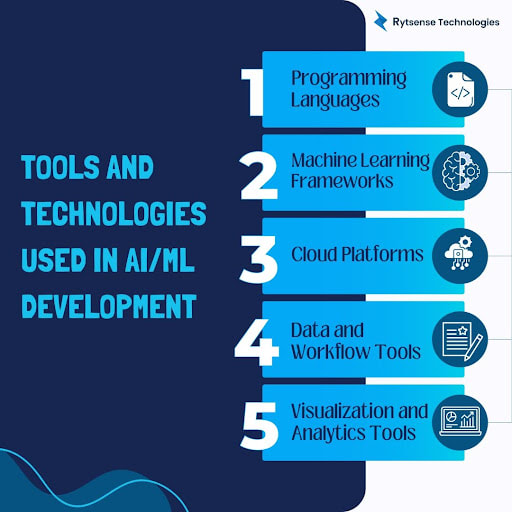
Programming Languages
| Language | Primary Use Cases | Key Advantages |
|---|---|---|
| Python | General AI/ML development | Extensive library ecosystem |
| R | Statistical analysis and data science | Advanced statistical capabilities |
| Java | Enterprise AI applications | Platform independence and scalability |
| Scala | Big data processing with Spark | Functional programming paradigms |
| Julia | High-performance computing | Optimized numerical computation |
Machine Learning Frameworks
Professional hire AI developers utilize extensive frameworks designed to squeeze hours out of the overall development pipeline ensuring production ready implementations. TensorFlow offers extremely extensive deep learning implementations, as well as distributed computing capabilities. PyTorch serves perfectly for research and experimentation with its dynamic computation graphs.
Specialized frameworks exist such as Hugging Face Transformers for NLP applications, OpenCV for computer vision, and Ray a distributed machine learning framework, that allows clients to optimize work based on domain-specific methodology.
Cloud Platforms
Cloud platforms offer computer power on demand, in a scalable structure, usually as managed services, and even offer niche tools. For example, Amazon Web Services has SageMaker that is useful for developing and deploying models. Google Cloud Platform has Vertex AI for end-to-end workflows for machine learning workflows.
Microsoft Azure Machine Learning provides a full suite of MLOps capabilities and enterprise integration requirements. Multi-cloud strategies help maintain vendor independence and to take advantage of resources from a cost-effective basis only when needed.
Data and Workflow Tools
Data orchestration tools such as Apache Airflow, Kubeflow, and Prefect can help manage complex ML workflows, populations, and dependencies. Similarly, data versioning (like DVC (Data Version Control)) can help track changes in datasets and iterations on models.
Feature stores (like Feast and Tecton) manage features and enable easier feature service into production ML systems or AI development company.
Visualization and Analytics Tools
Visualization platforms help users explore datasets, explain models, or communicate model results. These tools include Tableau, Power BI, or custom dashboards (typically developed in Plotly or D3.js) for interactive visualizations.
Model Explainability tools (like LIME, SHAP, and custom interpretability systems) typically help to provide transparency and adherence to audit and regulatory standards,applied by expert teams in a professional ai ml development company.
Facing hurdles in AI/ML implementation?
Our team helps businesses overcome data, scalability, and integration challenges with proven solutions.
Benefits of Hiring AI/ML Engineers
Professional AI engineers accelerate development, bring specialized knowledge, and implement scalable solutions. Partnering with an experienced ai ml development company ensures access to:
- Specialized expertise in algorithms, statistical modeling, and neural networks.
- Faster development using reusable libraries and automated pipelines.
- Latest tools, frameworks, and industry best practices.
- Scalable solutions aligned to business needs.
Specialized Expertise
When organizations hire AI engineers whose career focus is AI, it means that the hiring organization will have access to specific informal expertise in advanced mathematical domains, statistical modeling, and algorithms designed for optimization. True AI engineers have a working theoretical understanding of selected machine learning disciplines, different neural networks architectures as well as their variants and what optimization to the hyper-parameters may become the best solution for performance in a specific dataset.
Experienced engineers usually have experience in a subset of selected domains; for instance, an engineer can have built experience in discrete areas such as computer vision, natural language processing, or reinforcement learning. This can usually build deep understandings of the real details of the different algorithms and at least indicate which algorithms may be preferred based upon a specific business need.
Faster and Efficient Development
Experienced and professional AI engineers will speed up the development cycle from the start. They do this by employing best practices, reusable code libraries, and automated development tools. They will combine pre-trained models with frameworks that already tailored for their needs, to reduce time and keep the company's standards.
Efficient development practices take form of automated testing, new code continuously integrated into the just as fast, and ultimately deployment pipelines that allow you iterate application developing before user, like you, will use it.
Access to Latest Tools and Frameworks
Everyone knows how fast framework, tools, and technologies will evolve. For example, AI engineers have already “used” or are “currently using” tools, and algorithms that may not become available to internal AI teams for weeks or months down the road. They are experienced with the latest and greatest for their work product.
Professional AI engineers are experienced in maintaining consensus or expertise across a cube or multiple technology stacks. They can confidently make recommendations towards the best choice based on specific project requirements and constraints.
Scalable Solutions Tailored to Business Needs
Most AI engineers with extensive experience come up with solutions that consider scale, sustainability for end users, and aligning to the business's needs. AI engineers with extensive experience know the basics surrounding enterprise notions such as security, compliance needs and integration that have impacts toward their architecture.
Custom AI software development can be developed for teams that are faced with unique business problem but still allows to see an evolving product as the organization iterates its struggling to what to do solution.
How to Choose the Right AI/ML Development Company
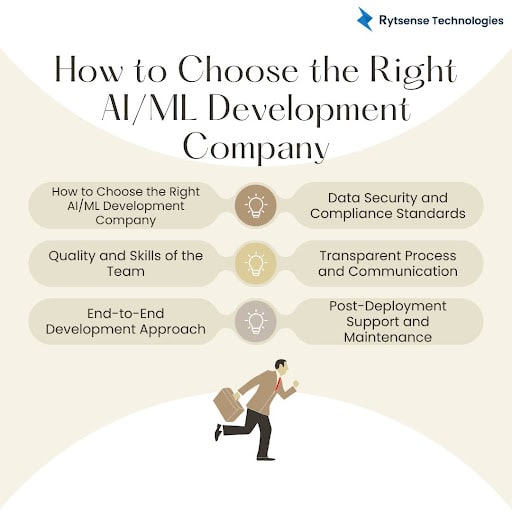
Choosing a suitable AI/ML development partner means you will want to consider technical competence, domain knowledge, team capabilities, development approach, security posture, and scalability and maintenance capabilities. The best development partner will have proven experience, collaborative interests, and openness about their capabilities and offerings.
Proven Experience and Domain Expertise
When evaluating the potential partner for your project, try to evaluate them based on their background and experience in similar projects and industry domains. Review case studies, client references and successful implementations to assess the partner's level of domain expertise and use.
Domain expertise is important to gain an understanding of the business context, regulatory requirements for the domain, and industry-specific challenges that will contribute to the design and implementation of your solution.
Quality and Skills of the Team
You will want to assess the qualifications, certifications and experiences of the development team's members. Review their background in regards to relevant technologies, educational credentials, and previous implementations, where applicable.
Technical interviews and proof-of-concept projects will allow you to gain insight into their capabilities and approaches of problem solving.
End-to-End Development Approach
Choose companies that are willing to provide end-to-end services, which would encompass the entire development process, from initial consultation to maintenance.
Utilizing end-to-end capabilities will help to ensure the quality is consistent and the project runs seamlessly through every stage of the development process.
When integrated services are provided, you will not have to deal with the overhead of coordinating and communicating with multiple vendors.
Data Security and Compliance Standards
The right partner should showcase their security frameworks, compliance certifications, and data protections practices prior to start. Each development project will not have the same regulatory requirements; you should ensure your partners compliance requirements align with the applicable regulations (GDPR, HIPAA, etc.) and any industry-specific standards.
Lastly, your partner should provide you with their processes of handling sensitive data, access controls, encryption protocols, and assess the auditing capabilities.
Transparent Process and Communication
Review of communication methods, project management practice, and reporting process flows. Transparent procedures create stakeholder alignment, and enable effective monitoring and controlling of the project.
Frequent updates progress, review of milestones, and collaborative plan sessions will help keep the project progressing, and maintain quality levels.
Post-Deployment Support and Maintenance
Review of the ongoing support abilities including monitoring service, maintenance processes and upgrades. Long-term relationship requires a cross-functional support infrastructure and the ability to deal with issues promptly.
Service Level Agreements should clearly define response times, build-in escalation procedures for issues and state responsibilities of the maintenance work.
Read also:
ROI of Generative AIChallenges in AI/ML Development (and How Companies Overcome Them)
AI/ML development requires a multidimensional approach as a result of the complex problems around technical and business challenges such as quality problems with data, issues with optimizing models, integrating systems, interpretability of models, and scalability problems. Reputable and professional development companies can address these situations using technical methods, tools, and frameworks.
Data Quality and Availability
Data quality issues such as missing values, inconsistencies, or bias will considerably affect model performance. The best organizations put data quality procedures and frameworks in place to assess and validate data quality.
Organizations who need to address availability issues of data can use transformation techniques, synthetic data generators or supplemental sources of data. But all these techniques require proper assurance of data quality.
Complex Model Training and Tuning
Model tuning involves any alteration of tuning parameters, which means endless rounds of experimenting with hyper parameters, architectures, and training methods. Automated ML platforms and optimization frameworks will reduce the time when tuning models.
Distributed computing architectures for your training process or using cloud-based training platforms will provide required computational resources for complex models.
Integration with Existing Systems
When integrating new systems with legacy systems, organizations need to consider the challenges associated with API design, data formats, and the testing process for compatibility. Professional organizations implement integration strategies to minimize disruption to the ongoing operations of the organizational environment.
Microservices architectures and containerization strategies provide organizations with flexible mechanisms for integration that enable their systems to evolve.
Interpretability and Transparency
Requirements for model interpretability range from various application domains and associated regulatory considerations. Organizations may employ industry-standard explainable AI techniques and established model interpretation frameworks that allow for transparency.
Documentation standards and model governance practices facilitate visibility and growth of audit trails that may be required in observance of regulatory requirements.
Scalability and Long-Term Maintenance
Scalable architectures have many requirements that organizations must plan ahead. It includes computational resources, data storage, and monitoring capabilities. Professional organizations plan solutions that enable growth and meet changing estimates of requirements for operational works.
Including MLOps practices to institutionalize regular sustainable maintenance practices and automated capabilities for updates enable organizations to assure their system performance requirements over time.
What Determines the Cost of AI/ML Development Solutions?
Key factors include: project scope, data complexity, technology stack, customization, and maintenance. Partnering with a reliable ai ml development company ensures accurate budgeting and resource allocation.
The cost of an ML project is dependent on various aspects such as complexity of scope, preprocessing of data, choosing technology stack, the amount of customization required, and extent of maintenance. Understanding these factors can assist organizations in understanding these cost drivers for better budgeting and assessment of investments into development.
Project Scope and Requirements
Project complexity must also be considered in terms of the associated impacts to cost and increase in development time, resources, and testing. Therefore, project cost estimates must also focus upon the complete requirements analysis process.
Scope management processes and practices must assure the cost is maintained to the necessary level of quality to meet stakeholder expectations.
Data Complexity
The dependencies incurred by the data preprocessing requirements, data quality issues and complexity associated with data integration, can also have significant impacts on costs incurred by the organizations. Organizations can plan for the accurate costing of a project by assessing the data readiness and data quality.
Advanced data engineering requirements, including real-time processing, multi-source integration, and quality validity increases the complexity and costs of data projects, which can impact balance sheets.
Tools and Technology Stack
Technology selection will affect licensing, and thus costs, time for development and even infrastructure requirements that could change total project spend. Development healthcare companies make recommendations on cost-effective technology stacks that perform.
Cloud platform costs, software licenses and service fees provided by third parties also contribute to costs.
Customization and Integration Needs
More custom AI software development requirements, the more time that project will take to deliver (in), and/or (ii) test for proper integration (and validate). Adaptable standard solutions and/or the counterparts’ existing frameworks will diminish the cost of development while creating a quality, business requirements driven object.
Ongoing Maintenance and Support
Costs of ongoing Maintenance & Support cover the long-term cost of maintenance and service, subsuming the areas of monitoring, model updates, and system enhancements (or carry out development fixes, etc). Professional healthcare organizations downplay the costs of ongoing support, and provide transparency around pricing in all aspects of ongoing support, either short or long-term.
Generally, service level agreements will outline the nature of maintenance, services available, responsibilities or obligations of both parties to each other, and, typically cost structure related obligations of both parties.
Trends Shaping AI/ML Development in 2025 and Beyond
AutoML, low-code/no-code platforms, and open-source frameworks expand access to AI & ML development services, while maintaining professional standards.
New connectivity trends may reshape development strategies. Professional organizations remain aware of technological advances and emerging opportunities.
AutoML, along with low-code/no-code development forms, will deliver a larger demographic to the world of AI, while continuing to hold on to the professional standards most countries expect and demand.
How AI/ML Companies Are Adapting
Best AI Development Company in USA businesses can adapt to evolving market demands by constantly developing the skills of their people, learning and deploying new technologies and operating services in different ways. Many companies are pouring money into research and development to stay ahead of their competitors.
Companies are leveraging partnerships across the industry, including public interest projects managing research with their academic collaborators fund and support public interventions in AI and ML. They also leverage better technologies that are open source (and also open access), which allows them to help with pushing the direction of technology and gaining access to solutions that are innovative.
Also Read:
Enterprise AI Chatbot Development CostHow Rytsense Technologies Can Support Your Business
Rytsense Technologies is a full-stack company that provides AI Agent Development Services and custom AI software development solutions in line with your business needs. Rytsense has experienced AI engineers and Data Scientists that deliver end-to-end services, from consultation design and Specification Document, or MLOps deployment, followed by maintenance and ultimate support.
Rytsense Technologies designs and customizes advanced machine learning algorithms, and deep learning architectures for "production ready" and business scalable AI systems. They really understand the meaning of 'Production-ready' and (gravity) scalability and can support your different domains such as Computer Vision, Natural Language Processing, Predictive Analytics etc.
Rytsense Technologies adheres to industry standard best practice in MLOps, data security, integrated systems to deliver consistently reliable and scalable solutions providing measurable value to your business. Open development, trusted and collaborative partnerships to deliver outcome-based projects and support, within risk/effectiveness framework, (are essential).
Final Thoughts
When it comes to selecting an ai ml development company, you need to consider a lot, such as technical skill level, industry experience, and ongoing support potential. Companies that engage professional AI/ML development services can gain a considerable competitive edge through improved operational efficiencies, better decision making skills, and even new solutions for offering to customers.
The landscape of AI/ML development company is rapidly changing and requires niche specialization and adaptability to changing technologies and best practices. A professional development company brings knowledge, resources, and experience to overcome these challenges, and produce measurable business improvements.
Successful implementation of AI/ML depends on choosing partners that understand technical requirements, as well as business outcomes. The right development company can help your organization accomplish all the required technical capabilities, while also bringing industry expertise and an agile partner approach, which can improve project success and sustain future value creation.
Take the next step in your AI/ML journey with Rytsense Technologies
From consultation to deployment, we deliver measurable results that fuel growth.
Meet the Author

Karthikeyan
Connect on LinkedInCo-Founder, Rytsense Technologies
Karthik is the Co-Founder of Rytsense Technologies, where he leads cutting-edge projects at the intersection of Data Science and Generative AI. With nearly a decade of hands-on experience in data-driven innovation, he has helped businesses unlock value from complex data through advanced analytics, machine learning, and AI-powered solutions. Currently, his focus is on building next-generation Generative AI applications that are reshaping the way enterprises operate and scale. When not architecting AI systems, Karthik explores the evolving future of technology, where creativity meets intelligence.