-
Key Takeaways
- Begin with APIs like pre trained models from OpenAI, Google and Anthropic and not with custom models.
- Define clear use cases and gather user feedback quickly to ensure you're building something people need and want to use.
- Plan for content filters, robust testing, and user feedback systems since AI outputs can be inconsistent.
- AI API costs may escalate quickly with usage, so implement caching, cost monitoring and usage limits.
- Be honest about AI limitations, plan proper error handling, and maintain data privacy.
Building generative AI-powered apps: A hands-on guide for developers
Generative AI-powered apps are smart computer programs that can generate new content on their own. Building generative AI-powered apps utilize a type of advanced computer brain called AI models to generate text, images, music, or videos when told to do so in a few easy steps. Think of them as smart assistants that can write you stories, draw you pictures, or compose songs for you whenever you ask them.
Generative AI-powered apps generate content by learning patterns from millions of examples. Let’s say you want an app that can write poems. You would first provide it with thousands of poems. The AI will learn how poems are organized, how they are structured and what words go together, so when someone (or something) requests a new poem about cats, it has a template to follow.
Building generative AI-powered apps is about building software that uses advanced AI models to help users create new content. Apps using generative AI powers are becoming really popular because they save time and allow for greater creativity.
Why Generative AI Matters for Developers
Generative AI for developers opens up fantastic new possibilities. Instead of building apps that store and display existing information, Developers can now build apps that generate something brand new - it is like having a creative partner that can never be exhausted and work 24 hours.
It is like having a creative collaborator who works 24 hours a day and will never get tired.
For businesses, these applications might write marketing content, generate product descriptions, create code snippets, or even provide graphics automatically, which can create value by saving time and money. For users; these applications remove barriers to create professional content even when users are lacking tangible capability.
Developers who learn to build applications that deploy these solutions will be in demand. Organizations around the world are seeking people who can blend traditional programming with AI specialization. This is valuable knowledge to learn.
Don’t know how to start with building generative AI-powered apps?
Ensure secure, scalable, and future-proof development with the right approach.
Getting Started with Building Generative AI-Powered Apps
Understanding basic ideas and choosing the right tools are the first steps in developing AI-powered applications. This fundamental understanding aids developers in navigating the intricate world of AI technologies, frameworks, and APIs.
You can create successful generative AI applications and make well-informed decisions about your development approach by mastering these fundamentals.
Key Concepts Behind Generative AI
To build generative AI applications, there are a few fundamental concepts to understand.
- Training data - This is similar to a textbook or collection of reading for an AI model. So if you want your AI to write business emails, you should start with something like thousands of examples of good business email copy.
- Models - Models are essentially the brains of AI and learn the patterns shared in the training data. Each different model is efficient at different areas of work. Some models are much better than others at creating or processing text, while many models are much more capable at creating images.
- Tokens - Tokens are another concept you need to be familiar with. Tokens are just small pieces of text the AI works with. For example, if you typed the words "Hello world," and the word tokenizer broke the text down to tokens, we would have "Hello" and "world." Knowing about tokens will help you have a better understanding of what your AI can process at any given time.
- Parameters - Parameters are located somewhat among the settings of an AI model. Models with more parameters can usually perform more complex tasks but require more computer power. While a model with less parameters are somewhat like the settings for an AI model.
Models with a greater number of parameters can perform more complex tasks compared to lesser models but require greater amounts of computer power. Models can be compared to a basic calculator as opposed to a computer.
Popular Frameworks and Tools
| Framework | Best For | Difficulty | Key Features |
|---|---|---|---|
| TensorFlow | Large-scale models | Advanced | Google-backed, great for production |
| PyTorch | Research and experimentation | Intermediate | Easy debugging, popular in research |
| Hugging Face | Pre-trained models | Beginner | Ready-to-use models, large community |
| LangChain | Text-based apps | Intermediate | Easy integration with language models |
| OpenAI API | Quick prototyping | Beginner | Powerful models, simple to use |
These tools work well to help the students and AI enthusiasts to take on the task of developing fully functional AI apps. You can be cautious . Instead of developing everything from scratch, you're going to be able to work with the framework from the dev tools.
Choosing the Right Tech Stack
If you are an enthusiast and starting to develop apps using AI models, it is key to knowing which tool or service you want to research. For novices, I would suggest starting with cloud-based APIs like OpenAI and/or Google AI services because they will manage all the complex AI bits and you will be able to focus more on building your application features.
When we are talking about the application; the common back-end setup includes Python, as it has many great AI libraries and JavaScript (Typescript) is a common front-end space for web apps. If you are developing for a mobile application, React Native or Flutter are common implementations as well.
Your database choice will depend on what you want to store, for example, PostgreSQL works for user data and app related information, but if your data is closely related to AI embedding, a vector database such as Pinecone is best suited.
Planning for Building Generative AI-Powered Apps
Before writing any code, careful planning is necessary for the development of successful AI applications. This entails determining the needs of users, outlining the project's parameters, and taking ethical considerations into account. A clear development roadmap is established, common pitfalls are avoided, and potential issues are addressed early on.
Defining Use Cases and User Needs
You need to be very clear on what real problem your app is solving before you write any code. Start by asking yourself: What content do users actually want to create? How are they creating it now? What is making that process painful or time-consuming?
Common use cases might be:
- Content creation: Helping marketers draft blog posts, social media snippets, or emails.
- Code generation: Helping developers by generating snippets of code or documentation.
- Design support: Helping create logos, graphics, or UI mockups.
- Education tools: Generating practice questions, explanations, or learning materials.
Talk to your prospective users early. Show them mockups and get their feedback. This will help ensure you're building something people actually want to use.
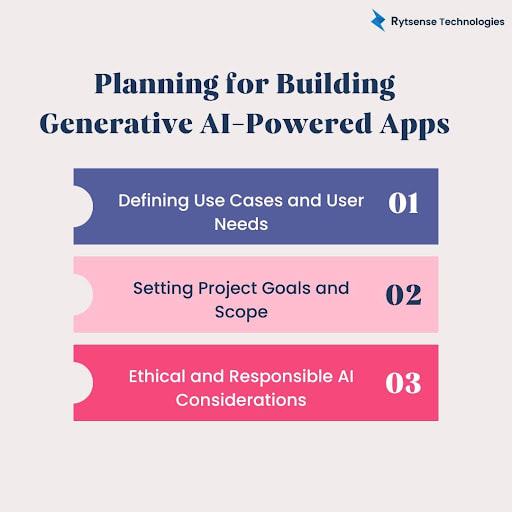
Setting Project Goals and Scope
The best way to keep the craftsmanship relatively uncomplicated is to establish clear goals. Think of measurable goals such as "Generate blog posts that at least 90% of users are pleased with" or "Reduce content creation to only 50% as long as the previous creation."
Define your limits on what your first version will (or will not) include. Usually, it is easier to build a simple app that works than attempt to build a complex one that doesn't work. You can always add more functionality down the road.
Think about the timing and budget as well. Building AI is inherently unpredictable, so account for additional time to debug and fine-tune your models.
Ethical and Responsible AI Considerations
When you create generative AI-powered apps, you have to consider your responsibilities. For instance, your app can produce biased content, generate false or misleading information, and infringe on copyrighted material.
Talk about and plan how you will manage these issues ahead of time:
- Add filtering to avoid generating hurtful or harmful content
- Disclaimers that AI-generated content should be viewed and edited by a human being
- Don’t train the AI on copyrighted content
- Test your app on multiple different users to identify bias
- Have a way for users to make reports
Ready to build your first generative AI app?
Discover how AI can save time, cut costs, and boost customer satisfaction.
Core Components in Building Generative AI-Powered Apps
Every AI-powered application depends on a number of crucial elements operating in unison. The foundation of your development process is an understanding of the available APIs, model selection criteria, and data requirements. The capabilities, functionality, and overall success of your app in providing users with value are determined by these fundamental components.
Data Collection and Preprocessing
High-quality data is necessary for building good AI applications - your model learns from an example, so the quality of your training data is directly proportional to the quality of output from your app.
Start by thinking about what kind of data you need - if your app is for writing, you may want articles, stories, or business documents. If you are building an image app, you will want images with descriptions, etc.
Clean your data properly - Proper data cleaning is crucial in AI development. This involves removing duplicates, correcting formatting errors, and filtering out low-quality examples. Although the process can be time-consuming, it significantly improves the accuracy and performance of the final application.
Think about data privacy legislation - If you have personal information, ensure you have permission and are compliant with GDPR or CCPA regulations.
Model Selection (LLMs, Diffusion Models, GANs)
| Model Type | Best For | Advantages | Challenges |
|---|---|---|---|
| LLMs (GPT, Claude) | Text generation | Versatile, human-like output | Can be expensive, may hallucinate |
| Diffusion Models | Image creation | High-quality images | Computationally intensive |
| GANs | Style transfer | Fast generation | Training can be unstable |
| Multimodal | Text + images | Flexible applications | More complex to implement |
Choosing models is based on each individual need. For every general text application, external APIs for existing LLMs would be the best choice. For specific tasks, you may be required to fine-tune models or train your own.
APIs and Pre-Trained Models
Leveraging pre-trained models saves time and resources. Instead of building models from scratch, you’re able to use models that companies like OpenAI, Google, or Anthropic already trained and offered to you using massive datasets.
Most AI development services will provide APIs that allow you to interface with the service, make requests, receive AI-generated responses, and carry out your application - this works well for prototyping and for most production applications.
Some popular APIs to consider as you build your application:
- OpenAI GPT for text generation
- DALL-E for your image generation
- Google Cloud AI for a mix of AI-related tasks
- Anthropic Claude for natural language processing tasks
Read Also:
Enterprise AI Chatbot Development CostHands-on AI app development: Building Generative AI-Powered Apps Step by Step
From environment setup to deployment, there are methodical steps in the actual development process. Every stage builds on the one before it to produce a useful AI application.
Throughout your development process, adhering to this methodical approach guarantees that you maintain code quality, apply best practices, and don't overlook any important components.
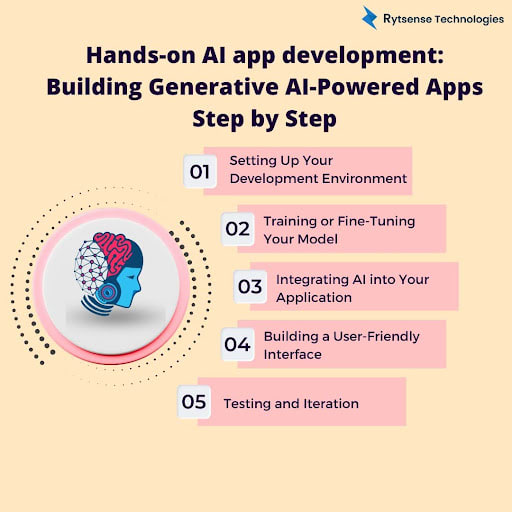
Step 1: Setting Up Your Development Environment
Install the software and tools you need to walk through this section. For a Python development project, all you need is an install of Python 3.8+, an installation of pip for package management, a text editor like VS Code and to have your project structure set-up with directories.
Step 2: Training or Fine-Tuning Your Model
In most cases, you will not train models from scratch. Instead, you will be using either a pretrained model, or fine-tuning a pretrained model.
Fine-tuning is when you take an existing model, and train it just a little more, on your context-specific data. For example, you are teaching a chef who understands the basics of cooking to make a special family recipe.
If you are using APIs, this step might include just tweaking parameters such as temperature (creativity level) and max tokens (length).
Step 3: Integrating AI into Your Application
Once integrated you should thoroughly test this integration with many different inputs to confirm it is usable and reliable.
Step 4: Building a User-Friendly Interface
You may need your interface to be user-friendly and accessible for various users who want to use the AI features of your application. You'll need to specifically provide:
- Include fields that are easy to find and use,
- Useful examples,
- Error messages.
Consider adding features such as:
- Input suggestions or template options to help users (more support)
- Progress indicators to inform users of the status for longer generations,
- Options to regenerate or refine,
- Share or save functionality.
Be sure that your interface working well on desktop and mobile devices!
Step 5: Testing and Iteration
Test your app with real users as often as you can, and as early as you can. AI doesn't always give predictable outputs, and so extensive testing is essential.
Create test cases for:
- Typical use cases
- Edge cases and unusual inputs
- Error conditions
- Load performance
Collect user feedback and iterate. AI apps often need a few dials for refining before they are usable.
Deployment and Scaling of Generative AI-Powered Apps
When transferring your AI application from development to production, hosting options, cost control, and performance optimisation must all be carefully considered. Unlike traditional web apps, scaling AI applications comes with special challenges, such as managing API costs as user demand increases and handling fluctuating computational loads.
Cloud Platforms and Hosting Options
| Platform | Pros | Cons | Best For |
|---|---|---|---|
| AWS | Comprehensive services, reliable | Complex pricing, steep learning curve | Large applications |
| Google Cloud | Great AI tools, competitive pricing | Smaller ecosystem than AWS | AI-heavy applications |
| Azure | Good Microsoft integration | Can be expensive | Enterprise applications |
| Heroku | Simple deployment | Limited AI-specific features | Small to medium apps |
| Vercel | Great for web apps | Less suitable for heavy AI workloads | Frontend-focused apps |
Optimizing Performance and Latency
AI models can be slow, especially depending on what it is you're generating. To help with performance:
- Cache output for common responses
- Use forest models where possible
- Implement request queuing
- Pre-generate content where you can
- Use CDN's to host static content
Make sure to constantly monitor your apps response times and user satisfaction.
Handling Costs and Scalability
The API costs associated with AI can ramp up quickly based on usage. Plan for this by:
- Setting resource use limitations to users
- Using as much as possible caching
- Constantly monitoring costs
- Use cheaper models for less meaningful AI tasks
- Implement cost alerts and measures
Plan your strategy for scaling early, AI workloads are not always like other web apps in what resources the workload requires.
Security and Compliance in Building Generative AI-Powered Apps
Security and compliance are crucial factors because AI applications handle sensitive data and produce content that has the potential to have a big impact on users. Proactive planning and the implementation of strong security measures across your application architecture are necessary to protect user privacy, guarantee output quality, and comply with industry regulations.
Data Privacy and Protection
Data to protect a user’s data by:
- Encrypting data when it is in transit and at rest
- Only collect data that is necessary
- Have proper user authentication
- Have security audits, and updates conducted on a regular basis
- Create privacy policies, and have informed consent from the user
Be especially cautions when dealing with sensitive data like personal information, business documents, or private communications.
Bias, Fairness, and Transparency
AI Models may also contain incidental bias from how they were built out of their training data. Some actions you can take to limit this bias are:
- Testing results of outputs across different user groups
- Have filters and moderation on the content
- Have transparency around the AI, and UI limitations
- For critical areas have oversight when using AI
- Regular bias tests, and attempt to mitigate them
Meeting Industry Regulations
Various industries have various rules. An app in healthcare may require HIPAA compliance, while a FinTech app may require SOC compliance, while an app in Europe may be subject to GDPR compliance.
You need to do your research to find regulations that impact your app, and incorporate compliance from the start as it is very hard to bolt on compliance after an app has been developed.
Real-World Examples of Generative AI-Powered Apps
Analysing effective AI applications in various industries yields insightful information about workable implementation techniques. These illustrations show how abstract ideas can be turned into approachable solutions to practical issues, providing ideas and direction for your own AI application development endeavours.
Content Creation (Text, Images, Music)
There are also apps like Copy.ai that help marketers write advertising copy, or imagine and create stunning images from text descriptions in their app like Midjourney. There are apps that generate music like AIVA that generate background music for videos and presentations.
App features you're likely to see:
- Ease of use, templates, and a simple interface
- Quickly generate several outputs
- Edits and refinements
- Various export options in multiple formats
Chatbots and Virtual Assistants
Modern chatbots go beyond simple question-and-answer. They can have natural conversations, understand context, and help with complex tasks.
Successful chatbot features include:
- Natural language understanding
- Context awareness across conversations
- Integration with business systems
- Escalation to human agents when needed
AI-Powered Productivity Tools
Tools like GitHub Copilot help developers write code faster, while Grammarly uses AI to improve writing. Notion AI helps with note-taking and document creation.
These apps succeed by:
- Integrating seamlessly into existing workflows
- Providing subtle, helpful suggestions
- Learning from user behavior
- Maintaining high accuracy and relevance
Best Practices for Developers When Building Generative AI-Powered Apps
Beyond technical implementation, successful AI application development involves staying up-to-date with quickly changing technologies, fostering user trust, and conducting continuous monitoring. These procedures guarantee that your application will continue to be dependable, safe, and competitive while preserving high user satisfaction and keeping up with technological advancements.
Continuous Model Monitoring
AI models can degrade over time or behave unexpectedly with new types of inputs. Implement monitoring to track:
- Output quality metrics
- User satisfaction scores
- Error rates and types
- Performance metrics
- Cost per request
Set up alerts for significant changes in these metrics.
Maintaining User Trust
Build trust by:
- Being transparent about AI capabilities and limitations
- Providing consistent, reliable outputs
- Implementing robust error handling
- Offering human support when needed
- Protecting user data and privacy
Trust takes time to build but can be lost quickly, especially with AI applications.
Staying Updated with AI Trends
The AI field moves fast. Stay current by:
- Following AI research publications
- Participating in developer communities
- Attending AI conferences and webinars
- Experimenting with new models and techniques
- Building relationships with AI service providers
This is where the counsel of an established AI development company can help. There are companies available, such as Rytsense Technologies that specializes in generative AI. Their team of developers remain up to date with the developments in the generative AI space, while you can focus on your main line of business.
How Rytsense Technologies Can Assist
Rytsense Technologies sets itself apart as one of the best AI development company in USA, providing a full-service experience of AI development services and AI consulting services.
The knowledge in generative AI consulting services and generative AI development services can help expedite your project timetable and make sure you keep best practices in mind while commencing work.
Their services include:
- Custom AI model creation and tuning
- AI application development at full-stack
- Cloud deployment and scaling
- Maintenance and monitoring
- Implementing compliance and security
Conclusion
Creating generative AI-powered applications signifies the potential of a new chapter in applications development and software development as a whole. The technology gets very complicated but with the tools and frameworks out there today, building applications with generative AI capabilities is possible for any developer willing to learn new concepts and learn a new way of developing apps with AI models.
Now, it is important to understand that success in engineering applications with generative AI capabilities requires leveraging traditional software development skills with an understanding of what AI can and can't do, especially when it comes to generative AI. Start small, start with solving real user problems, and more importantly, use user feedback to iterate.
The future for creating applications is no question becoming increasingly blurred with generative AI capabilities. Developers who get comfortable building generative AI-powered apps today will be the developers that succeed and seize the opportunities of tomorrow.
Meet the Author

Karthikeyan
Connect on LinkedInCo-Founder, Rytsense Technologies
Karthik is the Co-Founder of Rytsense Technologies, where he leads cutting-edge projects at the intersection of Data Science and Generative AI. With nearly a decade of hands-on experience in data-driven innovation, he has helped businesses unlock value from complex data through advanced analytics, machine learning, and AI-powered solutions. Currently, his focus is on building next-generation Generative AI applications that are reshaping the way enterprises operate and scale. When not architecting AI systems, Karthik explores the evolving future of technology, where creativity meets intelligence.