Key Takeaways
- Automated intelligence is changing how businesses design, execute, and scale daily workflows.
- Custom-built AI systems adapt better to specific processes than off-the-shelf platforms.
- Custom AI enhances the efficiency, accuracy, and scalability of departments in the long-term.
- Generic AI tools are fast to implement, but may not perform well when complexity is high.
- To remain tough, businesses should strike a balance between automation and human decision-making.
- The crucial areas of sustainable adoption of AI are ethical design and transparency.
How Is Automated Intelligence Reshaping Business Workflows?
Automated intelligence refers to systems that use artificial intelligence to perform, optimize, and improve business tasks with minimal human intervention. These systems process information, get used to trends, and execute choices to simplify the workflow in operations, finance, customer service, and other areas.
By reducing manual effort and improving consistency, automated intelligence enables organizations to focus on strategy rather than repetitive execution.
What Does Automated Intelligence Mean in Business Terms?
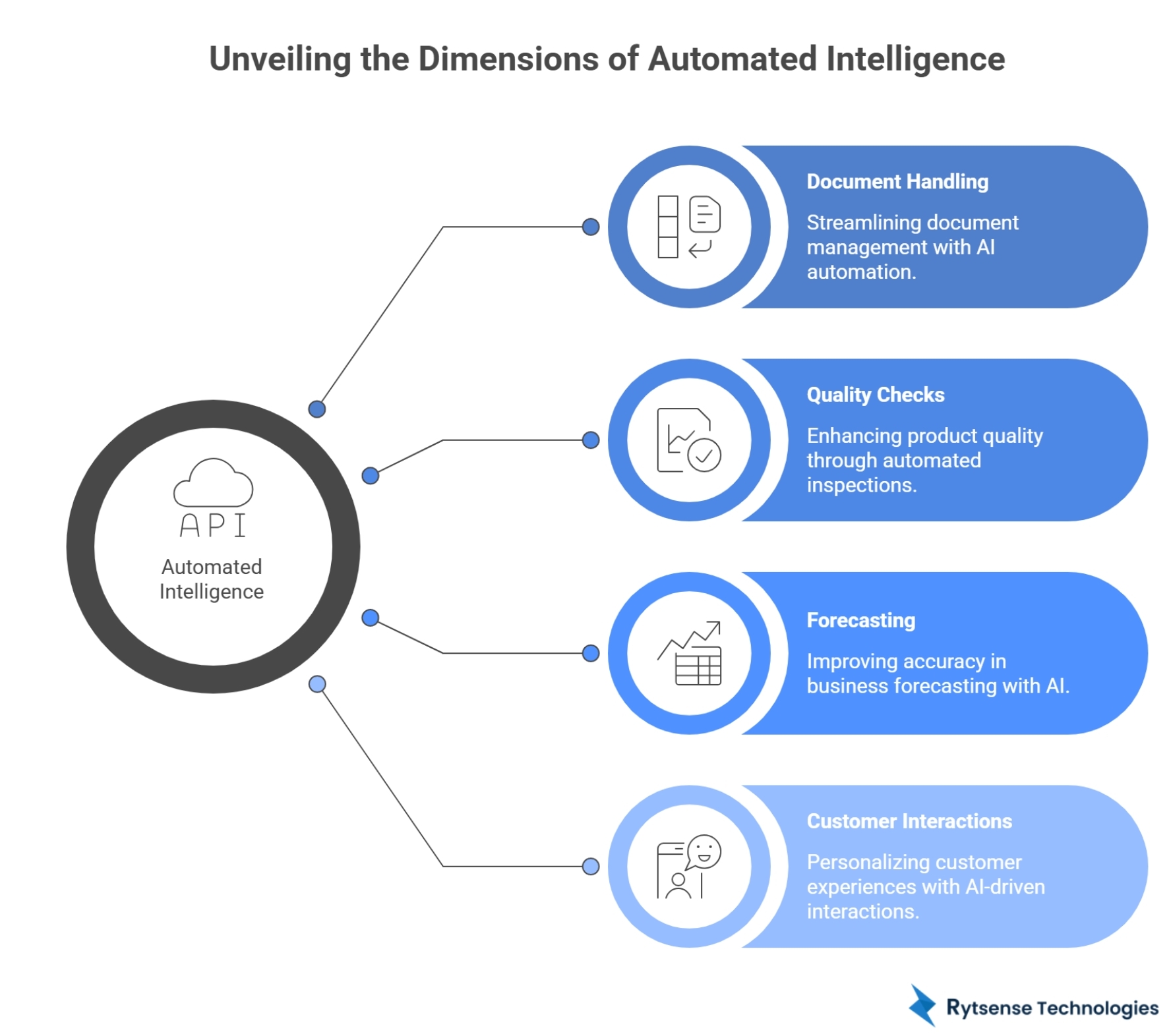
In practice, automated intelligence means embedding AI into everyday processes such as document handling, quality checks, forecasting, and customer interactions. Workflows become dynamic and responsive to the real world, rather than fixed rules.
The current companies are dependent on this transition to manage the increasing amount of data and the quicker cycles of decisions. Early adopters take the step of first seeking enterprise ai development solutions to modernize internal systems without losing control over how automation will fit their objectives.
The Current State of Automated Intelligence Adoption
Most companies begin with off-the-shelf AI solutions as they are said to be deployed faster and they cost less upfront. These tools can add value at an early phase particularly in standardized activities.
Nevertheless, there are still some myths:
- Generic AI will fit in any workflow completely.
- Custom AI always requires excessive time and cost.
- All AI platforms scale equally well.
As workflows grow more complex, limitations become apparent. Businesses are becoming more aware that automation is not a one-two-three option but a fundamental aspect that needs to grow alongside operations.
Automated Intelligence Explained for Everyone
At its foundation, automated intelligence combines data, algorithms, and process logic to make workflows smarter. Imagine it as the transition of checklists to context-aware systems.
In the non-technical teams, it implies reduced handoffs and delays. In the case of technical teams, it involves the development of systems that address operational requirements as opposed to making processes fit given software templates.
Core Components of Automated Intelligence Systems
Automated intelligence is not a single technology. It is a blend of various elements functioning concurrently.
1. Data Integration
AI systems are based on clean, connected data of various sources. The custom solutions are integrated with existing tools and databases.
2. Decision Models
The models are used to determine the system response to inputs. Compared to generic models that make assumptions about average use cases, custom models resemble the actual business rules.
3. Automation Layer
The roles performed by this layer include approvals, warning, or routing of tasks. Specialized automation makes the workflows compliant with the internal policies.
4. Monitoring and Feedback
Systems that are constantly monitored can be improved with time. Custom configurations provide better insights into performance and results.
Business Benefits of Custom Automation
When automated intelligence is designed around real workflows, businesses experience measurable advantages.
- Increased productivity because of the decreased manual intervention.
- Better validity and reliability of outputs.
- Increased scalability with increased data and workload.
- Reduce long-term expenses by productive resource consumption.
| Aspect | Custom AI Solutions | Off-the-Shelf Platforms |
|---|---|---|
| Workflow fit | Designed for specific processes | Limited configuration |
| Scalability | Grows with business needs | Fixed capabilities |
| Performance | Optimized for use case | Generalized results |
| Control | Full ownership and transparency | Vendor-dependent |
Why Automated Intelligence Is Becoming Essential
Competitive businesses no longer have the option of automation. Paperwork processes are unable to meet the market expectations, compliance standards, and customer demands.
Slow operations, increased cost, and visibility are some of the risks that organizations which do not adopt on time face. Custom systems, including those built around computer vision development services and solutions, address specific challenges that generic tools often overlook.
Finding a Balance Between Automation and Human Expertise
Automated intelligence excels at processing data and executing repeatable tasks. Humans excel at judgment, creativity, and ethical reasoning.
The most effective workflows combine both. Automation is concerned with scale and speed, people strategy, exceptions, and continuous improvement. Such balance develops trust and makes systems complementary to human roles and not to substitute them.
Responsibility, Ethics, and Transparency
Custom-made AI systems enable companies to establish the ethical limits initially.
This includes:
- Clear rules for data usage
- Transparent decision logic
- Ongoing bias evaluation
- Compliance with industry regulations
Because the organization controls the system, accountability is clearer than with third-party platforms that operate as black boxes.
Real-Life Applications in Industries
Automated intelligence is already delivering results across sectors.
| Industry | Application | Outcome |
|---|---|---|
| Manufacturing | Visual quality inspection | Reduced defects |
| Retail | Demand forecasting | Better inventory planning |
| Finance | Risk analysis | Improved fraud detection |
| Logistics | Route optimization | Lower delivery costs |
These are just some examples of how custom automation can be converted into the real world.
How Different Businesses Should Apply Automated Intelligence

1. Startups
Target one or two workflows with high impact. Construct scalable systems in the future.
2. Small and Medium Businesses
Add automation to existing tools. Prioritize efficiency gains without overengineering.
3. Enterprises
Develop long-term automation strategies. Make investments in governance, data infrastructure and cross-team alignment.
Challenges and Limitations to Consider
Despite its benefits, automated intelligence presents challenges:
- Initial development costs for custom systems
- Skilled data and AI workforce requirements.
- Complexity with legacy systems.
- Continuous maintenance and monitoring.
Early recognition of these challenges assists organizations in making realistic plans.
The Future of Automated Intelligence in Workflows
Automated intelligence will continue to evolve toward more adaptive and collaborative systems. The workflows of the future will be well informed with the ability to learn what has occurred and understand the human decision-making process.
Companies that invest intelligently today will be in a better position to face ongoing changes.
Conclusion
Automated intelligence is reshaping business workflows by making them more adaptive, efficient, and scalable. Although off-the-shelf platforms are a good starting point, custom-built systems can offer the flexibility and performance to be successful over the long term. Automation is a strategic benefit, not a technical shortcut, when properly designed and applied collaboratively with humans.
This perspective aligns closely with how Rytsense Technologies approaches intelligent system design, focusing on sustainable value rather than quick fixes.
Meet the Author

Co-Founder, Rytsense Technologies
Karthik is the Co-Founder of Rytsense Technologies, where he leads cutting-edge projects at the intersection of Data Science and Generative AI. With nearly a decade of hands-on experience in data-driven innovation, he has helped businesses unlock value from complex data through advanced analytics, machine learning, and AI-powered solutions. Currently, his focus is on building next-generation Generative AI applications that are reshaping the way enterprises operate and scale. When not architecting AI systems, Karthik explores the evolving future of technology, where creativity meets intelligence.