From Chaos to Security: How AI Invoice Processing Agent could have saved Rs 2.16 Crore for Dr. Reddy's
Introduction
Between November 3 - 5, 2025, a sophisticated cyber fraud targeted two major Indian pharmaceutical companies, Dr. Reddy's Laboratories and Group Pharmaceuticals resulting in the loss of Rs 2.16 crore.
The incident offers a critical lesson for the enterprises worldwide that manual validation processes and human judgment alone are no longer sufficient against modern payment diversion scams.
This detailed guide explores how the fraud was pulled off, why it succeeded, and how AI invoice processing agents powered by artificial intelligence can serve as an impenetrable defense against such attacks. For enterprises handling high-value transactions, understanding this case is not optional, it's essential - especially for those adopting AI development services and enterprise AI automation.
The Dr. Reddy's Cyber Fraud , a chronological breakdown
What happened?
November 3, 2025: Cybercriminals gained unauthorized access to email communications between Group Pharmaceuticals (Bengaluru) and Dr. Reddy's Laboratories (Hyderabad). The hackers intercepted ongoing correspondence and created a spoofed email address that closely mimicked Group Pharmaceuticals' legitimate domain - a growing threat in cybersecurity in finance.
What is email spoofing?
Email spoofing is a cyber attack technique where fraudsters forge or manipulate email headers to make it appear as though an email is coming from a legitimate, trusted source—when it actually originates from an attacker. The attacker impersonates a known person, organization, or domain to deceive the recipient into trusting the message.
November 4, 2025: The fraudsters sent emails to Dr. Reddy's finance team, posing as Group Pharmaceuticals officials. They provided new bank account details (a Bank of Baroda account) and instructed the payment of Rs 2.16 crore to be transferred immediately. Dr. Reddy's finance team, believing the communication to be genuine, processed the transfer within 24 hours.
November 5, 2025: When Group Pharmaceuticals realized they hadn't received the expected payment, they contacted Dr. Reddy's. The discrepancy triggered an investigation, and both companies filed a complaint with Bengaluru Cyber Crime Police. Police immediately froze the fraudulent account, which was traced to Vadodara, Gujarat.
The Attack Vector
The Attack Vector
The hackers employed a multi-layered social engineering and technical attack:
1. Email Interception: They gained access to the email chain between the two companies, giving them context and timing.
2. Domain Spoofing: They created an email address visually similar to the legitimate one exploiting human tendency to miss subtle differences.
3. Payment Diversion: They provided new bank details, betting that the finance team wouldn't verify them against historical records.
4. Urgency Exploitation: The tone implied routine payment processing, creating psychological pressure to act quickly without questioning.
Seven critical gaps that enabled the fraud
The Dr. Reddy's finance team faced several vulnerabilities:
1. Over-Reliance on Manual Verification: Email addresses can be spoofed convincingly. Visual inspection is unreliable, especially under operational pressure.
2. Lack of Multi-Factor Validation: No requirement for secondary confirmation (e.g., phone verification) when payment details change.
3. Absence of Automated Anomaly Detection: No system flagged the unusual bank account change against historical vendor master data.
4. Inadequate Email Authentication: Simple email-level authentication protocols couldn't catch the sophisticated spoofing.
5. Legacy Approval Workflows: Traditional three-way matching (PO, invoice, receipt) didn't apply because this was an existing vendor with an established payment channel.
The Broader cyber fraud crisis
· 43% of cyberattacks target businesses, with payment fraud accounting for a substantial portion of losses.
· Payment diversion fraud costs organizations over $13 billion annually in the US alone, with similar proportions globally.
· Average detection time for payment fraud is 280+ days, during which attackers extract maximum value.
· Email-based fraud attempts have increased by 300% in the last three years, particularly targeting B2B transactions.
· Pharmaceutical companies face 2x higher cyber risk - making fraud detection using AI crucial.
The Resource Crunch in Current Processes
Traditional invoice processing and payment validation rely on:
· Manual data entry and verification: A single finance person can process 20-50 invoices per day, creating a bottleneck.
· Email-based communication: Still the primary method for payment instructions, making companies vulnerable to spoofing.
· Spreadsheet-based tracking: Error-prone and difficult to audit.
· Phone-based confirmations: Time-consuming and not scalable for high-volume operations.
· Delayed reconciliation: Most companies discover fraud weeks or months after the fact.
For Dr. Reddy's, the cost wasn't just Rs 2.16 crore - it also included investigation time, regulatory compliance work, reputational impact, legal fees, and operational disruption. Beyond the financial loss, the incident highlighted missed opportunities to implement AI integration in finance that could have prevented such payment diversion fraud in the first place.
How AI Agents Automate Invoice Processing
What Are AI Invoice Processing Agents?
An AI Invoice Processing Agent is a software solution that leverages advanced artificial intelligence including Vision-language models (VLMs) and large language models (LLMs)/ Multi modal LLMs to automate the entire lifecycle of invoice management. From reading invoice documents and extracting data to approving payments and updating ERP records, these agents work autonomously, slashing manual effort , drastically reducing error & preventing fraud.
Unlike rigid rule-based systems, AI agents reason through exceptions, learn from historical patterns, and adapt to new threats, exactly what the Dr. Reddy's case required.
The Modern AI Invoice Processing Agent: Architecture Overview
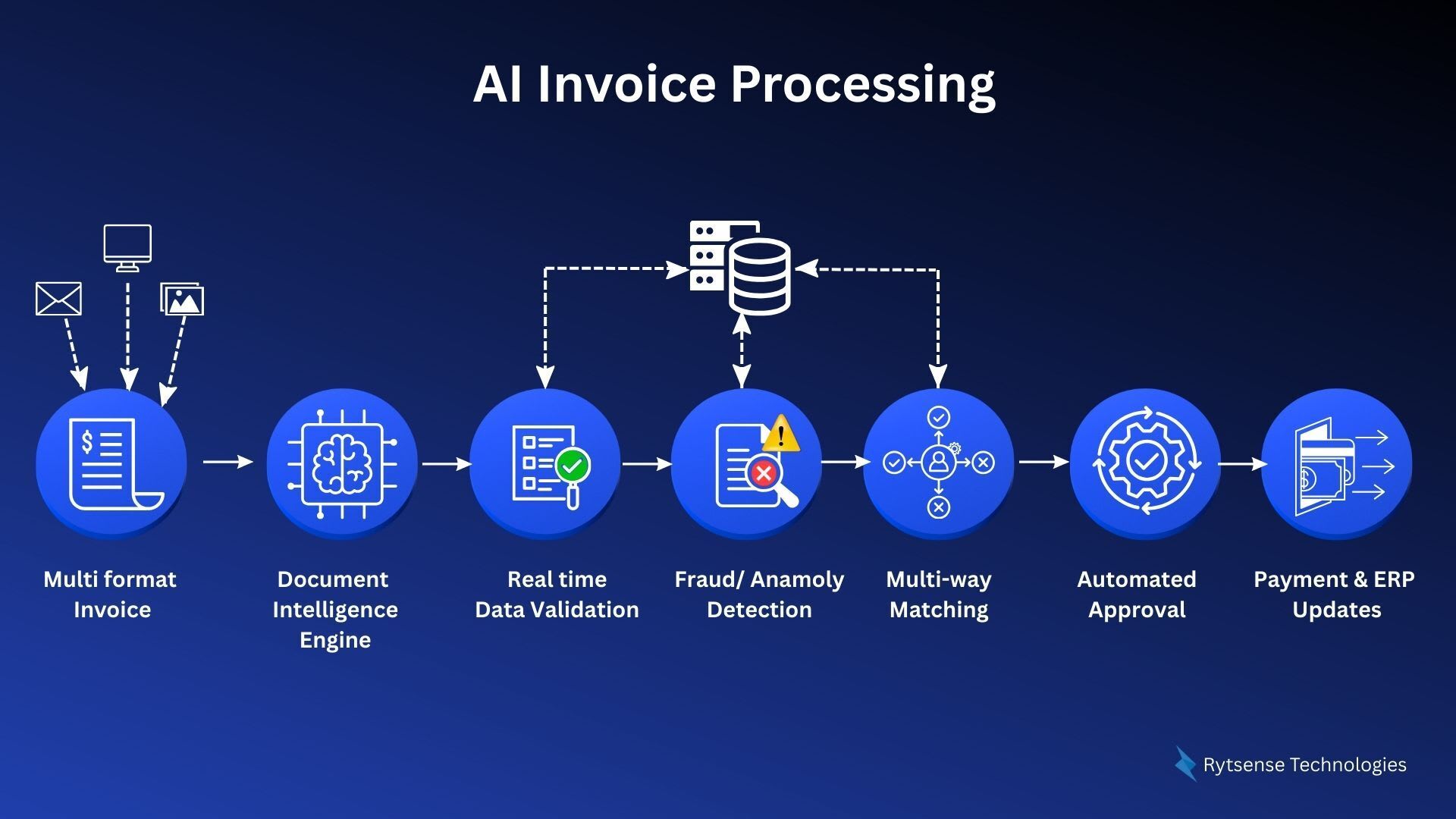
Layer 1: Invoice Ingestion
· What It Does: Invoices arrive via email, portals, scans, or as image files. The AI agent instantly detects and ingests documents in any format.
· Impact: 90% reduction in manual data entry errors; 24-hour automated processing.
Layer 2: Document Intelligence with LLMs
· What It Does: Traditional document processing systems depended on OCR engines and isolated NLP components, which often struggled with complex layouts or low-quality scans. Modern AI agents now use Unified LLM-driven Document Intelligence, delivering far more accurate and flexible results.
· Vision-language models read documents both visually and semantically, understanding structure and meaning together.
· They extract key fields such as invoice numbers, dates, vendor information, line items, and totals with strong contextual awareness.
· The agent transforms raw document data into a clean, structured digital record (usually JSON), ready for downstream processing.
· Impact: 80% reduction in processing time across operational workflows. It recognizes variations and adapts quickly to new invoice formats with impressive accuracy.
Layer 3: Real-Time Vendor Master Data Validation
· What It Does: Cross-references extracted info against the vendor master database
· This includes:
- Checking vendor and bank account authenticity
- Detecting duplicates and anomalies
- Ensuring the invoice matches purchase orders (PO) and goods receipts (multi-way matching)
· Impact: 85-95% accuracy in vendor matching; immediate anomaly alerts.
Layer 4: Fraud / Anomaly Detection & Risk Scoring
· AI agent monitors for suspicious changes such as new email, unexpected bank account alterations and deviations from past transaction patterns. If anything is unusual, the agent raises alerts, blocks payments, and prompts human intervention.
· Assigns a risk score based on vendor history, transaction size, frequency, account changes, etc. Triggers automated holds when risk exceeds thresholds.
Impact:
- Phishing and spoofing detection accuracy: 98%+
- 80% faster fraud detection & real-time alerts.
Layer 5: Multi-Way Matching & Reconciliation
· What It Does: Automatically matches invoices against POs and goods receipts. Identifies duplicates and flags discrepancies.
· Impact: 99% accuracy in duplicate detection; 75% fewer reconciliation errors.
Layer 6: Automated Approval Workflows with Escalation
· What It Does: Routes invoices based on risk profile. Sends alerts to approvers with context. Maintains audit trails.
· Impact: Payment processing time reduced to hours; 100% compliance audit trail.
Layer 7: Continuous Learning & Threat Adaptation
· What It Does: Uses feedback to improve detection. Updates risk models based on emerging fraud patterns.
· Impact: System accuracy improves 2-3% monthly.
How an AI Invoice Processing Agent Would Have Prevented This Scam
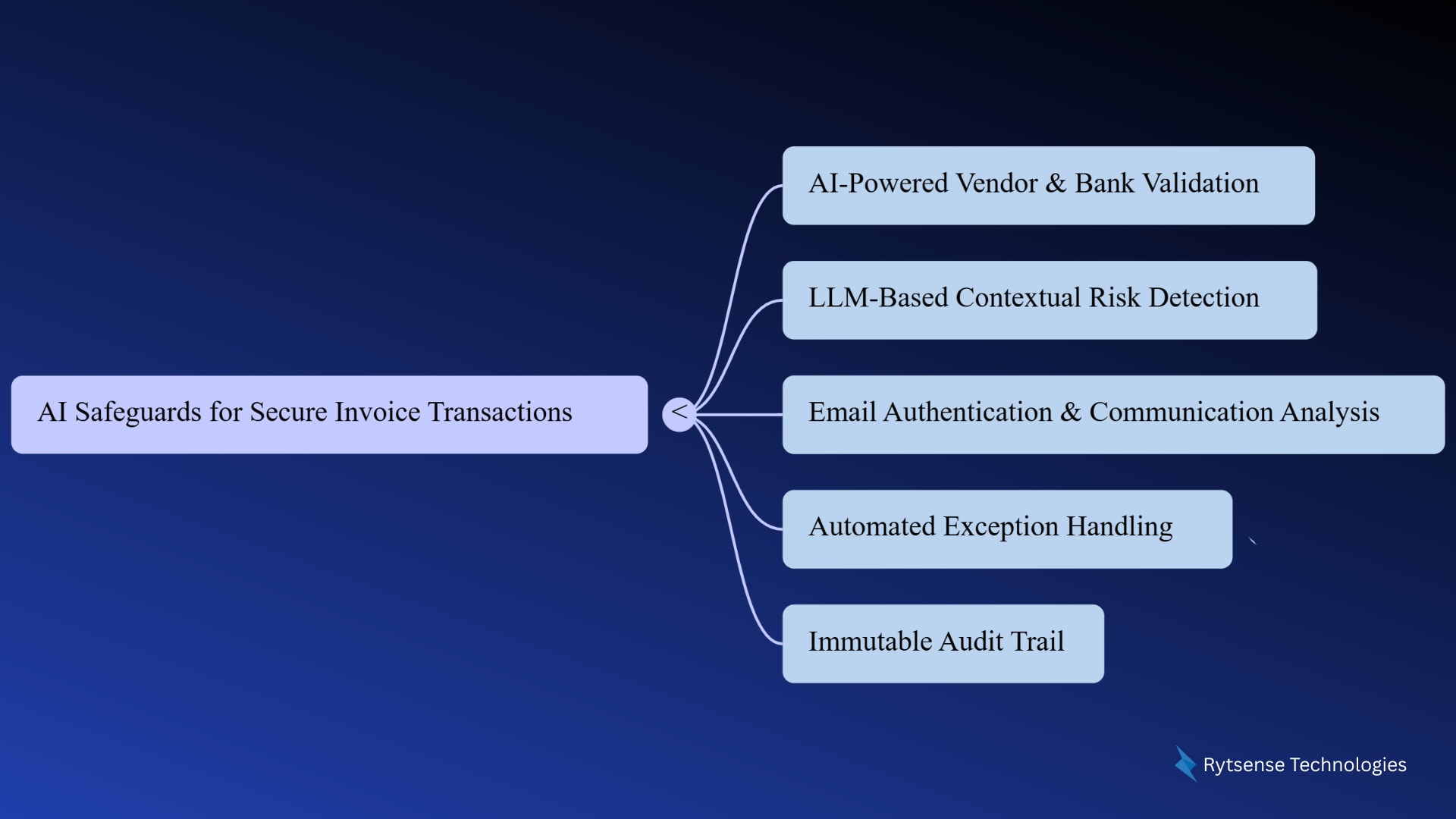
1. AI-Powered Vendor & Bank Validation
AI would have identified that the requested bank account was new and untrusted compared to the master vendor database. Any request to change bank details would be blocked pending multi-factor human and portal-based verification.
2. LLM-Based Contextual Risk Detection
The LLM reads not just field values, but reasons: “This payment request comes from a vendor communication pattern that deviates from historical records.” It would instantly flag such pattern breaks for review.
3. Email Authentication & Communication Analysis
The agent verifies sender domains, authenticates messages via DMARC/SPF/DKIM, and alerts on any email spoofing or unusual sender behaviors.
4. Automated Exception Handling
Requests that fail validation are automatically routed for escalation - requiring human checks and explicit confirmations before payments proceed.
5. Immutable Audit Trail
Every action, anomaly, and override is digitally logged, ensuring transparency for future audits and compliance.
Conclusion: From Risk to Resilience
The Dr. Reddy's cyber fraud incident in which Rs 2.16 crore lost in less than 24 hours is not an isolated case. It's a wake-up call for enterprises worldwide that manual, human-centric invoice processing and payment validation are no longer adequate in today's threat landscape.
AI-driven invoice processing agents represent a paradigm shift in finance automation, fraud prevention, and enterprise AI transformation. They automate the tedious, error-prone tasks of data entry and manual verification while simultaneously providing 24/7 vigilance against sophisticated fraud attacks.
Upgrade to AI-Driven Finance Operations
Accelerate approvals, reduce manual errors, and ensure compliance effortlessly.
Meet the Author

Karthikeyan
Connect on LinkedInCo-Founder, Rytsense Technologies
Karthik is the Co-Founder of Rytsense Technologies, where he leads cutting-edge projects at the intersection of Data Science and Generative AI. With nearly a decade of hands-on experience in data-driven innovation, he has helped businesses unlock value from complex data through advanced analytics, machine learning, and AI-powered solutions. Currently, his focus is on building next-generation Generative AI applications that are reshaping the way enterprises operate and scale. When not architecting AI systems, Karthik explores the evolving future of technology, where creativity meets intelligence.